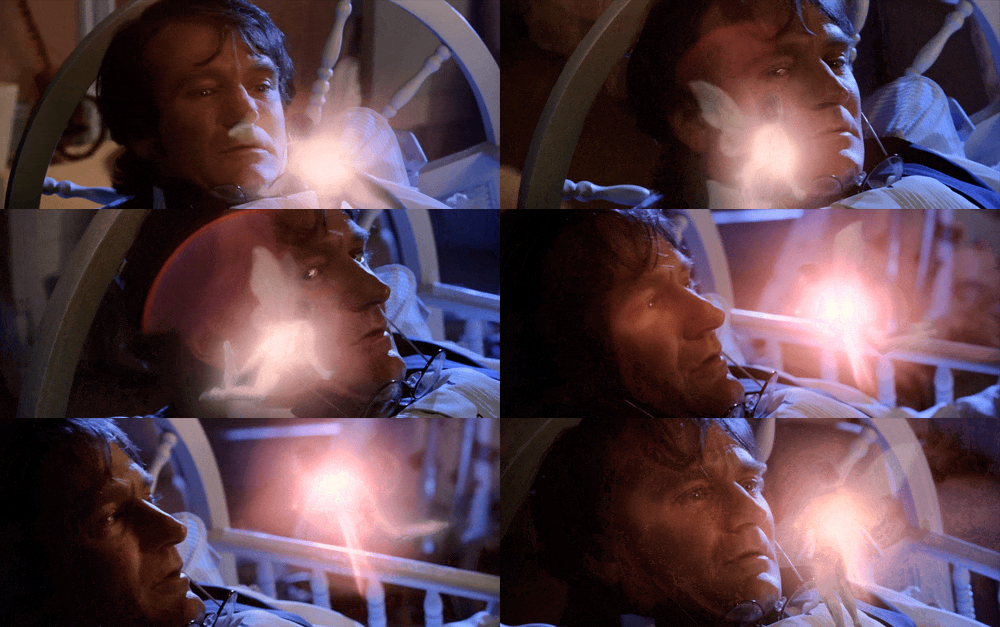
Holy cow - my sister is on the television!I wrote about her before, when her book debuted a few weeks ago. Well, were she is, promoting her book "Raising Twins: From Pregnancy to Preschool" on WGN News with Allison Payne.
Way to go, Shelly!
A blogtacular blog filled with words, images, and whipped cream on top. Written by Todd Vaziri.

Holy cow - my sister is on the television!
Do you know someone with young twins? Or is expecting twins? Is that someone you? If the answer to any of these questions is yes, then you have to buy this book.
My sister, my amazing little sister, wrote a book called "Raising Twins: From Pregnancy to Preschool." She's a mother of four and a brilliant pediatrician, and offers a unique insight into raising twins.
Looking back at the last few posts, it seems like I nearly leapfrogged over an entire production on which I worked. It's almost as if "Transformers 2" didn't even happen, as if it is being erased from our collective consciousness. Huh. Imagine that.
From "The Colbert Report," June 2, 2009. During the opening segment, the camera does an inadvertent cut, briefly taking Stephen by surprise. Ostensibly remaining in character, Stephen gives an honest and hilarious reaction. I just love Stephen's complete mastery and control over his face, and how he can change his entire screen presence with relative ease. I also admire Stephen's ability to move the show forward with nary a pause, as well as the producers' choice to keep the minor glitch in the show (rather than edit around it, or reshoot the segment).| The Colbert Report | Mon - Thurs 11:30pm / 10:30c | |||
| Saudi Arabia Press Restrictions | ||||
| colbertnation.com | ||||
| ||||

Post Magazine's cover story is all about ILM's visual effects for J.J. Abrams' "Star Trek." The article, written by Ken McGorry, touches on some of the major challenges behind our visual effects.
The banner image for Gizmodo's review of "Star Trek."
The flares weren't just happening from on-camera light sources, they were happening off camera, and that was really the key to it. I want [to create] the sense that, just off camera, something spectacular is happening. There was always a sense of something, and also there is a really cool organic layer thats a quality of it... There are something about those flares, especially in a movie that can potentially be very sterile and CG and overly controlled. There is something incredibly unpredictable and gorgeous about them. It is a really fun thing. Our DP would be off camera with this incredibly powerful flashlight aiming it at the lens. It became an art because different lenses required angles, and different proximity to the lens. Sometimes, when we were outside we'd use mirrors. Certain sizes were too big... literally, it was ridiculous. It was like another actor in the scene.
We had two cameras, so sometimes we had two different spotlight operators. When there was atmosphere in the room, you had to be really careful because you could see the beams. So it was this ridiculous, added level of pain in the ass, but I love... [looking at] the final cut, [the flares] to me, were a fun additional touch that I think, while overdone, in some places, it feels like the future is that bright.
Okay, so "True Blood" is not actually a feature film (it's the Alan Ball series on HBO), but the studio used this one-sheet as a prominent part of their publicity campaign. The series debuted in 2008, and the Megan Fox starrer "Jennifer's Body" comes to theaters later in 2009.
Millimeter Magazine recently posted a really nice article about the making of "Star Trek," with an emphasis on the cinematography, visual effects design, and the digital intermediate color timing process. As part of a discussion about the photographic style of the film, director J.J. Abrams, cinematographer Dan Mindel and visual effects supervisor Roger Guyett talked about the use of lens flares in the film. As a sequence supervisor at Industrial Light & Magic, one of my duties on "Star Trek" was to create synthetic lens flare aberrations for our visual effects shots that matched stylistically and technically with the first unit photography.
[The] technique was the strategic plan to build camera lens flares into the photography. For a sci-fi space film—or any film these days—that aesthetic is extremely rare, since filmmakers usually battle to remove flares from their photography, rather than insert them. Abrams’ and Mindel’s obsession with lens flares, however, was part of a strategic vision for the photography. The technique is so prevalent that Abrams jokes he may have designed “a future in which you’ll have to wear shades.” “I can’t explain it with intellectual reasoning—I can just say it was important to me,” Abrams says. “Even though some people may think we went over the top with flares, I just loved that they made it feel like there was always something spectacular going on off-camera, as well as what was happening on-camera. It reminded me of the feeling I would get watching NASA footage. It might be a distraction to some people, and I apologize to them, but I loved that feeling that this was a more natural future, rather than a [stereotypical sci-fi] shiny future.”
Mindel says the approach required an attitude adjustment on the part of the camera crew. “We have been spending the last 20 to 30 years trying to take flares out,” he says. “Here, we loved the way the anamorphic lenses flare naturally, and we were told to let them happen and we even put them in when they weren’t there. Other space movies have that non-believable aspect of being photographically sterile, and they rarely allow the idiosyncratic nature of light and movement into the arena, which gives you a kind of homogenized movie. We were eager to make sure that did not happen here. We felt a degree of believability comes with the idiosyncrasies that we allowed onto the film—those aberrations on the lenses, flaring, and even a little misframing or accidents. Often, it’s accidents that go on to make up the great pieces of movie art. We felt that by allowing flares in, we would get an organic infringement into the sterile frame—adding a bit of imperfection, a degree of reality.
“We developed an interesting, low-tech technique for it. We had two guys with flashlights flaring the lens constantly. There is a real expertise to it. The hardest thing about the technique was how to keep the lamp operators out of frame since they had to play very close to the lens. The trickery comes from knowing how to flare the lens and hide behind the flare."
But the flaring technique hardly stopped once the production left the set. Mindel’s camera work served as the inspiration for the creation of artificial lens flares for many bits of hundreds of visual-effects shots. These flares were created using a proprietary system developed at ILM to match the specific aberrations of Mindel’s anamorphic lenses. ILM Sequence Supervisor Todd Vaziri was responsible for developing the artificial lens-flare software system, which the company dubbed SunSpot. The system essentially combines off-the-shelf software, certain proprietary ILM tools, photographed elements, and several custom paint elements to painstakingly match the flares captured on the negative.
“The technique gives compositors instant, highly realistic anamorphic lens flares for our all-CG shots that are indistinguishable from real, practical flares shots by the first unit,” Guyett says. “We used it to create flares for a variety of purposes such as spotlights on the exterior of the Enterprise, lights on synthetic set extensions, the Vulcan sun, and a dwarf star featured in the film’s prologue.”


The article is available online here (free registration may be required), and in its April 2009 print edition.
It looks like the full credits for "Star Trek" are available online at trekmovie.com. Scroll down to the Industrial Light & Magic section to see the names of the 300 people who worked to create the film's visual effects.
I recently came across a nine-year-old article to which I contributed. Frank Garcia was looking for visual effects professionals' opinions on the idea of creating new visual effects for the original "Star Trek" episodes. The article, from January 2000, was written in the shadow of the Special Editions of the "Star Wars" trilogy and "Close Encounters of the Third Kind," each of which featured newly created visual effects.

'I'm very much an advocate of preserving the past and looking forward to try and create new classics. Which is the current, most accurate film? Are we going to get special editions with every film every 10 or 20 years? When a film comes out I'm assuming already 'Okay, this is the first pass, the rough draft.' '

| The Colbert Report | Mon - Thurs 11:30pm / 10:30c | |||
| Shepard Smith Swears | ||||
| colbertnation.com | ||||
| ||||