Showing posts with label Star Wars. Show all posts

Thursday, October 10, 2019

Twin Suns Setting and Beyond: The Perfect Star Wars Shots


Hal Hickel and I had a lot of fun talking with Ashley Barry-Biancuzzo about our favorite shots from the "Star Wars" movie series for StarWars.com

Twin Suns Setting and Beyond: The Perfect Star Wars Shots
https://www.starwars.com/news/perfect-star-wars-shots

From Luke Skywalker gazing wistfully at the twin suns to the X-wings swooping through the trenches of the Death Star, Star Wars is chock-full of iconic shots. But what’s going on in these images from a filmmaking perspective? To satiate our curiosity, StarWars.com sat down with Industrial Light & Magic’s Hal Hickel and Todd Vaziri to find out. They shared with us the emotional impact of their favorite scenes, the technical trickery of a Texas Switch, the challenges of hand-drawn animation, and much more.

Here's an excerpt:

StarWars.com: In your opinion, what’s the most beautifully designed shot in Star Wars?

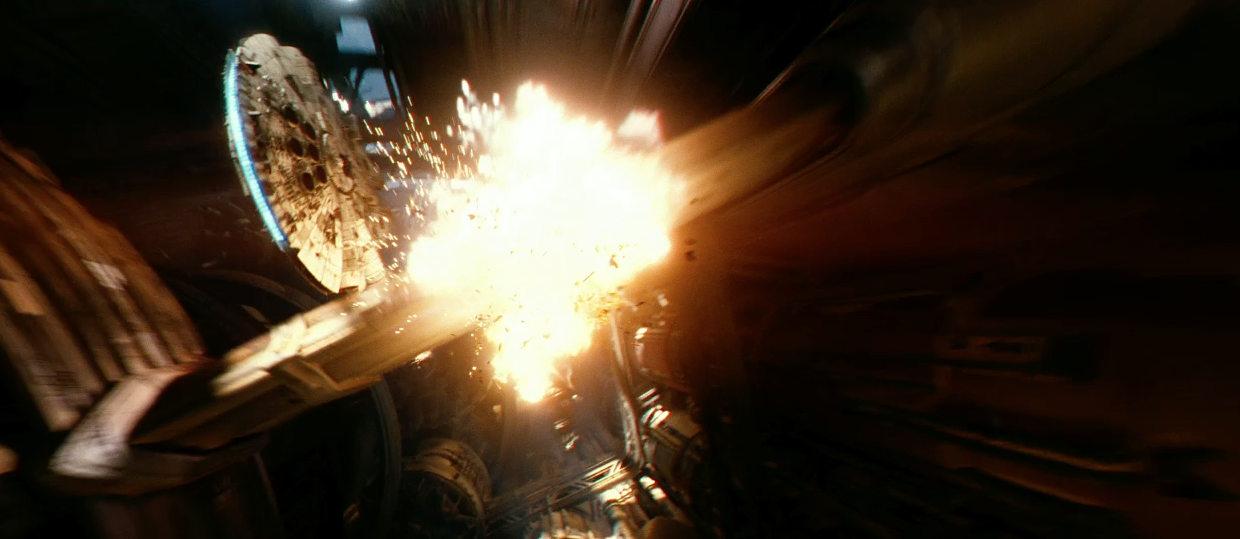
Todd Vaziri: The shot where the Millennium Falcon flies toward the camera with the core of the Death Star exploding behind it in Return of the Jedi resonates with me on a technical and aesthetic level. There’s a real progression to it, too. First you’re inside these claustrophobic tunnels and then you’re zooming around inside the main reactor, which is huge and cavernous. The last part of the sequence has you going through those tight tunnels again, but doing the exact inverse. It has this rubber-band effect where the tension releases and then builds up again.


I tweeted about this moment earlier this year. Click on the tweet below to see the whole thread:


Tuesday, September 11, 2018

"Darth Vader Being a Jerk", HD Restoration


I made a Special Edition High Definition restoration of Doomblake's video, "Darth Vader being a Jerk."

direct link to YouTube

I used an HD source of "The Empire Strikes Back" and did a frame-by-frame restoration of Doomblake's edit. Later, I realized I messed up one of the edits (a second cut to Piett), but I liked my cutaway to Veers more, so I kept it. Making arbitrary changes to source material is a Star Wars Special Edition trademark, so why not continue that tradition. I also added titles, and an actual introduction and conclusion. The audio of the new sequences is mine, but the audio from Doomblake's amazing editing is pure Doomblake.

Update: Doomblake deleted her/his YouTube account, but the good news is that I kept an archive copy of the clip.


Saturday, June 02, 2018

The Cave in Real Time


Every single shot of the original "Star Wars" trilogy is shown in real time without any temporal maniuplation, with only two exceptions. The first is a single shot of Darth Vader striking down Obi-Wan Kenobi in the original “Star Wars”.


The shot is step printed, meaning the action was filmed in the standard frame rate of 24 frames per second, but in this case each frame of the shot was printed twice (hence, double-printed). The ultimate effect is slow motion, stretching a real life moment into twice its original, real-world length.

The only other use of time-distortion in the trilogy occurs in the cave sequence in “The Empire Strikes Back”, which features a dream-like encounter between Luke Skywalker and Darth Vader deep underneath the Dagobah swamp planet. The entire thirteen shot sequence (not including one jump cut) was triple printed; the sequence was filmed at 24 frames per second but each frame of the sequence was printed three times, slowing down the motion to ⅓ its original speed. The slow motion effect is used as a narrative device, to disorient the audience with the surprising appearance of Vader, ultimately revealed as a nightmarish vision.

Ever since I was a kid, I wondered what the scene might have looked like in real time, and how the scene, without slow-motion, would play differently to the audience. So I created it.

view on YouTube

I removed the step printing by lifting two out of every three frames of the sequence, which was fairly trivial. The audio editing took much longer and required much more precision, since I wanted to keep as many sync sounds in the cut as possible. The edit would look pretty bizarre without the appropriate lightsaber whooshes and explosions, so it was tricky to get all of those sound cues to feel honest to the original sequence.

If the real-time sequence feels fast to you, it should! Two reasons: if you've seen the film before, the original pacing and rhythm of the sequence is burned into your brain. The slow motion is driven by the narrative, which is why it works so well. Taking away that significant visual element robs the scene of an emotional truth, which make it feel odd and rushed. Secondly, and it goes without saying, but I feel like I need to say it anyway: had the filmmakers chose to run the sequence in real time, it's a safe bet to say the length of the shots would undoubtedly had been adjusted from what you see in the final film.

To remove the step printing, I used After Effects (to give me fine control over the retiming), and used Final Cut Pro X for all the picture and sound editing.


Friday, December 18, 2015

My Pre-Release "Force Awakens" Thoughts


For nearly a year, I helped create visual effects for "Star Wars: The Force Awakens". I feel honored and grateful for the experience. I tried to summarize my feelings before the release of the film in a series of tweets, Storify'd below.


Sunday, November 02, 2008

Stephen Colbert + Star Wars + Star Trek = Funny


From September 16, 2008, "The Colbert Report." For the extremely impatient, skip to 2:10 for the threat from nerds.

Saturday, November 01, 2008

When I Was on Extra! Extra!

Here's a clip that ran on the entertainment show "Extra" back in 2005, in the days leading up to the release of "Star Wars: Episode III."


Did you miss me? Did you blink? Like these things usually go, the reporter from "Extra" and I talked for well over an hour, and really got into the nitty gritty of that particular shot... and it was all boiled down to two lines. At least they got to show my breakdown of the shot, which featured some sweet footage of actual lava blasts from Mt. Aetna in Sicily, photographed in HD by Ron Fricke (director of "Baraka") in late 2004. I placed most of the elements in 3D space in After Effects, but rendered out those passes and comped the shot in our in-house compositing tool, CompTime.

The entire Mustafar sequence was a real joy to help create - we had an amazing team comprised of visual effects supervisor Roger Guyett, compositing supervisor Pat Tubach, and comp sequence supervisor Mike Conte, all of whom were extremely generous.

Thursday, April 05, 2007

Hey, I Know That Shot!

Peter Litwinowicz and Pierre Jasmin picked up Oscars at the 2006 Scientific & Technical Academy Awards. I've been using their software for years on countless films, and have been a big fan of their software. I was honored to be a reference for them during the application process, and thrilled when they won.

This is just one of many shots that I've used RE:Vision Effects software. In the last few years, I've used Twixtor, Warp, and their other After Effects plugins on "Pirates of the Caribbean: Dead Man's Chest" (dude getting yanked by the Kraken), "Mission: Impossible III" (Tom being thrown in to a car) and "Star Wars: Episode III" (Anakin becoming char-broiled). And it was a real nice surprise to see the shot appear during the Oscar telecast, beside host Maggie Gyllenhaal.

A hearty congratulations to Peter and Pierre and their teams. You guys rock.

Oh, and ILM's very own Florian Katz,
Steve Sullivan, Colin Davidson, Max Chen and Francesco Callari picked up Sci-Tech Oscars, too. Swzeet.