Since directing the magnificent "Training Day" thirteen years ago, Antoine Fuqua has directed six more feature films. Every single film predominately featured the exact same card in its trailer: "From the director of TRAINING DAY". This year, however, with the release of the first trailer for "The Equalizer", the filmmakers have added "and OLYMPUS HAS FALLEN", which earned over $161M worldwide at the box office to the card.
Let's go down the checklist... Font - CHECK Black text with white outline - CHECK 3D text - CHECK Cyan color palette - CHECK Superfluous flares - CHECK Giant number behind title basename - CHECK
Tomorrow is the big Oscar telecast, so let's do a quick roundup of pre-Oscar Predictinator-related news and links.
Cinefex Blog: Predictinating the Oscars with Todd Vaziri
Graham Edwards talked with me about the origin of The VFX Predictinator and this year's prediction. The article serves as a terrific introduction to our complicated (yet simple) formula for predicting the visual effects Oscar. We also talk a little bit about my work on "Star Trek Into Darkness" and "The Lone Ranger". Cinefex is an institution; the magazine of record for visual effects, so it was a great thrill to speak with them about my work.
FXGuide: The VFX Show #179: 2014 Oscar Preview Show
Mike Seymour, Jason Diamond and Mark Christiansen have a lively discussion about this year's Academy Awards, and bring up The VFX Predictinator. One minor note: at one point in the podcast, they mistakenly say that when accepting his Golden Globe for directing "Gravity", Alfonso Cuaron made the same grievous error that Ang Lee did at the Oscars: he didn't mention the visual effects team in his acceptance speech, when, in fact, Cuaron did. (Also covered by Cartoon Brew.)
Props to Alfonso Cuaron for thanking the ‘hundreds of people’ who worked on GRAVITY, and for thanking vfx supervisor Tim Webber.
— Todd Vaziri (@tvaziri) January 13, 2014
To give you a sense of how obtuse and goofy is this article by Graeme McMillan: the published piece has Martin Scorsese and Ang Lee's last names misspelled ("Scorcese" and "Le"). It also incorrectly states that "[Industrial Light and Magic] has won three times in the last decade", within a discussion of ILM being 'snubbed' for Oscars recently. This isn't really accurate; ILM was the lead house on the Oscar-winning "Pirates 2", but was one of the many supporting visual effects vendors on the Oscar-winning "Avatar" and "Hugo". I talked about this way back in 2007, addressing the ILM 'drought' of Academy Awards.
To sum up McMillan's theory, in 2009 and 2011 (odd numbered years) ILM contributed visual effects to the winner of the Oscar. And 2013 is an odd numbered year. So, yeah. There you go. (cough)
On Twitter, some folks are starting to understand the underlying meta-commentary about The VFX Predictinator: the Academy is relatively homogeneous and prefers to vote for safe choices. This was illustrated in The L.A. Times' reporting from 2012, Who's Who In The Academy, which features some startling statistics about the nearly 6,000 strong Academy. For example, it's 94% white.
More recently, Lee and Low Books made an infographic called "The Diversity Gap in the Academy Awards", which dives deeper into the demographics of the Academy and the voting choices it has made over its history.
The complete lack of diversity within the ranks of the Academy membership contributes to the predictability of their choices.
Considering the complete accuracy of our VFX Predictinator from 1989-2012, I was thrilled to read this quote from Nate Silver, renowned statistician and famous for accurately predicting elections over at FiveThirtyEight.
"There's not a great statistical way to predict the Oscars." - Nate Silver
It's time for the Awesomest Oscar Pool Ballot In The History Of Oscar Pool Ballots. Every year I create a special ballot based on the oscar.com printable ballot -- but on my ballot, each category has a different point value. The highest valued category is "Best Picture," while the mainstream films' categories are valued at two points. The non-mainstream categories (like the documentary and short film categories) are valued at one point.
This way, in a tight race for the winner, the winner most likely would not be determined by the non-mainstream films (i.e., blind guesses).
"Gravity" was the big winner at the 12th VES Awards, hosted by Patton Oswalt, earning six awards from its eight nominations. "The Hobbit: The Desolation of Smaug" bested "Gravity" (in its only loss of the night) in the category Outstanding Animated Character, for its work on the dragon Smaug.
"The Lone Ranger" won the VES Award for Outstanding Supporting Visual Effects in a Feature Film.
Also that night, VES gave its Visionary Award to "Gravity" director Alfonso Cuaron (presented by Sandra Bullock), and presented a Lifetime Achievement award to vfx pioneer John Dykstra.
Listed below are all of the live-action feature film category winners. To see all of the winners and to view Jeff Heusser's photos of the night, visit FXGuide's coverage here. To learn more about the Visual Effects Society, visit their web site.
Outstanding Visual Effects in a Visual Effects-Driven Feature Motion Picture Gravity Tim Webber, Nikki Penny, Chris Lawrence, Richard Mcbride Outstanding Supporting Visual Effects in a Feature Motion Picture The Lone Ranger Tim Alexander, Gary Brozenich, Shari Hanson, Kevin Martel Outstanding Animated Character in a Live Action Feature Motion Picture The Hobbit: The Desolation of Smaug: Smaug Eric Reynolds, David Clayton, Myriam Catrin, Guillaume Francois Outstanding Created Environment in a Live Action Feature Motion Picture Gravity: Exterior Paul Beilby, Kyle Mcculloch, Stuart Penn, Ian Comley
Outstanding Virtual Cinematography in a Live Action Feature Motion Picture Gravity Tim Webber, Emmanuel Lubezki, Richard Mcbride, Dale Newton Outstanding Models in a Feature Motion Picture Gravity: ISS Exterior Ben Lambert, Paul Beilby, Chris Lawrence, Andy Nicholson
Outstanding FX and Simulation Animation in a Live Action Feature Motion Picture Gravity: Parachute and ISS Destruction Alexis Wajsbrot, Sylvain Degrotte, Horacio Mendoza, Juan-Luis Sanchez Outstanding Compositing in a Feature Motion Picture Gravity Mark Bakowski, Anthony Smith, Theodor Groeneboom, Adrian Metzelaar
Just as I did for 2012 films and 2011 films, I thought it would be interesting to track the average global box office grosses from this year's Academy Award nominees, per category.
This year's numbers, compared to the last two years, were heavily skewed by the box office behemoth "Gravity" which, tied with "American Hustle", earned more nominations than any other film. With a worldwide gross of nearly $700M, "Gravity" radically boosted the average box office of all 10 categories it was featured; compared to the last two years, this is anomalous.
For context, here are the top two nomination earners and their global box office take over the last three years: 86th Academy Awards Gravity (10 noms, $695M), American Hustle(10 noms, $188M) 85th Academy Awards Lincoln (12 noms, $204M), Life of Pi (11 noms, $548M)
84th Academy Awards Hugo (11 noms, $83M) The Artist (10, $34M)
As a result, nearly all categories got a major boost from "Gravity"'s box office. Even so, Best Picture's average went down a bit to $177M average (as opposed to 2012's $203M).
The Best Animated Feature's average box office was boosted by three megahits ("Despicable Me 2" ($970M), "Frozen" ($867M) and "The Croods" ($587M)), giving the category an average box office earning of $506M.
But at the top of the heap, yet again, is the visual effects category. Buoyed by "Gravity"'s giant earnings, the average visual effects Academy Award nominee earned $698M globally. Even with earning nearly $700M, "Gravity" is actually the third highest grossing film of the category, after "Iron Man 3" ($1.2B) and "The Hobbit 2" ($855M).
The five nominees for visual effects earned a total global box office gross of $3.5 billion.
Repeating what I've said in the past, this chart should surprise no one. I wrote all my caveats and explanations in previous articles, so I won't rehash them here. Put simply, the average box office earnings from 'the best' visual effects films films far exceeds any other discipline's 'best' work.
It also illustrates the sad state of the visual effects community. The average Oscar nominee for visual effects made over $662 million globally, and yet our industry has relatively little power in Hollywood.
The subtle dolly zoom in "Ratatouille". Scroll down for a large, annotated film clip.
Vashi Nedomansky has edited a brilliant 8 1/2 minute montage called "Evolution of the Dolly Zoom", which is a big hit on the internets. Thankfully, Nedomansky did not feel the need to add every single dolly zoom used in the history of cinema, especially since the 1990's the trick shot technique has long since turned into a visual cliche -- a crutch to crudely jackhammer an emotional reaction from the audience. Nedomansky's montage flows extremely well, especially with his soundtrack choice: Bernard Herrmann's haunting music from "Vertigo".
My first exposure to the dolly zoom was Steven Spielberg's "Jaws". I nearly burned out my VHS copy of the film, rewinding its dolly zoom shot over and over again to study the effect. Many years later I saw Alfred Hitchcock's "Vertigo", which many regard as the origin of the technique in popular cinema.
To sum up the effect of a dolly zoom: the camera moves closer to a subject while at the same time zooming out its field of view. The effect could also be achieved in reverse: the camera dollies away from the subject while zooming in its field of view. The effect is jarring - the world seems to become a foldable accordion; we rarely see these two processes happening at the same time in cinema. One can dive deeper into the mechanics of the dolly zoom here.
The camera move is most often used by directors who want to visually punctuate a dramatic emotional turn; a character's world is being turned upside down, and their relationship with the world has dramatically changed in a single moment. In "Jaws", Spielberg used it at the precise moment Chief Brody's deepest fears came true, as he witnesses a brutal shark attack at the beach. (For "Jaws", Spielberg began the shot with a long lens and the camera far away, then dollied close to Roy Scheider while zooming out.) In "Quiz Show" director Robert Redford applies the technique as Charles Van Doren takes his first step into a world of deceit and fraud inside the game show booth, betraying his values by cheating on a television game show.
In contrast, in"Goodfellas" Martin Scorsese uses the technique to illustrate Henry Hill's increasing pressure and paranoia.. Hill meets with Jimmy Conway, but is fearful that Conway is setting him up for a fall. As they sit down at a restaurant for their discussion, tension fills the screen as the background dramatically increases in size while Conway and Hill remain consistent, visually mirroring the intense, increasing stress these characters are under. (For "Goodfellas", Scorsese does the opposite of Spielberg's "Jaws" example: he begins the shot with the camera close to the actors, slowly dollies backwards while zooming in during the move, collapsing visual depth during the shot.)
And, most dramatically, its use in Tobe Hooper's "Poltergeist" is terrifying. Simulating the awful dream-like feeling of running without getting anywhere, with your goal receding into the distance, Hooper (and Spielberg) designed a shot where Diane Freeling, desperately running down a hallway to rescue her children from ghosts, sees her children's bedroom drift into the distance, putting them out of reach. It's a truly nightmarish sequence, visually portraying a loss of control.
In his video edit, Nedomansky also smartly includes context for these dolly zoom moments, rather than simply creating a supercut of dolly zooms cut together. This way, students of film can catch a glimpse of the surrounding shots, giving a bit of context as to how and why the dolly zoom was used by the filmmaker.
However, not included in Nedomansky's cut is the subtle dolly zoom in Brad Bird's "Ratatouille", one of my favorite uses of the technique in the last decade.
Why do I find this use of the dolly zoom in "Ratatouille" so brilliant? For one, most audiences did not even consciously realize the effect was occurring because a critical piece of the emotional core of the film was being delivered to the audience. In the shot, the camera is focused on the television in the background, giving the audience important information about Remy's culinary hero, Chef Gusteau. The chef gives our hero an inspirational speech across space and time (through the television), and reminds Remy of the all-important notion that "Anyone can cook, but only the fearless can be great." The shot begins with a conventional move; the camera dollies towards Remy, with the television in focus. In the middle of the shot, the camera slows to a stop, and begins to dolly backward just as a zoom-in begins. Remy remains the same size in screen space, but the television screen blows up dramatically. A lovely feature of this effect is not only the collapsing depth (which focuses our attention), but also the ever decreasing depth of field. Remy becomes more out of focus as the shot progresses (since the focal length is getting larger), which is exactly what would happen with real-life camera systems.
(I've written about "Ratatouille" and its thoughtful camera work before; if you're interested, click here and scroll down for other "Ratatouille" articles.)
Director Bird could have simply dollied in toward the television as Gusteau gives his speech, but he chose to execute a dolly zoom. The scene lays groundwork for the emotional themes of the film. The dolly zoom underscores this important, emotional moment.
The effect is used in "Ratatouille" with confidence and elegant subtlety; like previously stated, most viewers do not even realize the perspective is flattening out*, which is antithetical to the modern, in-your-face cliche use of the dolly zoom. The technique is generally used as punctuation (usually an exclamation point), screaming "The characters are going through something significant RIGHT NOW!" In this scene from "Ratatouille", the dolly zoom is simply part of themise-en-scèneand not the focus of the shot. Like the editing, costumes, and the lighting, the dolly zoom is not meant to be seen, but felt.
Although the effect has been done in animated projects before, it is extremely rare to see the technique outside of live-action. Pulling off a flawless dolly zoom in live-action takes repeated rehearsals and intense, precision choreography between the camera operator, camera assistant, grips and actors. The zoom and dolly need to ramp in and out of their curves with grace, and requires the crew to execute the move with nearly a hive-mind. (Just look at all those dolly zooms in Sam Raimi's "The Quick and The Dead" in Nedomansky's supercut. For the most part, the initial starts and ultimate ends of the moves are left on the cutting room floor, but the shots add an additional variable - the animated dutch angle, where the camera rolls during the dolly zoom. Just the thought of the intense choreography that was required to pull off those complicated moves makes my head spin.)
In computer animation, the intense precision required to pull off a flawless dolly zoom in live-action is greatly simplified with curve editors plotted on a computer screen. In the digital realm, where pretty much any camera move is possible, the filmmaker is allowed to express himself with precision nearly impossible within the confines of the real world.
The bonus, super-quick dolly zoom from Ego's bite of Remy's food. For the animated GIF above, I've edited out the flashback, retaining only the start and end of the flashback, which reveals the extremely subtle dolly zoom effect. As a bonus, notice how the lighting on Ego's face is neutral/cool before the flashback, but after the flashback he's bathed in a warmer light on his face, visually underlining his new, warmer perspective.
In fact, Bird sneaked an additional dolly zoom into "Ratatouille", albeit a brief one. In the film's single most dramatic and memorable shot, Anton Ego's first taste of Remy's ratatouille dish throws him into a childhood flashback. The first frames of that flashback, depicted as an extremely fast whoosh with the camera traveling backwards in space (and time), settling on a young Anton Ego at his childhood doorstep, begins with a smash dolly backwards that actually ends up moving through young Ego's pupil and settling on the final composition. The flashback whooshes away, revealing the present, and the camera inverts the action with the reverse of the initial dolly zoom. The effect is disorienting and barely visible, introducing this radical and unexpected flashback, and ultimately enhances the emotional impact of the brilliant shot.
*Before publishing this article, a Google search for "dolly zoom Ratatouille" came up with zero results discussing the Gusteau dolly zoom, which I found quite remarkable.
Now that the Academy Award nominations have been announced, it’s time to fire up The VFX Predictinator. This year’s predicted winner may not surprise you. But first, here's some background for those of you just joining us.
The VFX Predictinator is a formula my wife and I created to predict the winner of the visual effects Oscar. We designed the formula before the 82nd Academy Awards based on 20 years of data (1989-2008); it assigns point values to certain criteria of each nominee. Part 1 of the series.
Using the same formula, we have correctly predicted the last four years of Oscar winners (“Avatar”, “Inception”, “Hugo” and “Life of Pi”). For 24 years, this single formula has correctly predicted the winner of the visual effects Oscar.
Allow me to reiterate that this discussion is not about artistic or technical achievements. This isn’t about who ‘deserves’ to win due to aesthetic achievement, technical prowess, or cultural significance; the whole point of this exercise is to prove that Academy voters are simply predictable when it comes to determining how they will vote. As a reminder, the visual effects branch of the Academy determines the nominees in a bake-off, while the full Academy membership of nearly 6,000 members votes on the winners.
Academy voters ride waves of popularity, acclaim, perceived challenges and their own short memory spans when voting for winners of Academy Awards. Many admit they haven't seen even a majority of nominated films. We designed The Predictinator to account for these things: for example, popularity (box office), acclaim (Rotten Tomatoes score), memory span (month of release), plus other criteria which can affect voters' emotional choices.
Is the nominee a sequel? Blech. Has its lead actor won an Oscar before? Oh, well, it’s got my vote! Is the movie filled with robots that destroy things? Meh, no thank you. I just saw this movie two months ago! I remember it!
Let’s see what the formula says about the 86th Academy Awards:
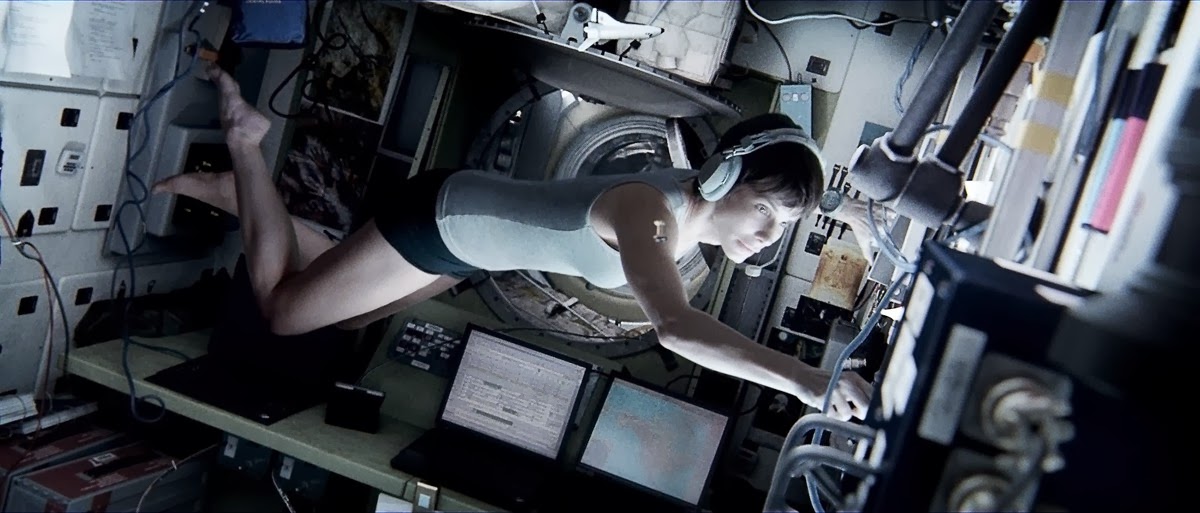
“Gravity” is the predicted winner, with 9.67 points. Its margin of victory is quite similar to last year’s winner, “Life of Pi” over its next closest competitor.
Alfonso Cuaron’s film excelled in nearly every piece of criteria; it was a critical darling (it had the highest RT score of all the nominees at a whopping 97%), earned a lot of money (the third top grosser), and was released late in the year. The film was one of two non-sequels nominated, which helped as well. Nominees that are sequels have their scores reduced by 0.5 points.
But most importantly, “Gravity” earned 10 total Oscar nominations, blowing all of the other films away. Previous winners “Life of Pi”, “Hugo” and "Return of the King" earned 11 total Oscar nominations. And over the last 24 years, the film that earned the most Oscar nominations among the visual effects nominees won the visual effects award 20 times.
Putting the final nail in the coffin, “Gravity” stars Sandra Bullock, who is an Oscar winner herself, giving the film another point.
Last year, “Hobbit 1” had the third highest Predictinator score; this year “Hobbit 2” earned enough to be in second place. Strengths for “Hobbit 2” included its month of release (December) and its respectable Tomatometer and box office scores. It was the only film that qualified for the extremely important “Primary FX are organic creatures” criteria, plus the subsequent “facial acting” criteria, for its creation of Smaug, the talking dragon. However, these positives weren't enough to overtake the juggernaut that is “Gravity”.
The relative lack of organic creatures in 2013 mimics 2011 and 2010; like those years, only one film had organic creatures as their primary visual effects. In both of those years, the creature film was not the predicted (nor actual) winner. If our 2013 prediction is true, it will continue this bizarre pattern.
At third and fourth place was “Star Trek Into Darkness” and “Iron Man 3”, two sequels that were well-reviewed and earned lots of money at the box office, but were penalized for being sequels, and without primary creature work. Plus, they were released earlier in the year, and didn’t earn enough additional Oscar nominations to earn any points.
“The Lone Ranger” earned a dismal score of 1.17 points; it was destroyed by its low Tomatometer rating and its relatively minuscule box office. But its low score was not record-breaking. At 1.04 points, “Transformers 3” has the lowest score of The Predictinator’s history. “Ranger” has the second lowest, with “Alien 3” as the third lowest.
Stepping away from the statistics for a moment; there’s no denying that “Gravity” has captured the imagination of the public and of Academy voters. The innovative techniques used in the creation of the effects, along with its flawless execution and gorgeous aesthetics (combined with the fact that it is a nearly universally-loved film) give this prediction emotional support. The Predictinator numbers quantify the wave of popularity and acclaim for the film.
You might respond to this prediction with Um, well, duh, of course ‘Gravity’ will win the Oscar. I don’t need a formula to tell me that.
I would be the first to admit that it would be truly surprising if "Gravity" didn't take home the Oscar. Lucky for us, The Predictinator seems just as accurate predicting the obvious winners as the nail-biters. How many people were predicting “Hugo” to win over “Rise of the Planet of the Apes” and the final “Harry Potter” film? Or "The Golden Compass" winning over "Transformers"? Or "Babe" over "Apollo 13"? The Predictinator nailed these winners, plus also correctly predicted the lopsided victories of “Avatar” and “Inception”.
We'll see what happens when the Academy Award winners are announced on March 2. UPDATE:Yep.
The nominees for the 86th Academy Awards have been announced. As always, the nominees were determined by the visual effects branch of the Academy after attending a bake-off of 10 films. The full Academy membership will vote on the winners of each category. The awards ceremony will take place on March 2, 2014.
Here are the nominees for Achievement in Visual Effects for the 86th Academy Awards. Congratulations to all who helped bring these images to the screen.
GRAVITY
Tim Webber, Chris Lawrence, Dave Shirk and Neil Corbould
IRON MAN 3
Christopher Townsend, Guy Williams, Erik Nash and Dan Sudick
THE HOBBIT: THE DESOLATION OF SMAUG
Joe Letteri, Eric Saindon, David Clayton and Eric Reynolds
THE LONE RANGER
Tim Alexander, Gary Brozenich, Edson Williams and John Frazier
STAR TREK INTO DARKNESS
Roger Guyett, Patrick Tubach, Ben Grossmann and Burt Dalton
And, yes, I will run The Predictinator on this year's group of nominees. Stay tuned. And here it is.
The Visual Effects Society has announced the nominees for the 12th VES Awards. The nominees were determined by VES members who participated in the nomination judging process.
Alfonso Cuaron's "Gravity" earned the most nominations, totaling eight, including Best Visual Effects in a Visual Effects Driven Film. "Pacific Rim" earned six noms, while "Iron Man 3" and "The Hobbit: The Desolation of Smaug" earned five each. "Star Trek Into Darkness", "The Lone Ranger" and "Man of Steel" each earned two nominations.
Earning one nomination was "The Great Gatsby", "The Secret Life of Walter Mitty", "The Wolf of Wall Street", "White House Down", "Oz: The Great and Powerful" and "Elysium".
Some interesting tidbits from this year's nominees: films that are in this year's Academy Bake-Off that didn't earn any VES nominations include "Oblivion", "Thor: The Dark World" and "World War Z". In contrast, "The Great Gatsby", "Man of Steel", "Mitty", "The Wolf of Wall Street", "White House Down", and "Oz: The Great and Powerful" earned VES nominations while not being invited to the Academy Bake-Off.
Listed below are all of the live-action feature film categories. To see all of the nominees, visit FXGuide's coverage. To learn more about the Visual Effects Society, visit their web site.
Outstanding Visual Effects in a Visual Effects-Driven Feature Motion Picture Gravity Tim Webber, Nikki Penny, Chris Lawrence, Richard Mcbride Iron Man 3 Christopher Townsend, Mark Soper, Guy Williams, Bryan Grill Pacific Rim John Knoll, Susan Greenhow, Chris Raimo, Hal Hickel Star Trek: Into Darkness Roger Guyett, Luke O’Byrne, Ron Ames, Ben Grossman The Hobbit: The Desolation of Smaug Joe Letteri, Eric Saindon, Kevin Sherwood, David Clayton Outstanding Supporting Visual Effects in a Feature Motion Picture Rush Jody Johnson, Moriah Etherington-Sparks, Mark Hodgkins, Antoine Moulineau The Great Gatsby Chris Godfrey, Prue Fletcher, Joyce Cox The Lone Ranger Tim Alexander, Gary Brozenich, Shari Hanson, Kevin Martel The Secret Life of Walter Mitty Guillaume Rocheron, Kurt Williams, Monette Dubin, Ivan Moran The Wolf of Wall Street Robert Legato, Mark Russell, Joseph Farrell, Lisa Spence White House Down Marc Weigert, Volker Engel, Julia Frey, Ollie Rankin Outstanding Animated Character in a Live Action Feature Motion Picture Gravity: Ryan Max Solomon, Mathieu Vig, Michael Brunet, David Shirk Oz the Great and Powerful: China Girl Troy Saliba, In-Ah Roediger, Carolyn Vale, Kevin Souls Pacific Rim: Kaiju – Leatherback Jakub Pistecky, Frank Gravatt, Cyrus Jam, Chris Havreberg The Hobbit: The Desolation of Smaug: Smaug Eric Reynolds, David Clayton, Myriam Catrin, Guillaume Francois Outstanding Created Environment in a Live Action Feature Motion Picture Elysium: Torus Votch Levi, Joshua Ong, Barry Poon Gravity: Interior Harry Bardak, Nathan Walster, Jonathan Fawkner, Claire Michaud Gravity: Exterior Paul Beilby, Kyle Mcculloch, Stuart Penn, Ian Comley Iron Man 3: Shipyard John Stevenson-Galvin, Greg Notzelman, Paul Harris, Justin Stockton Pacific Rim: Virtual Hong Kong Johan Thorngren, Jeremy Bloch, David Meny, Polly Ing Outstanding Virtual Cinematography in a Live Action Feature Motion Picture Gravity Tim Webber, Emmanuel Lubezki, Richard Mcbride, Dale Newton Iron Man 3 Mark Smith, Aaron Gilman, Thelvin Cabezas, Gerardo Ramirez Man of Steel Daniel Paulsson, Edmund Kolloen, Joel Prager, David Stripinis Pacific Rim: Hong Kong Ocean Brawl Colin Benoit, Nick Walker, Adam Schnitzer, Victor Schutz The Hobbit: The Desolation of Smaug Christian Rivers, Phil Barrenger, Mark Gee, Thelvin Tico Cabezas Outstanding Models in a Feature Motion Picture Gravity: ISS Exterior Ben Lambert, Paul Beilby, Chris Lawrence, Andy Nicholson Pacific Rim David Fogler, Alex Jaeger, Aaron Wilson, David Behrens Star Trek: Into Darkness Bruce Holcomb, Ron Woodall, John Goodson, Thomas Fejes The Lone Ranger: Colby Locomotive Rene Garcia, Steve Walton, Brian Paik, Gerald Gutschmidt Outstanding FX and Simulation Animation in a Live Action Feature Motion Picture Gravity: Parachute and ISS Destruction Alexis Wajsbrot, Sylvain Degrotte, Horacio Mendoza, Juan-Luis Sanchez Man of Steel Brian Goodwin, Gray Horsfield, Mathieu Chardonnet, Adrien Toupet Pacific Rim: Fluid Simulation & Destruction Ryan Hopkins, Michael Balog, Patrick Conran, Rick Hankins The Hobbit: The Desolation of Smaug Areito Echevarria, Andreas Soderstrom, Ronnie Menahem, Christoph Sprenger Outstanding Compositing in a Feature Motion Picture Elysium Jean Lapointe, Jordan Benwick, Robin Hackl, Janeen Elliott Gravity Mark Bakowski, Anthony Smith, Theodor Groeneboom, Adrian Metzelaar Iron Man 3: Barrel of Monkeys Michael Maloney, Francis Puthanangadi, Justin Van Der Lek, Howard Cabalfin Iron Man 3: House Attack Darren Poe, Stefano Trivelli, Josiah Howison, Zach Zaubi The Hobbit: The Desolation of Smaug Charles Tait, Robin Hollander, Giuseppe Tagliavini, Sean Heuston
The teaser for Gareth Edwards’ “Godzilla” was given high praise from moviegoers for its beautiful, evocative imagery. The rhythm and pacing of the teaser, combined with the gorgeous visual effects work of a group of paratroopers gliding their way into the ravaged San Francisco skyline, made it one of the most memorable teasers of the year.
Most importantly, the “Godzilla” teaser succeeded because it teased; it didn’t reveal a shred of the film's plot or character, or show audiences exactly what the movie is about, which is refreshing.
One of the reasons the “Godzilla” teaser works so well is the music -- in fact, the first time I watched the trailer, I shouted at my computer screen, “Hey, that’s cheating!” The filmmakers used the music from a sequence in Stanley Kubrick’s “2001: A Space Odyssey”, the famous Jupiter And Beyond The Infinite scene, which features the dazzling slit screen photography, shot by the visual effects legend Douglas Trumbull.
“Any trailer that uses that music would look cool!” I joked. And then, I wondered if that’s really true? Can any trailer with the music from the “2001” stargate sequence look cool?Challenge accepted!
So I put the Lux Aeterna orchestration from “2001” (by Gyoergy Ligeti) underneath the “Grown Ups 2” trailer, starring Adam Sandler, the least-cool trailer I could think of. I did some minor picture editing to make the edit work, sweetened the audio and added some stingers.
Just for kicks, I put together the thirteen most popular films in North America last weekend and listed each film's running time, from longest to shortest.
The Wolf of Wall Street - 179 minutes
The Hobbit 2 - 161m
Hunger Games: Catching Fire - 146m
Mandela - 139m
American Hustle - 129m
47 Ronin - 127m
The Secret Life of Walter Mitty -125m
Saving Mr. Banks - 120m
Anchorman 2 - 119m
Grudge Match - 113m
Frozen - 108m
Tyler Perry's A Madea Christmas - 105m
Walking With Dinosaurs - 87m
The average running time of the top thirteen films at the box office is 128 minutes.