Tuesday, April 28, 2009

Remastering "Star Trek"

I recently came across a nine-year-old article to which I contributed. Frank Garcia was looking for visual effects professionals' opinions on the idea of creating new visual effects for the original "Star Trek" episodes. The article, from January 2000, was written in the shadow of the Special Editions of the "Star Wars" trilogy and "Close Encounters of the Third Kind," each of which featured newly created visual effects.


CBS Digital ultimately performed visual effects facelifts to the episodes, and has since released them on video and broadcast. You can learn everything that Paramount wants you to know about the remastered episodes at startrek.com, which features plenty of articles and before-and-after comparisons.

I contributed to the article, "Special Effects Redux," and my comments hold up surprisingly well. I'm always hesitant to read some of my old writing and interviews, (a few of the reviews on VFX HQ still make me cringe) but am happily satisfied that, in this case, I made an ounce of sense. I still am of the opinion that these 'special edition' revisits are ridiculous and purely driven by commercial concerns, rather than artistic merit.

For a discussion on contemporary visual effects and exploring the idea of recreating STAR TREK'S SFX, Fandom asked two visual effects professionals who are working in the business today for their views. First is Todd Vaziri, a noted visual special effects supervisor whose artistry can be seen in DR. DOLITTLE and XENA: WARRIOR PRINCESS. He also writes extensively about the visual SFX business at his website Visual FX Headquarters. After a full briefing of Digital Stream's activities, Vaziri's feelings were mixed, just as they are with STAR WARS' special edition releases, about which he has written previously. 'As a purist, I think it's rather ridiculous,' says Vaziri. 'At a certain point you have to call a piece of art finished. And when they're done, you let it be. And you move on to a new project. You don't continually go back and fix a mistake that you may have made or retread the same ideas you had before. 'I'm very much an advocate of preserving the past and looking forward to try and create new classics. Which is the current, most accurate film? Are we going to get special editions with every film every 10 or 20 years? When a film comes out I'm assuming already 'Okay, this is the first pass, the rough draft.' '

On the other hand, Vaziri recognizes the allure of a compelling idea. 'It was such a refreshing change to see in DEEP SPACE NINE's 'Trials and Tribble-ations' the technology and the detail we can get today of the space station and the Enterprise. It was an interesting gimmick. Replacing the SFX of a single episode, that would be kinda cool. You put it on UPN and get great ratings. But to get into it for the entire series or a couple of episodes, is ridiculous.'

Vaziri also has strong feelings from an artists' point of view. 'I think of the people who toiled feverishly over the original STAR WARS, getting the shots and how revolutionary they were. The original SW shots that were replaced, they'll never be seen again!' Although Vaziri recognizes that the original STAR WARS releases will live on with DVDs and videotape, he says, 'The Special Edition is the 'final edition.' 'They made those episodes as well as they could with the money they had,' he says. 'Don't betray their efforts just because, oh, 20 or 30 years have passed and they can do it much better now.'

Asked if it is likely for Hollywood to develop a practice of replacing SFX on other iconic film or TV projects, Vaziri replies that the bottom line is economics. 'It could be profitable,' he says. 'The studio executives have to look and say, 'Are we going to spend to revamp this 30 year old film?' Studios are even reluctant to making new video transfers. They think it's not worth it. I think it will be very sparse.'


If there are any sins in Hollywood, in the way that visual special effects are produced, says Vaziri, are those projects that are spectacle over substance. 'I'm constantly pushing towards the use of SFX as a portion of the film,' he says. 'Not as a character gimmick or 'Hey! Look at me!' The best films are always about stories and characters. The SFX creates the worlds in which they live. In rare cases, the SFX are the characters, like JURASSIC PARK or THE PHANTOM MENACE where an entire character is being generated as SFX. For the most part, they should never take center stage. They shouldn't draw attention to themselves. The best SFX I've ever done are the ones people haven't noticed because they were so caught up with the film. We did about 50 or 60 visual effects for A STIR OF ECHOES, and there were only two or three that were really 'in your face.' Nobody noticed any of the other SFX. That's a big compliment because the work doesn't draw attention to itself. People don't walk out of the theater saying, 'Wow! Great SFX!' I think invisible is important.'

Contextual usage of SFX as part of the film is also very important, says Vaziri. Sinful 'spectacle over substance' effects films includes THE AVENGERS, LOST IN SPACE and GOZILLA, says Vaziri. In the case of a Digital Stream-created STAR TREK vision, Vaziri also has a problem with the forced comparison between the original and a new edition. 'That's extremely distracting. You're going to see an episode where the sets were so cheaply made that you can see a little gap on the floor and then you cut to this new, perfectly detailed CGI SFX shot? It totally does not fit within the context of the film! It takes you out of the film and draws attention to itself. If new SFX are made for 'The Doomsday Machine,' they're out of place and context. It draws attention to them rather than being a service to the story and characters.'


Friday, April 24, 2009

We Are America

For quite possibly the first time ever, I wholeheartedly agree with a Fox News anchor. Here's Shepard Smith speakin' the truth, with some salty language, as an added bonus!


Update: Our friend Stephen Colbert had something to say about Smith's antics.

The Colbert ReportMon - Thurs 11:30pm / 10:30c
Shepard Smith Swears
colbertnation.com
Colbert Report Full EpisodesPolitical HumorGay Marriage Commercial

Wednesday, April 22, 2009

Our Director

If you only read one article about director J.J. Abrams and his approach to creating a brand new "Star Trek" film, read this one. Here are some choice excerpts:

LATimes: You know that no matter what you do, you'll get an earful from hardcore fans.

Abrams: The key is to appreciate that there are purists and fans of "Star Trek" who are going to be very vocal if they see things that aren't what what they want. But I can't make this movie for readers of Nacelles Monthly who are only concerned with what the ship's engines look like. They're going to find something they hate no matter what I do. And yet, the movie at its core is not only inspired by what has come before, it's deeply true to what's come before. The bottom line is we have different actors playing these parts and from that point on it's literally not what they've seen before. It will be evident when people see this movie that it is true to what Roddenberry created and what those amazing actors did in the 1960s. At the same time, I think, it's going to blow people's minds because its a completely different experience than what they expect.

...it felt to me that the key to "Star Trek" was to go from the inside-out: Be as true to the characters as possible, be as real and as emotional and as exciting as possible and not be distracted by the specter of all that the "Star Wars" film accomplished.

"Star Trek," directed by J.J. Abrams, featuring visual effects by Industrial Light and Magic, hits theaters on May 8. Watch HD trailers for "Star Trek" at Apple.com.

Los Angeles Times Interview with J.J. Abrams, part 1 and part 2.

Friday, February 27, 2009

"Button" Buttons Up VES Awards

The visual effects teams from "The Curious Case of Benjamin Button" nabbed four VES Awards last week, with "The Dark Knight" earning three and "Changeling" earning two.

It wasn't easy to find coverage of the VES Awards from the Visual Effects Society itself. If you go to VESAwards.com, there is no information on the winners listed (only applications and nominees). No email went out to VES members, which is strange because VES is usually pretty good about disseminating information via email. I went to visualeffectssociety.com, and on the far right side is a tiny link to a hastily prepped PDF file, which contained the names of the winners. The site contained no photographs of the event, no video, no acceptance speeches, and no links to other press coverage of the event. Disappointing, to say the least, especially for VES' biggest night of the year.

One of the many elaborate matte paintings for Clint Eastwood's "Changeling"

As for the awards themselves, I heard that it was a fun show. They gave lifetime achievement awards to the one and only Phil Tippett, as well as the monster producing partners Kathleen Kennedy and Frank Marshall.

As for the awards themselves, I was, of course, rooting for my fellow ILMers for our nominations for "Iron Man" and "Indiana Jones." I especially was hoping for an "Indiana Jones" win for Best Created Environment, since I contributed to the Temple Heart sequence (hopefully more on this in a future post). But "Button" and "Dark Knight" swooped up most of the awards, and for the most part, rightfully so.

If you haven't seen it yet, make sure you visit the well-made The Science Behind Benjamin Button, which nicely highlights some of the visual effects challenges from the film.

Here are some press clippings that I was able to muster:
And here are all of the winners of the live-action feature film categories. (To see all the nominees, click here.)

Outstanding Visual Effects in a Visual Effects Driven Motion Picture
THE CURIOUS CASE OF BENJAMIN BUTTON
Eric Barba, Edson Williams, Nathan McGuinness, Lisa Beroud

Outstanding Supporting Visual Effects in a Motion Picture
CHANGELING
Michael Owens, Geoffrey Hancock, Jinnie Pak, Dennis Hoffman

Best Single Visual Effect of the Year
THE CURIOUS CASE OF BENJAMIN BUTTON - Benjamin's Secret
Eric Barba, Lisa Beroud, Steve Preeg, Jonathan Litt

Outstanding Animated Character in a Live Action Motion Picture
THE CURIOUS CASE OF BENJAMIN BUTTON - Benjamin Button
Steve Preeg, Matthias Wittmann, Tom St. Amand, David McLean

Outstanding Matte Paintings in a Feature Motion Picture
CHANGELING
- 1928 Downtown L.A.
Romain Bayle, Abel Milanes, Allan Lee, Debor Dunphy

Outstanding Models and Miniatures in a Feature Motion Picture
THE DARK KNIGHT - Garbage Truck Crash Models and Miniatures
Ian Hunter, Forest Fischer, Branden Seifert, Adam Gelbart

Outstanding Created Environment in a Feature Motion Picture
THE DARK KNIGHT - IMAX Gotham City Scapes
Peter Bebb, David Vickery, Philippe Leprince, Andrew Lockley

Outstanding Compositing in a Feature Motion Picture
THE CURIOUS CASE OF BENJAMIN BUTTON - Benjamin Comes Together
Janelle Croshaw, Paul Lambert, Sonja Burchard, Sarahjane Javelo

Outstanding Special Effects in a Motion Picture
THE DARK KNIGHT
Chris Corbould, Peter Notley, Ian Lowe

Tuesday, February 24, 2009

"Button" Buttons Up The Oscar

“The Curious Case of Benjamin Button”
Eric Barba, Steve Preeg, Burt Dalton and Craig Barron

Hearty congratulations go out to the visual effects teams behind "The Curious Case of Benjamin Button," which won the Oscar for Best Visual Effects at the 81st Academy Awards. Here's Eric Barba's acceptance speech:

Oh my God. On behalf of myself, Steve Preeg, Burt Dalton and Craig Barron, I'd like to thank the Academy for this incredible honor. I'd also like to thank Edson Williams and his team at Lola Visual Effects and Nathan McGuinness and his team at Asylum as well as all the other visual effects teams that worked so hard on this film. I'd like to thank our amazing team at Digital Domain, my mentor Ed Ulbrich, my wonderful producer Lisa Beroud, the woman who is my biggest supporter, my wife Roma, Kathleen Kennedy, Frank Marshall and Ceán Chaffin, for trusting that we could actually pull this off. Brad Pitt for an amazing performance. And of course David Fincher for giving us all the opportunity to work on this film. To my kids, Cole and Nicolette, I'd just like to say, "Work hard, do good work and never give up." Thank you.


This was a rare year in which all three nominees were worthy of Oscar, in my opinion. And it was extra special to see my friend Craig Barron holding that statuette on the stage of the Kodak Theater. Way to go, Craig!

I even updated the Academy Awards section of Visual Effects Headquarters. How about that?

Update: Here is the backstage Thank-You cam, where Steve Preeg, Burt Dalton and Craig Barron were allowed to make their thank-you's.

...and there are the four winners, answering questions from the press backstage.


Saturday, February 07, 2009

"Transformers 2" Superbowl

Not only did a new commercial for "Star Trek" appear during the Superbowl last week, but the very first images from "Transformers: Revenge of the Fallen" landed on television screens. Head over to Apple's Quicktime page to view the new commercial in HD.

These four still frames were chosen by the Randomizer 2009™ software, featuring ArbitraryBoost 3.0.


"Star Trek" Superbowl

So, a little movie called "Star Trek" debuted a new commercial during the Superbowl last week. Make sure you watch the commercial (in sweet, sweet high definition). In the meantime, here's a frame from the commercial, chosen by the Randomizer 2009™ software, featuring ArbitraryBoost 3.0.

Thursday, January 22, 2009

And The Nominees Are...

Here are the nominees for Best Visual Effects for the 81st Annual Academy Awards:

“The Curious Case of Benjamin Button”
Eric Barba, Steve Preeg, Burt Dalton and Craig Barron

“The Dark Knight”
Nick Davis, Chris Corbould, Tim Webber and Paul Franklin

“Iron Man”
John Nelson, Ben Snow, Dan Sudick and Shane Mahan

Congratulations to all the nominees and everyone who contributed to the visual effects of these three films! The winner of the Academy Award will be announced February 22, 2009.

Monday, January 19, 2009

VES Announces Nominations for 7th VES Awards

Hi, all! Here's the press release sent out by the Visual Effects Society, announcing their nominees for the 7th Annual VES Awards. I'll provide some personal notes in a forthcoming post. What follows is an edited list of nominees, listing live-action feature film categories only.

-todd

VISUAL EFFECTS SOCIETY (VES) ANNOUNCES NOMINEES FOR 7th ANNUAL VES AWARDS
"Iron Man" Leads with 5 Noms, Awards Ceremony Scheduled for February 21, 2009

Los Angeles, January 19, 2009 - The Visual Effects Society (VES) today announced the nominees for the 7th Annual VES Awards ceremony recognizing outstanding visual effects in over a dozen categories of film, animation, television, commercials and video games. Nominees were chosen Saturday, January 17, 2009, by numerous panels of VES members who viewed submissions at the FotoKem screening facilities in Burbank.

In making the announcement, Jeffrey A. Okun, Chair of the Visual Effects Awards Committee said, "Because visual effects continue to grow in complexity and intensity, touching every aspect of the entertainment industry, we are proud to announce the nominees and their work, which have been deemed by the judges as the best of the best. I congratulate all the artists on their achievements."

The nominees for the 7th Annual VES Awards are the following:

Outstanding Visual Effects in a Visual Effects Driven Motion Picture
THE CHRONICLES OF NARNIA, PRINCE CASPIAN
Wendy Rogers, Dean Wright, Andrew Fowler, Greg Butler
THE CURIOUS CASE OF BENJAMIN BUTTON
Eric Barba, Edson Williams, Nathan McGuinness, Lisa Beroud
HELLBOY II THE GOLDEN ARMY
Michael J. Wassel, Lucy Killick, Adrian de Wet, Eamonn Butler
CLOVERFIELD
Kevin Blank, Chantal Feghali, Michael Ellis, Eric Leven
IRON MAN
Ben Snow, Hal Hickel, Victoria Alonso, John Nelson

Outstanding Supporting Visual Effects in a Motion Picture
CHANGELING
Michael Owens, Geoffrey Hancock, Jinnie Pak, Dennis Hoffman
EAGLE EYE
Jim Rygiel, Jim Berney, Crys Forsyth-Smith, David Smith
VALKYRIE
Richard R. Hoover, Maricel Pagulayan, Peter Nofz, Daniel Eaton
NIM'S ISLAND
Camille Cellucci, Scott Gordon, Fred Pienkos, James Straus
SYNECDOCHE, NEW YORK
Mark Russell, Richard Friedlander, Eric Robertson, Brett Miller

Best Single Visual Effect of the Year
CLOVERFIELD - Statue of Liberty Crash and Woolworth Tower Collapse
Michael Ellis, Chantal Feghali, David Vickery, Ben Taylor
THE CURIOUS CASE OF BENJAMIN BUTTON - Benjamin's Secret
Eric Barba, Lisa Beroud, Steve Preeg, Jonathan Litt
THE DAY THE EARTH STOOD STILL - Newborn Klaatu
Jeffrey A. Okun, R. Christopher White, Thomas M. Boland, Ben Thompson
INDIANA JONES AND THE KINGDOM OF THE CRYSTAL SKULL - Valley Destruction
Stephanie Hornish, Pablo Helman, Jeff White, Craig Hammack
IRON MAN
Ben Snow, Wayne Billheimer, Victoria Alonso, John Nelson

Outstanding Animated Character in a Live Action Motion Picture
THE CURIOUS CASE OF BENJAMIN BUTTON - Benjamin Button
Steve Preeg, Matthias Wittmann, Tom St. Amand, David McLean
HELLBOY II THE GOLDEN ARMY - Elemental Sequence
Colin McEvoy, Christoph Ammann
IRON MAN
Hal Hickel, Bruce Holcomb, James Tooley, John Walker
THE SPIDERWICK CHRONICLES - Hogsqueal
Todd Labonte, Michael Brunet, Nathan Fredenburg, Aharon Bourland

Outstanding Matte Paintings in a Feature Motion Picture
CHANGELING
- 1928 Downtown L.A.
Romain Bayle, Abel Milanes, Allan Lee, Debor Dunphy
INDIANA JONES AND THE KINGDOM OF THE CRYSTAL SKULL

Richard Bluff, Barry Williams, Yanick Dusseault, Yusei Uesugi
SYNECDOCHE, NEW YORK
- Matte Paintings
Brett Miller, Garrett Eaton, Matthew Conner
SPEED RACER
- Overall Matte Painting Presentation

Lubo Hristov, Dennis Martin, Ron Crabb

Outstanding Models and Miniatures in a Feature Motion Picture
THE DARK KNIGHT - Garbage Truck Crash Models and Miniatures
Ian Hunter, Forest Fischer, Branden Seifert, Adam Gelbart
INDIANA JONES AND THE KINGDOM OF THE CRYSTAL SKULL
David Fogler, Craig Hammack, Brian Gernand, Geoff Heron
IRON MAN - Suit Up Machine
Aaron McBride, Russell Paul, Gerald Gutschmidt, Keiji Yamaguchi
MY DARLING OF THE MOUNTAINS - Hot Springs
Taro Kiba, Kenji Nagatani, Yuki Minagawa, Hideo Udo

Outstanding Created Environment in a Feature Motion Picture
CLOVERFIELD - Brooklyn Bridge Sequence
David Vickery, Phil Johnson, Victor Wade, Sean Stranks
THE DARK KNIGHT - IMAX Gotham City Scapes
Peter Bebb, David Vickery, Philippe Leprince, Andrew Lockley
INDIANA JONES AND THE KINGDOM OF THE CRYSTAL SKULL - Temple Heart
Michael Halsted, David Fogler, Steve Walton, David Weitzberg
THE MUMMY - TOMB OF THE DRAGON EMPEROR - Avalanche Sequence
Mike Meaker, Rich Mahon, Jason Iverson, Sho Hasegawa
SYNECDOCHE, NEW YORK - Created Environment
Brett Miller, Garrett Eaton, Matthew Conner

Outstanding Compositing in a Feature Motion Picture
THE CHRONICLES OF NARNIA, PRINCE CASPIAN
Stuart Lashley, Arundi Asregadoo, Mark Curtis, Richard Baker
THE CURIOUS CASE OF BENJAMIN BUTTON - Benjamin Comes Together
Janelle Croshaw, Paul Lambert, Sonja Burchard, Sarahjane Javelo
IRON MAN - Head Under Display - HUD Compositing
Jonathan Rothbart, Dav Rauch, Kyle McCulloch, Kent Seki
QUANTUM OF SOLACE - Sienna Chase and Fight Sequence
Anthony Smith, Christian Kaestner, Adrian Metzelaar, Jon Thum

Outstanding Special Effects in a Motion Picture
THE DARK KNIGHT
Chris Corbould, Peter Notley, Ian Lowe
THE DARK KNIGHT - Garbage Truck Crash Mechanical Effects
Scott Beverly, Robert Spurlock, Jon Warren, Brian Kelly Hahn
DEFIANCE - Special Effects
Neil Corbould, Steve Warner, Anne Maria Walters, Alan Young


This year the VES will present producers Kathleen Kennedy and Frank Marshall with the VES Lifetime Achievement Award and Phil Tippett with the Georges Méliès Award.

For more information on the VES Awards, sponsorship and tickets, please visit www.visualeffectssociety.com.

Friday, January 16, 2009

Abrams: "It's Amazing"

From Sci Fi Wire:

J.J. Abrams, who directed the upcoming Star Trek reboot movie, addressed the film's new take on starship battles...

Earlier in the evening, screenwriter Roberto Orci described the battles as still maritime-influenced, despite the new, lavish look. Abrams clarified.

"They're big ships, so I'd say that there is a little bit of that, but there's a little bit more flash and fun and action than you've seen before," Abrams said in a group interview. "There are some pretty spectacular visual effects. ILM outdid themselves. It's amazing."

Tuesday, January 06, 2009

The List of 7

It's Bake-Off time! The visual effects branch of the Academy have narrowed their 'list of 15' films to the seven films that will be participating in the bake-off for the race for this year's Oscar nominations.
  • “Australia”
  • “The Curious Case of Benjamin Button”
  • “The Dark Knight”
  • “Hellboy II: The Golden Army”
  • “Iron Man”
  • “Journey to the Center of the Earth”
  • “The Mummy: Tomb of the Dragon Emperor”
The Executive Committee narrowed the List of 15 to these seven earlier this week. The Bake Off, which features 15 minute reels from each film, will take place on January 15, where the entire visual effects branch gets to vote on the final three nominees for the Academy Award for Best Visual Effects. As always, the entire Academy then votes for the winner of the award.

My predictions were way off this year. While I got four films right, I thought "Indy," "Caspian" and "Spiderwick" would have made it to the bake-off, rather than "Australia," "Mummy 3" and "Journey."

My not-to-be-trusted predictions for the three nominees? "Dark Knight," "Iron Man," and "Benjamin Button," which are coincidentally my personal choices of the three films that deserve a nomination.

Friday, December 12, 2008

The List of 15

The visual effects branch of the Academy have announced their 'list of 15' films, considered semifinalists in the race for the Oscar nominations for the 81st Academy Awards.
  • “Australia”
  • “The Chronicles of Narnia: Prince Caspian”
  • “Cloverfield”
  • “The Curious Case of Benjamin Button”
  • “The Dark Knight”
  • “The Day the Earth Stood Still”
  • “Hancock”
  • “Hellboy II: The Golden Army”
  • “The Incredible Hulk”
  • “Indiana Jones and the Kingdom of the Crystal Skull”
  • “Iron Man”
  • “Journey to the Center of the Earth”
  • “The Mummy: Tomb of the Dragon Emperor”
  • “Quantum of Solace”
  • “The Spiderwick Chronicles”
The Executive Committee will then whittle this list down to seven films in the next few weeks, which will be featured at the bake-off (to take place on January 15), where each of the seven films presents a reel of their finished work, and takes questions from the entire visual effects branch. The entire branch then votes for their top three choices, which ultimately determine the three Academy Award nominees for Best Visual Effects. The nominees for all categories will be announced on January 22. The entire Academy then votes on the winner.

Personally, I'm happy that none of this year's animated films made this list of 15, which allows the industry to sidestep the entire issue of debating the term visual effects, as we had to last year, when "Ratatouille" and "Beowulf" made it to the 'list of 15.'

I am also generally happy with this list of films, meaning, I don't sense any major snubs ("The Matrix Revolutions" being ignored in 2003) or 'are you kidding me?!' films on this list.

My prediction for the final seven films: "Prince Caspian," "Benjamin Button," "Dark Knight," "Hellboy II," "Indy IV," "Iron Man," "Spiderwick."

Films Every Visual Effects Artist Should Watch: "Baraka"

This is the first of a series of articles, titled "Films Every Visual Effects Artist Should Watch."

I have written many times about the need for visual effects artists to watch movies, particularly non-visual effects films. For those of us working in the realm of photorealistic visual effects, that is, visual effects whose goal is to blend into the world of the live-action film, it is essential for us to keep our eyes on the target of our efforts. Our target is photorealism - scenarios and characters that, ostensibly, have been photographed right alongside our actors on soundstages and on location, that help tell the filmmakers' stories. In this respect, I encourage young visual effects artists and seasoned artists alike to watch, break down and analyze non-visual effects films. Understanding what is photorealistic will help artists create photorealistic images. This ability is especially important for those in the disciplines of, but not limited to, model making (both CG and practical), texture painters, lighters, and compositors.

Watching and analyzing non-visual effects films will give artists the visual vocabulary of photorealism, and gives the artist the ability to answer questions like, "What makes this look real? What are the visual cues that force the audience to believe that character is standing there? What are the shadows doing in this shot?" One does not need to ask "Why" questions, as in "Why is that portion of the frame overexposed?" One needs to be more concerned with "What" questions.

A mastery of the visual cues that trigger our impulse to "believe in" an image is the single strongest tool in a visual effects artists' toolbox. And this is why every visual effects artist should watch Ron Fricke's "Baraka."

Created in 1992, "Baraka" contains moments of spectacular beauty and intimate humanity, both on an epic scale and in miniature proportions. And there are no visual effects in the film, which makes it a terrific candidate for visual analysis.

It's not a travelogue, nor a vanilla, large-format nature documentary. The film is an exploration of what it means to be a human being on this planet. Or not. One of the beautiful aspects of this dialogue-free film is its seemingly limitless expanse of interpretation. Ten people could watch this film and emerge with ten completely distinguishable interpretations of its meaning, or its central theme.

One thing is certain: the photography in "Baraka" is breathtaking. Photographed by Fricke in a 65mm film format, largely with available light with relatively fast setups in difficult locations with a tiny crew (usually three people, including Fricke), the shots in "Baraka" are stunning. The camera is largely sedentary (with long, lingering lockoffs, peppered with deliberate dolly moves), which allows the imagery to speak for itself. Fricke is an extraordinary cinematographer, and "Baraka" is his crowning achievement as a cameraman. (As an aside, I had the unique privledge of compositing some of Fricke's photography; for "Star Wars: Episode III," it was Fricke and his team who photographed the real lava blasts on Mt. Aetna in Italy, which we ultimately used as elements in the Mustafar sequences for the film.)

Much has been written about "Baraka," so I will excerpt from a far-superior writer to get his take on the film. From Roger Ebert, who recently revisited "Baraka," crowning it one of his "Great Movies":

The film consists of awesome sights, joyful, sad, always in their own way beautiful. By that I do not mean picturesque. A friend came into the room while I was watching the film, saw a closeup of the head of a Gila monster and said, "That's beautiful." I asked if she liked lizards. "I hate lizards," she said, shuddering. She wasn't thinking about lizards. She was observing the iridescent scales of the creature's head... Tiny bright plumes in a desert are revealed as the burning oil fields of Kuwait. Mothballed B-52 bombers reach to the horizon. Manhattan. Corpses are burned on the banks of the Ganges. Will they know the donkeys are pulling a cart much too heavy for them? They will probably understand mountains, waterfalls, volcanoes. Do we? "Baraka" is paced so we can contemplate the places we will never go, the places we are destroying, the places where we might find renewal. It is like a prayer.

Like Ebert writes, the deliberate pace of the film allows the viewer to not only absorb the images, but to contemplate their meaning. And this deliberate pace gives us an opportunity to study the imagery in unique ways.

Specifically, there are several things effects artists can take away from the film. For one, "Baraka" allows effects artists to see how scale is represented, both large and small. Notice the visual cues that the shots of Ayers Rock in Australia are giving the audience. How does this look different than, say, a one-foot dirt pile in the road?

The slow moving dolly shots allow artists to analyze the effects of parallax. When working within a 3D system, most of these technical decisions are made for you automatically. However, if you're designing a world, and are trying to convey a feeling of vastness, how you build the scale of your scene will dramatically affect the way it is interpreted by the audience if you are unaware of the power of parallax. (A lack of understanding can sometimes lead to visual effects shots where elements are placed in space in such a way that, when the camera moves, the audience feels like they're viewing billboards on cards of varying scale, rather than real-life objects placed realistically within a world.)

One of the many deliberate, slow dolly shots in "Baraka," featuring skulls from one of the killing fields in Cambodia.

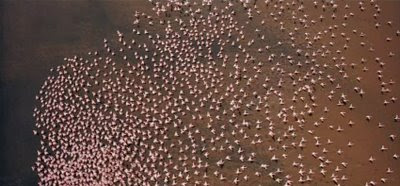
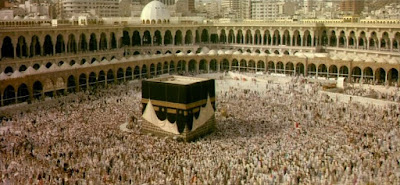
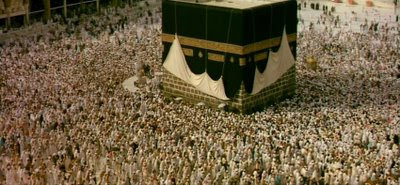
There are several shots in the film that feature group behavior, which is perfect for analysis for anyone who is tasked with creating synthetic crowd shots, either human or animal. Watch the poetic precision of Amazonian men dancing crosslegged, or the swirl of men walking around the Kaaba cube in Mecca, or the seated factory workers creating cigarettes in rows as far as the eye can see. For anyone who has to create crowd behavior, there is much to examine here.

And for those who create synthetic environments, there is plenty to examine. Modern cityscapes, both crisp and new, and dilapidated and pathetic. Ancient ruins, religious temples, places of intense historical horror, and locales of deep spiritual significance. Also represented are elements of the earth; water, wind, sky and stars.
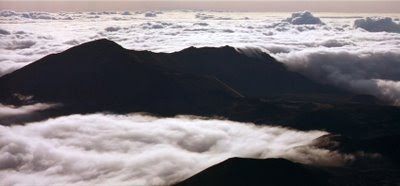

Although there are no optical tricks used in "Baraka" to enhance the film, one technological technique used to create certain shots involves a giant step in the evolution of time lapse photography. Several shots in the film feature extreme speed changes, both slow motion (running the film camera at a higher frame rate), and fast motion (running the film at a slower frame rate). Traditionally, these shots are from a locked off camera with a single exposure, which freezes the point of view. It's the time-lapse with which our eyes are quite familiar. The filmmakers behind "Baraka" added an additional element to their time lapse (fast motion) shots: a moving camera.

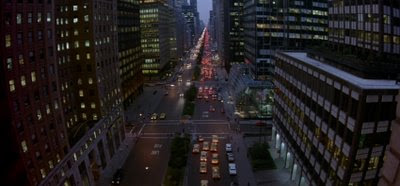
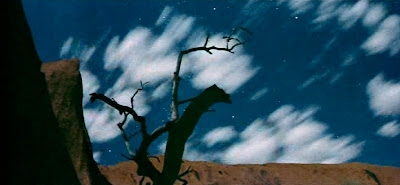
Using motion control dolly systems, the cinematographer was able to program a dolly/pan/tilt move on their time-lapse shots, which creates a unique viewing experience. The process is very much the inverse of so-called 'Bullet Time,' which features elaborate camera moves on slow motion shots. The "Baraka" team also had the capability to program exposure changes into their timelapse shots, which means they could photograph a single take that occurs over several hours and compensate for massive changes in light. This is especially important for the day-to-night time-lapse shots, such as the big city dolly into traffic, or the film's climax which features several moving camera time-lapse shots of canyons at night with starfields and clouds zipping past mountains.

In this amazing time-lapse shot, the camera slowly dollys forward through an open window to reveal the living, breathing city, just as the sun sets. The rhythmic pulsing of the synchronized street lights, along with the subtle soundtrack, imparts an ironic sense of organic life amidst a sea of concrete and steel. This motion control time-lapse shot is one of the most memorable scenes in the film.
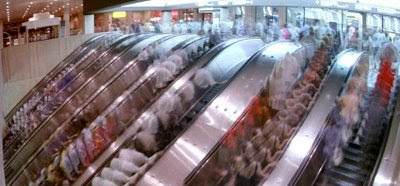
"Baraka" also has fun with its editing style, frequently cross cutting between two very disparate scenarios, allowing the viewer to interpret its significance. In one of the showcase montages of the film, Fricke cross cuts between baby chicks placed on conveyor belts in preparation for their lives as egg hens, and various time-lapse shots of commuters around the world. This narration-less juxtaposition of images allows the viewer to interpret a message (if one exists), rather than having it spelled out by the artist.

Consistently, the photography of "Baraka" is honest and true. It provides a gold mine of inspiration for modern visual effects artists whose job it is to create honest and true images, both in the grand scheme and in specific terms.

Even though "Baraka" is a small, special-interest film that is over 15 years old, its following is strong. 70mm prints of the film show up at 70mm film festivals in big cities all the time. (Take a peek at this schedule from in70mm.com, which shows upcoming 70mm screenings from all around the world, and notice all of the "Baraka" listings.) I've personally seen it projected in 70mm in Chicago, Los Angeles and San Francisco. And the DVD of the film looks pretty darn good, as well. But for those of you with Blu-ray players, you're in for a special treat.

Recently, the film was painstakingly restored for future generations, creating a stunning new video transfer which is now available on Blu-ray. Ebert wrote, "The restored 2008 Blu-ray is the finest video disc I have ever viewed or ever imagined. It was made from the Todd-AO print, which was digitally restored to a perfection arguably superior to the original film... 'Baraka' by itself is sufficient reason to acquire a Blu-ray player."

The Digital Bits wrote: "Quite simply, Baraka is the best looking live action Blu-ray release I have EVER seen. It's truly an extraordinary viewing experience... astonishing. [The] Blu-ray release of 'Baraka' is a landmark achievement for the format."


Over the years, I have been hesitant to toss a DVD of "Baraka" in front of someone who had never seen the film before, thinking that I would be giving them an abstract approximation of the film by showing them a crippled, low-resolution version of the film. And although the DVD is worth viewing, it cannot remotely get close to the experience of viewing this beautiful film in 70mm on a huge screen. In fact, I considered embedding video clips into this article, but ultimately decided against it for this same reason. However, with the superlatives being thrown around concerning the quality of the Blu-ray release, I can confidently recommend a home video option for viewing this exceptional film.

These last three shots, scenes from the Ganges river in India, are ripe for visual analysis. In the middle image of the harbor, for example, notice how the atmosphere builds up over the depth of the shot, how the foreground boats have a richness of contrast, while the background boats and buildings appear contaminated with atmosphere. The lens is not particularly wide, but the sense of depth is palpable. The lower image, of bodies being cremated at the river's edge, is richly composed. We have areas of direct sunlight and shadow, various levels of smoke and fire, atmosphere that is patchy yet discernable, and people moving in and out of all of these elements. Visual effects artists are frequently tasked with creating these scenarios completely from scratch. If one analyzes rich, deep, authentic real-life shots like these, one will have a stronger toolset of techniques to help create realistic, plausible effects scenes.