Showing posts with label visual effects. Show all posts
Showing posts with label visual effects. Show all posts
Monday, September 07, 2015
My Visual Effects Twitter Q&A
A few weeks ago, I did an impromptu question and answer session on Twitter. I've collected all the tweets into a Storify, and am reposting it below. Enjoy.


Monday, August 31, 2015
"Be Prepared for Dailies", Restored

Many moons ago, a valuable blog post by “Vizy Acky” was circulated in online visual effects communities, simply titled “Be Prepared For Dailies”. The post was a concise, laser-focused white paper on how visual effects artists should approach “dailies”, the morning ritual of visual effects artists, supervisors and producers sitting in a dark screening room and reviewing the previous day’s work. Every visual effects shop runs differently, and every visual effects and animation supervisor has his or her preferences as to how dailies should be run.
For example, sometimes animation and lighting have combined dailies. Others invite roto and paint artists. Some run dailies just with only top-level supervisors, and rely on coordinators to disseminate the notes. However, there exist certain universal commonalities of decorum, etiquette, and plain common sense when communicating in dailies.
Generally speaking, dailies should be run as efficiently as possible. No one wants dailies to run endlessly for hours and hours-- that’s valuable time wasted, which frustrates everyone in the pipeline. My personal pet peeve is dailies that never start on time… but I digress.
Unfortunately, the original source of the terrific blog post about dailies has vanished from the internet. I did some poking around on Internet Archive, and was able to resurrect the text. This is a lovely document which should continue to live on. The author was specifically commenting on ‘effects’ dailies, which involve particle effects and simulations (like water, dust, smoke, etc.), but the essay is applicable to nearly all types of animation and visual effects dailies.
I’m printing it below with some slight typo and clarification corrections, and occasional annotations. Enjoy.

Here are four questions I had asked my visual effects team to prepare for me each day for each shot. These questions came out of my years of working at studios in Los Angeles, a composite of the things I learned from my supervisors about how to speed the dailies process. I started using these questions when dealing with a Chinese team in Beijing. This gave time for the crew to write out their comments and allow time for the translator to prepare.
This method also works well for regular dailies where the artist is prepared beforehand. This also helps the vfx supervisor to know what they are looking at and what to comment about.
Garman’s Four “Questions” for dailies.
1) What to look at and what not to look at.
Take It Offline
(Plus, if you like this kind of thing, head over to Scott Squires’ blog, where he writes thoughtful posts like this one, “What Makes a Good Visual Effects Artist?”, which touches on the dailies process.)

Be Prepared for Dailies
from Vizy Acky Blog, Garman Visual Effects Academy
Resurrected from https://web.archive.org/web/20120712084932/http://vizyacky.com/blog/work-life/be-prepared-for-dailies/
Here are four things you should always be prepared to discuss during dailies.
Here are four things you should always be prepared to discuss during dailies.
1) what to look at and what not to look at
2) what changed from the previous version
3) what the artist thinks should be done to improve their shot
4) any questions or concerns about this shot
Visual effects iterations sent to dailies often look abstract and can be difficult to comment on. Dailies can become a huge waste of time and I’ve noticed when studios followed this kind of format often each shot can be covered in as little as 20-40 seconds. The submission might be a work in progress, a technical proof-of-concept test or a rough comp not refined by the final compositor.
Visual effects iterations sent to dailies often look abstract and can be difficult to comment on. Dailies can become a huge waste of time and I’ve noticed when studios followed this kind of format often each shot can be covered in as little as 20-40 seconds. The submission might be a work in progress, a technical proof-of-concept test or a rough comp not refined by the final compositor.
Here are four questions I had asked my visual effects team to prepare for me each day for each shot. These questions came out of my years of working at studios in Los Angeles, a composite of the things I learned from my supervisors about how to speed the dailies process. I started using these questions when dealing with a Chinese team in Beijing. This gave time for the crew to write out their comments and allow time for the translator to prepare.
This method also works well for regular dailies where the artist is prepared beforehand. This also helps the vfx supervisor to know what they are looking at and what to comment about.
Garman’s Four “Questions” for dailies.
Each of these four questions should be answered by the artist before dailies. The coordinator playing shots should state the shot name and the artists’ names, play the shot and ask the artists for their comments. The artist should be go through these “questions” as the shot is being looped, before any comments are expected.
Don’t wait in silence for the VFX Supervisor to guess what they are looking at. [Todd: This is super important. Don’t think the vfx supervisor is a mind-reader. Speak up!] Tell the supervisor what to look for.
Don’t wait in silence for the VFX Supervisor to guess what they are looking at. [Todd: This is super important. Don’t think the vfx supervisor is a mind-reader. Speak up!] Tell the supervisor what to look for.
1) What to look at and what not to look at.
-Tell what you need comments on and what to ignore. This helps the vfx sup to not waste his time trying to figure out what he is looking at.
-An example would be, “Look at the speed of the particle motion but not the color or size.”
2) What changed from the previous version.
2) What changed from the previous version.
-Tell what you changed or what you were asked to change. If this is the first time the effect is show, state what you are trying to demonstrate.
-An example would be, “This motion is 2x faster than the previous version and the particles now live 1.2x longer.”
3) What the artist thinks should be done to improve their shot.
3) What the artist thinks should be done to improve their shot.
-Tell what you think you should do next. This helps the vfx supervisor know if you are on the right track and perhaps they will say “fine, continue” and will avoid him having to think for you.
-An example would be, “In this version the particles would cover the hero in the background so I feel we should have the particles move a bit faster and have a shorter lifespan so we can see the actors.”
4) Any questions or concerns about this shot.
4) Any questions or concerns about this shot.
-Now is the time to ask for specific guidance.
-Examples would be, “Does the smoke linger in the following shot because this is a closeup of the hero and we should see smoke from that camera view but it’s not assigned.” Or, “I noticed a bump in the camera track where the smoke goes around the car. Can we look into that.”
Getting Comments Back
Getting Comments Back
Now we can get the comments from the VFX supervisor or others. Since you already stated what you think should be done next, then it can make it easier to say, “OK to continue.” Or to get more specific guidance.
Take Notes
Take Notes
I’ve always been a good note taker since I was in high school. Perhaps because I was good at taking notes made it easier for me to study less after class. Taking notes made me pay more attention to what was being said while it was being said. I’m always amazed to be in meetings where people are discussing actions which involve tens or hundreds of thousands of dollars worth of work, yet not many people are taking notes. [Todd: I always take notes in dailies, then after I return to my desk, I immediately transcribe the notes with clearer language and specific frame numbers or screen coordinates (screen right fire on frame 1024 looks pinkish)]
Don’t depend on the coordinator to take notes for you. They may be a professional note taker as part of their job but they don’t understand effects like you are supposed to and often don’t get it as accurate as you need it. Take notes about what you are supposed to do. Then take notes about what others are talking about even if you don't understand it. Use your notes to help you find out what you need to understand later. If you want to be the VFX Supervisor someday, you’ll need to know a lot, and taking notes at dailies is a great way to start.
Don’t depend on the coordinator to take notes for you. They may be a professional note taker as part of their job but they don’t understand effects like you are supposed to and often don’t get it as accurate as you need it. Take notes about what you are supposed to do. Then take notes about what others are talking about even if you don't understand it. Use your notes to help you find out what you need to understand later. If you want to be the VFX Supervisor someday, you’ll need to know a lot, and taking notes at dailies is a great way to start.
Take It Offline
Dailies is the time for quick review of work in progress. It helps production know it is staying on schedule, and helps the supervisors see all the work being done each day. It’s supposed to be quick. Most shots can be covered in 15-30 seconds. [Todd: If you spend over two minutes on a single shot in dailies, something is wrong.] Dailies is not the time to determine deep technical solutions while wasting everyone else’s time. Dailies is to help find problems and solve them later.
-Garman
2012.01.07 Vancouver BC-Garman
Wednesday, July 29, 2015
My Tweetstorm about Interactive Light
The other night, I unleashed a tweetstorm about interactive light. Enjoy.
Monday, July 06, 2015
My Tweetstorm On How "CGI is Ruining Movies!"
The time I ranted on Twitter about those horrible videos and articles about how "CGI" is ruining modern movies. Here's the direct link to the full Storify collection.
Thursday, May 28, 2015
Diopter Tweets
The other day, I unleashed a mini-tweetstorm about diopter shots. It all started with a visual effects shot from "Star Wars: Episode III", which I proposed to include synthetic diopter artifacts, to simulate the use of a diopter.
Wednesday, February 12, 2014
Visual Effects, Oscars and the Box Office in 2013


This year's numbers, compared to the last two years, were heavily skewed by the box office behemoth "Gravity" which, tied with "American Hustle", earned more nominations than any other film. With a worldwide gross of nearly $700M, "Gravity" radically boosted the average box office of all 10 categories it was featured; compared to the last two years, this is anomalous.
For context, here are the top two nomination earners and their global box office take over the last three years:
86th Academy Awards
Gravity (10 noms, $695M), American Hustle (10 noms, $188M)
85th Academy Awards
Lincoln (12 noms, $204M), Life of Pi (11 noms, $548M)
84th Academy Awards
Hugo (11 noms, $83M) The Artist (10, $34M)
As a result, nearly all categories got a major boost from "Gravity"'s box office. Even so, Best Picture's average went down a bit to $177M average (as opposed to 2012's $203M).
The Best Animated Feature's average box office was boosted by three megahits ("Despicable Me 2" ($970M), "Frozen" ($867M) and "The Croods" ($587M)), giving the category an average box office earning of $506M.
But at the top of the heap, yet again, is the visual effects category. Buoyed by "Gravity"'s giant earnings, the average visual effects Academy Award nominee earned $698M globally. Even with earning nearly $700M, "Gravity" is actually the third highest grossing film of the category, after "Iron Man 3" ($1.2B) and "The Hobbit 2" ($855M).
Hugo (11 noms, $83M) The Artist (10, $34M)
As a result, nearly all categories got a major boost from "Gravity"'s box office. Even so, Best Picture's average went down a bit to $177M average (as opposed to 2012's $203M).
The Best Animated Feature's average box office was boosted by three megahits ("Despicable Me 2" ($970M), "Frozen" ($867M) and "The Croods" ($587M)), giving the category an average box office earning of $506M.
But at the top of the heap, yet again, is the visual effects category. Buoyed by "Gravity"'s giant earnings, the average visual effects Academy Award nominee earned $698M globally. Even with earning nearly $700M, "Gravity" is actually the third highest grossing film of the category, after "Iron Man 3" ($1.2B) and "The Hobbit 2" ($855M).
The five nominees for visual effects earned a total global box office gross of $3.5 billion.
Repeating what I've said in the past, this chart should surprise no one. I wrote all my caveats and explanations in previous articles, so I won't rehash them here. Put simply, the average box office earnings from 'the best' visual effects films films far exceeds any other discipline's 'best' work.
I wrote this concerning the 2011 box office when I charted the box office averages for the 84th Academy Awards, and unfortunately, this still is true.
It also illustrates the sad state of the visual effects community. The average Oscar nominee for visual effects made over $662 million globally, and yet our industry has relatively little power in Hollywood.
Showing my work, CSV of this year's data.
Sunday, March 17, 2013
We've Been Busy
Saturday, February 23, 2013
Visual Effects, Oscars and Box Office

Just like last year, I thought it would be interesting to see a breakdown of the average box office earnings of each of this year's 85th Academy Award nominees, per category.
And, just like last year, it is completely lopsided. Here is this year's chart, indicating the average domestic and international box office take of the nominees for each category, as of February 5, 2013. Click here for a larger version of the chart.

The average Oscar nominee for visual effects earned $763M (up from $662M last year). By comparison, the average nominee for Best Picture this year earned $202M, which is a particularly strong box office year for Best Picture nominees. Leading the pack in the visual effects race was "The Avengers" (which earned $1.5B), "The Hobbit 1" ($956) and "Life of Pi" ($548M).
The second highest grossing category is Best Music (Song) with an average of $503M box office earnings per nominee; the category was buoyed by hits like "Skyfall" ($1.1B), "Life of Pi" ($548M) and "Ted" ($529M).
Again, this should surprise virtually no one. I wrote all my caveats and explanations last year, so I won't rehash them here. This only proves that in each major cinema discipline that the Academy chooses to reward with a statuette, the average box office take of 'the best' visual effects films far exceeds any other discipline's 'best' work.
I wrote this last year when I charted the box office averages for the 84th Academy Awards:
It also illustrates the sad state of the visual effects community. The average Oscar nominee for visual effects made over $662 million globally, and yet our industry has relatively little power in Hollywood.
This is still true, of course.
Showing my work; a CSV of the data is here.
Thursday, January 10, 2013
85th Academy Award Nominees for Visual Effects

Here are the nominees for Achievement in Visual Effects, for the 85th Academy Awards:
The Hobbit: An Unexpected Journey
Joe Letteri, Eric Saindon, David Clayton and R. Christopher White
Life of Pi
Bill Westenhofer, Guillaume Rocheron, Erik-Jan De Boer and Donald R. Elliott
Marvel's The Avengers
Janek Sirrs, Jeff White, Guy Williams and Dan Sudick
Prometheus
Richard Stammers, Trevor Wood, Charley Henley and Martin Hill
Snow White and the Huntsman
Cedric Nicolas-Troyan, Philip Brennan, Neil Corbould and Michael Dawson
Wednesday, December 12, 2012
"Star Trek Into Darkness" Teaser

The first teaser for J.J. Abrams' "Star Trek Into Darkness" has arrived. You can watch it in HD at Apple Trailers, or on YouTube.
An exclusive, nine-minute preview of the film will be shown in IMAX 3D theaters in front of "The Hobbit", starting December 14. For a list of theaters showing the extended preview, click here.
The film features visual effects by Industrial Light & Magic, supervised by VFX supervisor Roger Guyett. Below are a few random images from the teaser.


Images selected by Randomizer Mountain Lion Edition software.
Friday, March 30, 2012
Monday, February 06, 2012
"Transformers 3"

For one, Deadline Hollywood reports that Michael Bay, Paramount and Dreamworks are buying television commercial ad time to help with the Oscar push for the latest "Transformers" film. This is unprecedented and very much appreciated. The commercial also touts the incredible sound work of the "Transformers" team.
Here's the commercial:
I contributed to shots throughout "Transformers 3", and was also compositing sequence supervisor on the tilted building sequence.
On behalf of all the artists at Industrial Light & Magic who worked on your film, I'd like to say, Thank You, Michael. We appreciate your very public support of our work, and for calling us "The Best Visual Effects Team of the year". (Here is The Hollywood Reporter's coverage of this event.)
Michael also released the bake-off reel for "Transformers 3" on his website, michaelbay.com. The bake-off reel is the montage shown to visual effects Academy branch members to help determine the final nominees for the Best Visual Effects Oscar. Each of the 10 bake-off candidates brings a 10 minute reel of finished work as it appeared in the film (no before/after's or breakdowns allowed). After seeing all the reels, along with brief Q&A with each visual effects supervisor, the visual effects branch votes on the five final nominees.
The edit clearly illustrates the massive amounts of work put into the visual effects of this epic film. In most cases, these reels are only seen on the night of the bake-off. Again, thanks to Michael for sharing this impressive reel with the world.
Visual Effects Are Important To Box Office

An image from "Harry Potter and The Deathly Hallows, Part II", which has earned over $1.3 billion at the global box office.
Last month, I tweeted this:
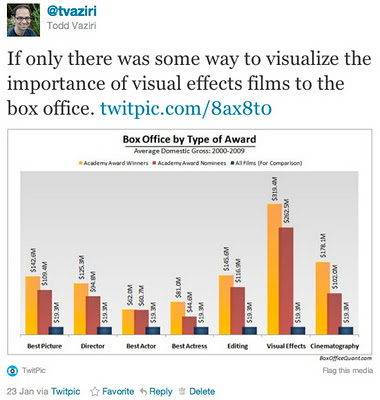
If only there was some way to visualize the importance of visual effects films to the box office. http://twitpic.com/8ax8t0
The above chart was made by the website BoxOfficeQuant.com, which, as many pointed out, only chose certain categories to chart, since they made the chart to support a specific point in one of their articles.
This inspired me to make my own, complete chart, customized to include everything I wanted to see. I wanted to visualize the average global box office take of each of the nominees of each category of the 84th Academy Awards. I had an idea of how the graph would ultimately turn out, but I wasn't expecting it to be this lopsided. Click here to see a larger version of the chart.

Now, I can happily, confidently and completely say that visual effects films have a significantly higher box office take than any other Oscar category for this year's 84th Academy Awards. The average nominee for Best Visual Effects earned over $662 million in global box office.
This should surprise virtually no one. Visual effects get people into the theaters. Our amazing images, brilliant spectacles, and never-before-seen worlds are the new movie stars, not just domestically, but globally.
To be fair, the Academy usually rewards actors and directors of prestige pictures with nominations-- films that don't typically earn hundreds of millions of dollars. I think it is, however, significant to illustrate this idea - out of all of these important categories of filmmaking that the Academy wishes to celebrate with awards, it is clear the visual effects branch's films are doing the heavy lifting of selling tickets around the world, lifting the industry.
It also illustrates the sad state of the visual effects community. The average Oscar nominee for visual effects made over $662 million globally, and yet our industry has relatively little power in Hollywood.
Some notes: Had this been a typical year, the Animated Feature average would have been much higher, since two out of the five nominees from this year have yet to see a wide release. But even if those two nominees made, say, $350M globally, it wouldn't have pushed the average even close to the visual effects average of $662M. Also, the Makeup category was significantly bolstered by the inclusion of "Harry Potter 7.2" (which currently has a global box office take of $1.3 billion), which offset its two very modest fellow nominees, "The Iron Lady" and "Albert Nobbs" (which has yet to have a wide release).
And, just to state the obvious, it would be interesting to see what this chart looks like for, say, the last 10 years of Academy Awards, to see if this years' chart is an anomaly, or if this is a good reflection of a decade's worth of data.
Showing my work; a CSV of the data is here.
Tuesday, January 31, 2012
Ghost Protocol

I’m overwhelmed by the positive response audiences have given “Mission: Impossible - Ghost Protocol”. The folks that had a chance to enjoy the film in a real IMAX theater were treated to an exceptional experience - nearly 30 minutes of the film is presented in true IMAX, with entire sequences filmed with the large-format camera, giving audiences a unique, immersive experience that is, personally, far more intriguing than 3-D.
I was compositing supervisor for Industrial Light & Magic, which provided around 650 visual effects for the film, and I’m extraordinarily proud of the entire team. The vast majority of our shots were intended to be invisible -- our goal was to stay out of the way of the storytelling and let the scenes play out without the effects calling attention to themselves. I had a blast working again with John Knoll, our visual effects supervisor, Lindy DeQuattro, our associate visual effects supervisor, Hayden Landis, our Digital Production Supervisor, and our teams at ILM in San Francisco and Singapore and all our facility partners. I offer humble thanks to all of them for a once-in-a-lifetime experience.
I’ve never had a greater impact on a film before, and I’m so proud to be associated with such a great film. I was lucky enough to catch a screening in IMAX, and really enjoyed the movie. In visual effects, we consider ourselves lucky if we get to work on one really, really good film in our entire career. I’ve been lucky enough to work on a few of them, and “MI4” ranks among my favorite films to which I’ve contributed. It was my second "Mission: Impossible" film, my first IMAX film, and my tenth anamorphic film.

Here’s a snapshot of how Brad Bird’s directorial debut has been received by the public:
Box Office
As of January 31, 2012, the film has grossed nearly $572 million dollars. Its $203 million dollar take in North America makes it the seventh highest grossing film of 2011. (It will most likely overtake “Fast Five” at number six, with $209M.) “MI4” is the highest grossing “Mission: Impossible” film, globally, and will most likely become the highest grossing Tom Cruise film of all time, toppling “War of the Worlds”.
Critical Acclaim
For the fourth entry of a franchise based on a television show, “MI4”’s 93% Tomatometer rating is through the roof. The Rotten Tomatoes summary is as follows: "Stylish, fast-paced, and loaded with gripping set pieces, the fourth Mission: Impossible is big-budget popcorn entertainment that really works."
Visual Effects Coverage
We were blown away when we were invited to present our film at the visual effects Academy Bake-Off, which featured ten films competing for five nomination slots. “MI4” was included in a list that also featured “Transformers 3” and “Rise of the Planet of the Apes”. Although we didn’t get a nomination, we were grateful for the opportunity to go to the bake-off and show our reel.
Cinefex and Jody Duncan will cover “MI4” in its April 2012 issue, which should make for a great read.
The Daily interviewed John Knoll to discuss the film’s visual effects.
FXGuide and Mike Seymour expand on The Daily’s coverage with a more extensive interview with John Knoll.
Vincent Frei at Art of VFX also talks to John about the film.
Over at The VFX Show podcast, Mike Seymour, Matt Leonard and Jason Diamond go over the visual effects of “MI4” with a fine tooth comb for nearly 70 minutes, and have some really nice things to say about them.
And if you’re at all interested in how the film was shot, please read this profile of cinematographer Robert Elswit, the man behind the photography of “There Will Be Blood”, on how he shot “MI4” on film with 35mm and IMAX cameras.
Thursday, December 15, 2011
"Mission: Impossible - Ghost Protocol"

I can't tell you how happy I am that the early reviews of Brad Bird's "Mission: Impossible - Ghost Protocol" are so positive. We worked very hard on this picture, and Bird was an ingenious and gracious collaborator.
Industrial Light and Magic provided the film's visual effects, supervised by John Knoll, with Lindy DeQuattro as our associate visual effects supervisor. I served as the film's compositing supervisor.
The project was an exhilarating creative experience for me, and I hope I'll be able to talk more about it in future posts.
Oh, and if you plan on seeing the film, try to make it to an IMAX screening. Several of the film's big action sequences were filmed with IMAX cameras, which includes lots of ILM effects work as well. It will be worth the extra effort.
Sunday, February 20, 2011
Oscar Pool Ballot
 It's time for the Awesomest Oscar Pool Ballot In The History Of Oscar Pool Ballots.
Each year I create a special ballot based on the oscar.com printable ballot -- but on my ballot, each category has a different point value. The highest valued category is "Best Picture," while the mainstream films' categories are valued at two points. The non-mainstream categories (like the documentary and short film categories) are valued at one point.
This way, in a tight race for the winner, the winner most likely would not be determined by the non-mainstream films (i.e., blind guesses).
Download the ballot here and use it at your Oscar party.

And if you're wondering why Tom Cruise is on my ballot... he's on every one of my Oscar ballots. Because he's soooo cool.
Tuesday, January 25, 2011
And the Nominees Are...
 For the first time ever, the visual effects category of the Academy Awards is filled with five nominees (rather than the traditional three).
Here are the nominees for Achievement in Visual Effects, for the 83rd Academy Awards:
Alice in Wonderland
Ken Ralston, David Schaub, Carey Villegas and Sean Phillips
Harry Potter and the Deathly Hallows Part 1
Tim Burke, John Richardson, Christian Manz and Nicolas Aithadi
Hereafter
Michael Owens, Bryan Grill, Stephan Trojanski and Joe Farrell
Inception
Paul Franklin, Chris Corbould, Andrew Lockley and Peter Bebb
Iron Man 2
Janek Sirrs, Ben Snow, Ged Wright and Daniel Sudick
Ken Ralston, David Schaub, Carey Villegas and Sean Phillips
Harry Potter and the Deathly Hallows Part 1
Tim Burke, John Richardson, Christian Manz and Nicolas Aithadi
Hereafter
Michael Owens, Bryan Grill, Stephan Trojanski and Joe Farrell
Inception
Paul Franklin, Chris Corbould, Andrew Lockley and Peter Bebb
Iron Man 2
Janek Sirrs, Ben Snow, Ged Wright and Daniel Sudick
The Awards will be broadcast on Sunday, February 27, 2011 on ABC.
Wednesday, May 19, 2010
Hell Has Frozen Over
 After years of relentless begging and pleading from people who know what they're talking about, the visual effects branch of the Academy of Motion Picture Arts and Sciences has finally, finally approved the expansion of the number of nominees for the Academy Awards from three to five films.
With the overall quality of feature film visual effects achieving new heights over the past 20 years, this decision, while awesome, comes much too late. Far too many films that deserved visual effects nominations were left nomination-less because of the branch's bizarre devotion for three nomination slots.
The visual effects branch's decision needs to be approved by the Rules Committee and Board of Governors. Hopefully, this will mean that the 83rd Academy Awards will feature five nominees for Best Visual Effects. Finally.
It is unknown, at this time, what this will mean to the two-step procedure of determining the 'bake-off' roster, or to the 'bake-off' itself.
And what will this mean to The VFX Predictinator, our totally awesome formula that accurately predicted the visual effects Oscar winner across 21 years? It will require a serious overhaul, since many of the formulas are dependent on the assumption of three nominees. More likely than not, we'll have to come up with an all-new formula.
Friday, March 05, 2010
Oscar Pool Ballot
 Having an Oscar party this weekend? Want to liven things up with a pool? If so, use this ballot I created for my Oscar party.
Every year I create a special ballot based on the oscar.com printable ballot -- but on my ballot, each category has a different point value. The highest valued category is "Best Picture," while the mainstream films' categories are valued at two points. The non-mainstream categories (like the documentary and short film categories) are valued at one point.
This way, in a tight race for the winner, the winner most likely would not be determined by the non-mainstream films (i.e., blind guesses).
To download the ballot, click here.

And if you're wondering why Tom Cruise is on my ballot... he's on every one of my Oscar ballots. Because he's soooo cool.
Tuesday, February 02, 2010
And the Nominees Are...
Here are the nominees for Best Visual Effects for the 82nd Academy Awards:
 “Avatar”
 “Avatar”
Joe Letteri, Stephen Rosenbaum, Richard Baneham and Andrew R. Jones
 "District 9"
Dan Kaufman, Peter Muyzers, Robert Habros and Matt Aitken
 "District 9"
Dan Kaufman, Peter Muyzers, Robert Habros and Matt Aitken

“Star Trek”
Roger Guyett, Russell Earl, Paul Kavanaugh, Burt Dalton
Subscribe to:
Posts (Atom)
