Showing posts with label James Cameron. Show all posts

Friday, April 18, 2025

The Keys, Locks and Doors of "Terminator 2"

There are a LOT of keys, locks and doors in "Terminator 2: Judgment Day" (1991), so I made a video in 2022 highlighting every major key, lock and door in the movie. It's fun. You should watch it.

watch on YouTube

Turns out, it's a really fun study not only of the importance that Jim Cameron's script placed on keys, locks and doors in defining the physical spaces of the movie, but also it's a study of the incredible sound design of the film, headed up by sound designer Gary Rydstrom.


Friday, February 21, 2025

The Directors of Visual Effects Oscar Winning Films, 1977-2024

James Cameron, directing "Titanic" (1997)

updated 3/4/25 for the 97th Academy Awards, with Denis Villeneuve snagging another VFX Oscar.

I've compiled a list of the directors of Academy Award-winning films for the visual effects trophy. Do with this as you will.

For me, when looking at this list of nearly fifty years of visual effects Oscar wins, I think one can see trends of the types of films (and directors) that make films that win the ultimate VFX award.


The Directors of Visual Effects Oscar Winning Films, 1977-2024

  • 1977 - George Lucas, “Star Wars”
  • 1978 - Richard Donner, “Superman”
  • 1979 - Ridley Scott, “Alien”
  • 1980 - Irvin Kershner, “The Empire Strikes Back”
  • 1981 - Steven Spielberg, “Raiders of the Lost Ark”
  • 1982 - Steven Spielberg, “E.T. the Extra-Terrestrial”
  • 1983 - Richard Marquand, “Return of the Jedi”
  • 1984 - Steven Spielberg, “Indiana Jones and the Temple of Doom”
  • 1985 - Ron Howard, “Cocoon”
  • 1986 - James Cameron, “Aliens”
  • 1987 - Joe Dante, “Innerspace”
  • 1988 - Robert Zemeckis, “Who Framed Roger Rabbit”
  • 1989 - James Cameron, “The Abyss”
  • 1990 - Paul Verhoeven, “Total Recall”
  • 1991 - James Cameron, “Terminator 2: Judgment Day”
  • 1992 - Robert Zemeckis, “Death Becomes Her”
  • 1993 - Steven Spielberg, “Jurassic Park”
  • 1994 - Robert Zemeckis, “Forrest Gump”
  • 1995 - Chris Noonan, “Babe”
  • 1996 - Roland Emmerich, “Independence Day”
  • 1997 - James Cameron, “Titanic”
  • 1998 - Vincent Ward, “What Dreams May Come”
  • 1999 - The Wachowskis, “The Matrix”
  • 2000 - Ridley Scott, “Gladiator”
  • 2001 - Peter Jackson, “The Fellowship of the Ring”
  • 2002 - Peter Jackson, “The Two Towers”
  • 2003 - Peter Jackson, “The Return of the King”
  • 2004 - Sam Raimi, “Spider-Man 2”
  • 2005 - Peter Jackson, “King Kong”
  • 2006 - Gore Verbinski, “Pirates of the Caribbean: Dead Man’s Chest”
  • 2007 - Chris Weitz, “The Golden Compass”
  • 2008 - David Fincher, “The Curious Case of Benjamin Button”
  • 2009 - James Cameron, “Avatar”
  • 2010 - Christopher Nolan, “Inception”
  • 2011 - Martin Scorsese, “Hugo”
  • 2012 - Ang Lee, “Life of Pi”
  • 2013 - Alfonso Cuaron, “Gravity”
  • 2014 - Christopher Nolan, “Interstellar”
  • 2015 - Alex Garland, “Ex Machina”
  • 2016 - Jon Favreau, “The Jungle Book”
  • 2017 - Denis Villeneuve, “Blade Runner 2049”
  • 2018 - Damien Chazelle, “First Man”
  • 2019 - Sam Mendes, “1917”
  • 2020 - Christopher Nolan, “Tenet”
  • 2021 - Denis Villeneuve, “Dune”
  • 2022 - James Cameron, “Avatar: The Way of Water”
  • 2023 - Takashi Yamazaki, “Godzilla Minus One”
  • 2024 - Denis Villeneuve, “Dune: Part Two”


Steven Spielberg, directing "Raiders of the Lost Ark" (1981)

Directors with Multiple Wins

  • 6 - James Cameron
  • 4 - Steven Spielberg
  • 4 - Peter Jackson
  • 
3 - Christopher Nolan
  • 3 - Robert Zemeckis
  • 3 - Denis Villeneuve
  • 2 - Ridley Scott

Peter Jackson, directing "The Return of the King" (2003)

Directors with Visual Effects Experience

  • 6 - James Cameron (artist, models, founded VFX company)
  • 4 - Peter Jackson (founded VFX company)
  • 1 - David Fincher (VFX artist)
  • 1 - Gore Verbinski (VFX artist)
  • 1 - Takashi Yamazaki (VFX supervisor)
  • 1 - George Lucas (founded VFX company)
  • 1 - Roland Emmerich (founded VFX company)


Wednesday, September 12, 2018

An Editing Trick in "Terminator 2" and "The Road Warrior"


To add impact to a shocking moment of extreme violence, director Jim Cameron and the editors of "Terminator 2" used a very old-fashioned, low-tech editing trick.


A single frame of solid white was added into the edit precisely at the moment of impact. Nestled within a predominantly dark sequence, the quick 1/24th-of-a-second flash of bright light shocks the audience and makes the moment that much more striking.


"Mad Max 2: The Road Warrior" (1982): another example of adding a single bright frame in the middle of the edit to intensify a moment of personal violence.


Unlike the "T2" example, the frame is a single frame of overexposure (rather than a white solid color).


There's also jump cut to a different take a just before the head butt, which is hardly noticeable in real-time, especially with the added subsequent flash frame.


Another example from "The Road Warrior", again with a single frame of overexposure to punctuate the impact.


Tuesday, July 27, 2010

"Back To The Future" and The VFX Show

Recently, I had the pleasure of discussing the visual effects of the Robert Zemeckis classic, “Back to the Future” on The VFX Show podcast. Mike Seymour and Mark Christiansen and I spent nearly an hour discussing and dissecting not only the film itself, but the impressive visual effects, special effects and makeup work on the film.

The VFX Show - Mike Seymour, Todd Vaziri & Mark Christiansen
revisit “Back To The Future"

show #105, July 20, 2010

Tunes link \ The VFX Show on FXGuide \ Overcast link

“Back to the Future” was an extremely influential movie for me. It’s the movie that inspired my passion of filmmaking, while the films of James Cameron opened my eyes to the possibilities and opportunities of visual effects. It was my privilege to appear on the show, and I want to thank Mike and Mark for inviting me.

I plan on posting some follow-up articles here on FXRant that expand upon some of the comments we made about the movie. [update: here are two additional posts!]


Friday, January 22, 2010

More About ILM and "Avatar"

Thank you so much to everyone who wrote me with kind words on our VES Award nomination. Even though there are four names associated with the nomination for Outstanding Compositing in a Feature Motion Picture (Jay Cooper, Beth D'Amato, Eddie Pasquarello and Todd Vaziri), the nod belongs to the entire ILM team that worked on "Avatar." Our ILM work for the film was also nominated for Best Single Visual Effect of the Year, for the Quaritch Escape (Jill Brooks, John Knoll, Frank Losasso Petterson and Tory Mercer).

The full credits for the film are here: Avatar: How Many People Does It Take To Make A Movie?, from the Birmingham Sunday Mercury, where you'll see the full visual effects credits for Weta Digital, ILM, Framestore, Prime Focus, Hybride, hy*drau"lx, Buf, Lola Visual Effects, Look Effects, Pixel Liberation Front, and Spy Post. Putting this ambitious film together took the skill, artistry and talent of hundreds upon hundreds of individuals, as you'll see when you read through the credits.

Who do the ILM nominations belong to? The folks listed below: the ILM team for "Avatar."

Visual Effects & Animation by
INDUSTRIAL LIGHT & MAGIC

A Lucasfilm Ltd. Company


ILM Visual Effects Supervisor JOHN KNOLL

ILM Animation Supervisor PAUL KAVANAGH

ILM Visual Effects Producer JILL BROOKS

Digital Production Supervisor MICHAEL DICOMO

Compositing Supervisor EDDIE PASQUARELLO

CG Supervisors PAT CONRAN
PHILIPPE REBOURS DAVID WEITZBERG
Digital Matte Supervisor RICHARD BLUFF

Digital Model Supervisors DAVE FOGLER BRUCE HOLCOMB

Viewpaint Supervisor RON WOODALL

Creature Supervisor KARIN COOPER

Layout Supervisor JOHN LEVIN

Roto and Paint Supervisor BETH D'AMATO

Sequence Supervisors
JAY COOPER, THOMAS FEJES, JEN HOWARD, TORY MERCER, MARK NETTLETON, GREG SALTER, ROBERT WEAVER


Digital Artists Leads

FRANCOIS ANTOINE, JASON BILLINGTON, YANICK DUSSEAULT, CHRIS FOREMAN, CHRISTOPHER HORVATH, FRANK LOSASSO PETTERSON, JOHN SIGURDSON, JIM SOUKUP, TODD VAZIRI, DAN WHEATON


Digital Artists

JOAKIM ARNESSON, JEREMY BLOCH, AMANDA BRAGGS, TRIPP BROWN, CATHERINE BURROW, KELA CABRALES, MICHAELA CALANCHINI CARTER, JEREMY CANTOR, TAMI CARTER, LANNY CERMAK, GRADY COFER, MIKE CONTE, MICHAEL CORDOVA, TIM DOBBERT, SELWYN EDDY III, CONNY FAUSER, SIMON FILLAT, SHINE FITZNER, BRIAN FLYNN, TIM FORTENBERRY, MARIA GOODALE, DAVID GOTTLIEB, GILES HANCOCK, TREVOR HAZEL, SHERRY HITCH, PEG HUNTER, JIRI JACKNOWITZ, PATRICK JARVIS, RYAN L. JONES, KIMBERLY LASHBROOK, ASIER LAVINA, HILMAR KOCH, MARSHALL KRASSER, DAVID MARSH, TIA MARSHALL, MARCEL MARTINEZ, KENT MATHESON, JOSEPH METTEN, CARLOS MONZON, DAVID MORRIS, TIM MUELLER, MYLES MURPHY, DAVID NAKABAYASHI, MARLA NEWALL, BEN O'BRIEN, AKIRA ORIKASA, COS¸ KU ÖZDEMIR, SCOTT PRIOR, EDWARD QUINTERO, MICHAEL RICH, ANTHONY RISPOLI, SHANE ROBERTS, ELSA RODRIGUEZ, BARRY SAFLEY, JEFF SALTZMAN, STEVE SAUERS, JERRY SELLS, JOE STEVENSON,
FLORIAN STROBL, ALAN TRAVIS, YUSEI UESUGI, NOAH VICE, KELLY WALSH, DAVID WASHBURN, TALMAGE WATSON, SCOTT YOUNKIN, DEAN YÜRKE, RITA ZIMMERMAN

Animators
JEREMY CANTOR, JEAN-DENIS HAAS, ALEX LEE, ERIK MORGANSEN, STEVE RAWLINS, GREG TOWNER, TIM WADDY, ANDY WONG, JOHN ZDANKIEWICZ


Digital Models and Simulation

LEIGH BARBIER, ANDY BUECKER, DAVID DEUBER, KALENE DUNSMOOR, CHRIS EVANS, CHRIS HAVREBERG, KELVIN LAU, SEUNGHUN LEE, GREG MAGUIRE, SCOTT MAY, STEVE SAUERS, AARON WILSON

Visual Effects Editor JIM MILTON
Production Coordinators STACY BISSELL, MARISSA GOMES

Production Assistants KAT BACHERT, LEE BRIGGS

Production Support MELISSA DE SANTIS, PETER LEBER, MIKE McCABE, PETER NICOLAI, JULIAN SALVADOR, JEROME SOLOMON, MARCI VELANDO, KEVIN WONG

Technical Support SEAN BITTINGER, CHANTELL BROWN, KAI CHANG, RAYMOND CHOU, GEORGE GAMBETTA, SHAHZAD KHAN, FRANKIE KWAK, SAM PENROSE, JESSICA RIEWE

Research & Development AARON ELDER, RONALD MALLET, ROBERT MOLHOLM, JOHN OLMSTEAD, POITR STANCZYK, STEVE SULLIVAN

ILM Executive Producer GRETCHEN LIBBY

ILM Senior Staff LYNWEN BRENNAN, CHRISSIE ENGLAND, CURT MIYASHIRO

Tuesday, January 19, 2010

"Avatar" and ILM

Hi, folks. Here's my big "Avatar" post, and there will probably be a few more about James Cameron's film in the coming weeks.

The overwhelming global box office dominance of "Avatar" continues, and with it, more stories about the process of creating the world of Pandora and its inhabitants are hitting newsstands. The industry leader of visual effects journalism is Don Shay's Cinefex, whose magazine which has inspired legions of visual effects fans and professionals (myself included). Cinefex #120, the January 2010 issue, covers "Avatar," along with "The Road" and "2012."

As an aside, the magazine also features the most astounding quote I've read in some time. "2012" visual effects supervisor Volker Engel describes Roland Emmerich's script for the disaster film: "... we though it was the best script that we ever got from Roland. It worked on so many levels, not just 'let's destroy everything we can and make it visually fantastic.' The characters worked well, and there were some very emotional moments [in the script]." Did he just say that with a straight face?

An image from Roland Emmerich's "2012." A fast, efficient way to anger Todd Vaziri is to add anamorphic lens flares to a non-anamorphic film.

Jody Duncan's Cinefex article on "Avatar" goes into great detail on how Weta Digital interpreted James Cameron's vision, and is the definitive text on the film's visual effects. As described in the article, with about a year remaining to deliver the final picture, Cameron and Weta awarded some 600 shots to other visual effects shops, including Industrial Light & Magic, which took on over 180 shots. The ILM shots were carefully chosen as to not contain any hero animation work (which was being completed at Weta), and heavily featured vehicles, certain Pandora environments, and battle sequences. The division of labor was crafted to be as logical as possible-- but it still required an extraordinary amount of coordination and cooperation between Weta, ILM and other vendors who shared assets, in order to make the work as seamless as possible. In the final film, you might see two Weta shots, then two ILM shots, then Weta and ILM shots back-to-back. We spent a great deal of time ensuring a seamless blend of our work; our hope was that audiences felt no perceptible change in quality, texture or feel between the different vendors' effects shots.

Due to the overwhelming amount of innovation involved with Weta's work on the film, the vast majority of Duncan's article focuses on Cameron and Weta's collaboration, but only has a few paragraphs about ILM's involvement. We're very proud to have six our our images published within the article.


Since "Avatar's" release, several articles about the films' visual effects have appeared to supplement the Cinefex article. A snapshot of these articles includes: VFXWorld, Cameron Geeks Out On "Avatar," VFXWorld, "Avatar," The Game Changer, and 30 Ninjas, Three-Part Interview with "Avatar's" John Bruno.

And then there's this CNet article, which is the only article I have yet to find that specifically focuses ILM's work on the film: CNet: ILM steps in to help finish 'Avatar' visual effects.

That headline makes me squirm, since the reader might get the wrong impression, as if the folks at Weta needed 'rescuing.' Headlines, by their very nature, only give you the slightest impression of the story, and tease you to read on. But I pushed this squirmy feeling aside, chalking it up to my increased sensitivity to visual effects journalism.

For the most part, the article by Daniel Terdiman does a nice job of giving an overview of ILM's work. He interviewed ILM visual effects supervisor John Knoll, and even gave more details on our work than the Cinefex article. For example:

For the most part, the teams at ILM and Weta worked on different scenes, but Knoll said there were some in which the two companies handles different parts of the same sequence. An example, he said, was a scene in the film where a group of helicopters attack the giant "home tree," where the Navi, the humanoid alien race in the film, live. Knoll said that the effects in the scene were mainly put together by Weta, but ILM handled all the shots in which the camera looks back toward the choppers. In the scenes where the two effects houses both were charged with creating shots, the challenge was figuring out how to "checkerboard" the shots, Knoll said, especially because in some cases, ILM didn't know what Weta's work looked like. "You keep cutting back between ILM shots and Weta shots," Knoll said. "They're really intermixed. I was worried, because we had to get going and go pretty far down the line before we had any Weta shots to refer to. We were both doing development in parallel."

However, near the top of the article, there was this unfortunate paragraph:

Weta Digital... was a bit in over its head. For ILM, this wasn't the first time it had been called in to help rescue another effects house, but it may well have been the first time it did so for one as big and as accomplished as Weta. And while ILM's overall contribution to the finished film was minor compared to Weta's, the fact that "Avatar" came out on time and is being seen as a visual tour de force is certainly due, in part, to ILM's ability to come in and, if not save the day, at least contribute mightily to the day turning out well.

911 work by its very nature is a sensitive issue for effects houses. The situation is nothing new (effects houses have been collaborating to finish a film for decades), but with the current climate of filmmakers demanding ever-increasingly difficult work and studios continuing to shrink post-production schedules, 911 work is as frequent as ever. As aggressive as effects houses need to be during the bidding process, we all respect one another and realize we are part of the same family. We all understand that, in most cases, when an effects house becomes overburdened with an impossible-to-complete body of work, it usually has more to do with studios and filmmakers' failure to accurately predict the scope of the work (combined with inexcusably small effects budgets), rather than failure on the effects' houses end.

Thankfully, a few days after the original publication of the original CNet article, the controversial paragraph was significantly altered, along with the following end note:

For ILM, this wasn't the first time it had been called in to help aid another effects house, but it may well have been the first time it did so for one as big and as accomplished as Weta. To be sure, ILM's overall contribution to the finished film was minor compared to Weta's, but nonetheless critical in helping get the film to its final, finished state, Knoll suggested.

footnote: The fifth paragraph in this story was updated on December 22 to better reflect Knoll's statements of how and when ILM came to be involved in "Avatar" and what the company's impact on it was.

The new, altered fifth paragraph of the story gives a slightly more accurate description of how ILM came to work on "Avatar," but does not expand on the delicate sensitivities involved with 911 work in our industry. And the article still contained the unfortunate phrase "Weta was a bit in over its head." Perhaps, someday, someone will write an essay on this aspect of the visual effects industry. The issue of 911 work is not only emotionally heated but can be economically dangerous. No effects house wants to ever appear as though they cannot deliver work on time and on budget, without the risk of losing out on future studio work. The issue is a public-relations minefield, and will probably remain shrouded in mystery, silence, and remain in the shadows (yet openly and frankly discussed privately amongst visual effects professionals).

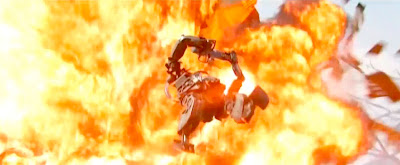
Back to the CNet story. Since its original publish date, the CNet article was apparently syndicated to other websites, several of which apparently decided to re-write the headline. After a copy of the article appeared on several dozen other news websites, we were quite shocked to read an article headlined "How ILM Rescued Avatar's Special Effects," which was a popular rewriting of the original headline (here's an example). Although the content of the article was identical, the headline, as it appeared in other venues, went from 'nearly inaccurate' to 'completely inaccurate.' ILM was brought on to help finish the movie, not to 'save' or 'rescue' the film. This wrong implication out in the world does nothing to help ILM's reputation. The syndicators' rewriting of an already painful headline was unfortunate.

And, to add insult to injury, some of the re-printed, syndicated versions of the article have the original, controversial, 'save the day' fifth paragraph intact. Ugh.

The artists at ILM were very proud and grateful to have made a contribution to James Cameron's vision, and were astounded and amazed by Weta Digital's extraordinary work. It's a shame that the CNet article had to unfold in a shoddy manner.

A much more detailed and tech-heavy exploration of ILM's work on "Avatar" took place in a recent FXGuide podcast. Make sure you listen to FXGuide's January 15 podcast, where Mike Seymour interviews John Knoll, and goes deep into the specifics of our body of work, as well as a lengthy discussion of stereo 3D techniques (scroll down to the "Avatar: ILM" podcast). FXGuide podcast host John Montgomery actually mentions the CNet article in his introduction to the interview, concurring that the tone of the article was not faithful to the collaborative spirit of the work.

Friday, November 20, 2009

James Cameron's "Avatar" Trailer

Yeah, it's a few weeks late, but I've been a bit busy finishing a film. On an unrelated note, the final trailer for James Cameron's "Avatar" is out in the world, and the Randomizer 2009™ software was cranked into overdrive and selected two images from the trailer.

Hey, didn't this shot look a little different in the teaser?

View the trailer here.

Thursday, August 20, 2009

James Cameron's "Avatar" Teaser


update:
Please read the new FXRant post, "'Avatar' and ILM" to learn more about ILM's work on the film.

Looking back at the last few posts, it seems like I nearly leapfrogged over an entire production on which I worked. It's almost as if "Transformers 2" didn't even happen, as if it is being erased from our collective consciousness. Huh. Imagine that.

Anywhoo, the highly anticipated teaser for James Cameron's "Avatar" is now available online. And the image above was chosen by the Randomizer 2009™ software, featuring ArbitraryBoost 3.0.

View the teaser here.

Sunday, March 02, 2008

VFX HQ Updated... No, I'm Not Joking

Okay, so I really only updated one page, the Academy Awards section of Visual Effects Headquarters that lists every visual effects Oscar winner and nominee since 1939. I've added "The Golden Compass," "Transformers," and "Pirates of the Caribbean: At World's End" to the list of Academy honors.

The Awards section is the only section that gets regular updates, since these pages scream out to be up-to-date... even though no new reviews appear on the site. But whenever a reader (and there are still thousands of readers of VFX HQ each week) points out an error on the site, I'm fast to correct it. Feel free to continue sending in typos, errors in credits, and overwhelmingly egregious grammatical errors.

I still stand by my opinions and reviews that are featured on VFX HQ, and am particularly fond of revisiting some of my old articles (even though my sometimes amateurish writing style makes me cringe). Here's one of my favorite codas that I wrote for the site, where after reviewing the effects for a particular film, I comment on the film itself.

Here's a snippet from my coda from James Cameron's "Titanic":

There are probably dozens of shots of the film's 600+ effects shots that will never be noticed--interior CG water, CG props, countless wire removals, rig, light, prop and character erasures, miniature interior sets, even body part erasures--all of which add to the rich visual tapestry created by director Cameron. The visual effects of TITANIC are like no other film's; not only are they some of the finest, most original shots ever made, but they work with the story instead of being straightforward eye candy.

The style of TITANIC's visual effects will inexorably and rightfully be credited to Cameron, who has crafted his film with effects to propel his characters and to drive the narrative. He is one of a select few Hollywood directors who can not only write for visual effects, but who has the faith in the industry to create never-before seen imagery previously limited to his imagination... Cameron is a grand storyteller whose palette always includes a healthy batch of innovative effects, and for that, moviegoers (and the industry, itself) should be thankful.

And here's another coda, this time from my visual effects review of Michael Bay's "Armageddon":

ARMAGEDDON contains some of the most brilliant visual effects of the year. Unfortunately, it is surrounded by one of the most annoying films of recent memory. The film is a loud, obnoxious experience that runs far too long. Combined with this year's other turkey, GODZILLA, one thing becomes quite clear: effects artists are doing their jobs... why can't writers and directors?

update:
In that "Titanic" snippet, there existed one of those famous typos on the site. I spelled "Titanic" "Titainic." Yeah, it's been like that on the website for 11 years. Good stuff.

Thursday, November 29, 2007

Hand Held Cameras

I love how author David Bordwell launches into a topic and digs deep. One of his terrific articles is "Unsteadicam Chronicles," from his website. I don't necessarily agree with his viewpoints, but I adore how deeply involved he gets with his material.

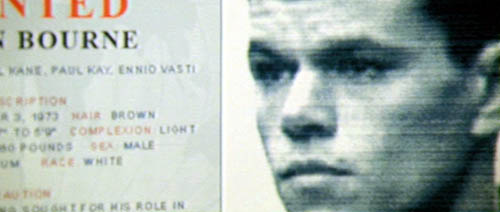
Personally, I thought the camerawork and cinematography of "The Bourne Supremacy" was brilliant. (Unfortunately, I haven't seen "Ultimatum" yet.) Like J.J. Abrams' "Mission: Impossible III," the Paul Greengrass' Bourne films, as well as Doug Liman's original Bourne film, are point-of-view superspy films, and the camerawork reflects this. In these cases, I believe that the handheld work does not camouflage or hide shoddy staging, set design, or acting (as his article suggests). The camera is moving as fast as our hero spy, and sometimes the speed is so intense that makes a scene abstract. I'm thinking primarily of "Supremacy's" car chase, with frequent cutting to blurry, intense Bourne-point-of-view shots.

However, as a general rule, I think is it paramount for a filmmaker to set up the geography of an action scene so that the audience can follow along with the choreography.

James Cameron is the undisputed master of orchestrating complex action sequences that take place over large expanses of space, and yet the geography is expertly laid out for the audience, allowing the audience to fully enjoy the sequence (see "Terminator 2," "True Lies," "Titanic," and "Aliens"). The opposite is true of Michael Bay, whose style suggests that every single shot is a hero shot, and its context is irrelevant ("Transformers," "Bad Boys II," "Armageddon").

As you may have guessed, I have a few articles in the pipeline concerning this subject. We'll be examining the construction of an action sequence from Cameron's "True Lies," as well as a scene from Bay's "Transformers," to illustrate how to create (and destroy) an audiences' sense of geography for an action sequence.