This is the first of a series of articles, titled "Films Every Visual Effects Artist Should Watch."
I have written many times about the need for visual effects artists to watch movies, particularly non-visual effects films. For those of us working in the realm of photorealistic visual effects, that is, visual effects whose goal is to blend into the world of the live-action film, it is essential for us to keep our eyes on the target of our efforts. Our target is photorealism - scenarios and characters that, ostensibly, have been photographed right alongside our actors on soundstages and on location, that help tell the filmmakers' stories. In this respect, I encourage young visual effects artists and seasoned artists alike to watch, break down and analyze non-visual effects films. Understanding what
is photorealistic will help artists
create photorealistic images. This ability is especially important for those in the disciplines of, but not limited to, model making (both CG and practical), texture painters, lighters, and compositors.
Watching and analyzing non-visual effects films will give artists the visual vocabulary of photorealism, and gives the artist the ability to answer questions like, "What makes this look real? What are the visual cues that force the audience to believe that character is standing there? What are the shadows doing in this shot?" One does not need to ask "Why" questions, as in "Why is that portion of the frame overexposed?" One needs to be more concerned with "What" questions.

A mastery of the visual cues that trigger our impulse to "believe in" an image is the single strongest tool in a visual effects artists' toolbox. And this is why every visual effects artist should watch
Ron Fricke's "Baraka."Created in 1992, "Baraka" contains moments of spectacular beauty and intimate humanity, both on an epic scale and in miniature proportions. And there are no visual effects in the film, which makes it a terrific candidate for visual analysis.

It's not a travelogue, nor a vanilla, large-format nature documentary. The film is an exploration of what it means to be a human being on this planet. Or not. One of the beautiful aspects of this dialogue-free film is its seemingly limitless expanse of interpretation. Ten people could watch this film and emerge with ten completely distinguishable interpretations of its meaning, or its central theme.

One thing is certain: the photography in "Baraka" is breathtaking. Photographed by Fricke in a 65mm film format, largely with available light with relatively fast setups in difficult locations with a tiny crew (usually three people, including Fricke), the shots in "Baraka" are stunning. The camera is largely sedentary (with long, lingering lockoffs, peppered with deliberate dolly moves), which allows the imagery to speak for itself. Fricke is an extraordinary cinematographer, and "Baraka" is his crowning achievement as a cameraman. (As an aside, I had the unique privledge of compositing some of Fricke's photography; for "Star Wars: Episode III," it was Fricke and his team who photographed the real lava blasts on Mt. Aetna in Italy, which we ultimately used as elements in the
Mustafar sequences for the film.)


Much has been written about "Baraka," so I will excerpt from a far-superior writer to get his take on the film. From Roger Ebert, who recently revisited "Baraka," crowning it one of his
"Great Movies":
The film consists of awesome sights, joyful, sad, always in their own way beautiful. By that I do not mean picturesque. A friend came into the room while I was watching the film, saw a closeup of the head of a Gila monster and said, "That's beautiful." I asked if she liked lizards. "I hate lizards," she said, shuddering. She wasn't thinking about lizards. She was observing the iridescent scales of the creature's head... Tiny bright plumes in a desert are revealed as the burning oil fields of Kuwait. Mothballed B-52 bombers reach to the horizon. Manhattan. Corpses are burned on the banks of the Ganges. Will they know the donkeys are pulling a cart much too heavy for them? They will probably understand mountains, waterfalls, volcanoes. Do we? "Baraka" is paced so we can contemplate the places we will never go, the places we are destroying, the places where we might find renewal. It is like a prayer.

Like Ebert writes, the deliberate pace of the film allows the viewer to not only absorb the images, but to contemplate their meaning. And this deliberate pace gives us an opportunity to study the imagery in unique ways.
Specifically, there are several things effects artists can take away from the film. For one, "Baraka" allows effects artists to see how scale is represented, both large and small. Notice the visual cues that the shots of Ayers Rock in Australia are giving the audience. How does this look different than, say, a one-foot dirt pile in the road?


The slow moving dolly shots allow artists to analyze the effects of parallax. When working within a 3D system, most of these technical decisions are made for you automatically. However, if you're designing a world, and are trying to convey a feeling of vastness, how you build the scale of your scene will dramatically affect the way it is interpreted by the audience if you are unaware of the power of parallax. (A lack of understanding can sometimes lead to visual effects shots where elements are placed in space in such a way that, when the camera moves, the audience feels like they're viewing billboards on cards of varying scale, rather than real-life objects placed realistically within a world.)

 One of the many deliberate, slow dolly shots in "Baraka," featuring skulls from one of the killing fields in Cambodia.
There are several shots in the film that feature group behavior, which is perfect for analysis for anyone who is tasked with creating synthetic crowd shots, either human or animal. Watch the poetic precision of Amazonian men dancing crosslegged, or the swirl of men walking around the Kaaba cube in Mecca, or the seated factory workers creating cigarettes in rows as far as the eye can see. For anyone who has to create crowd behavior, there is much to examine here.


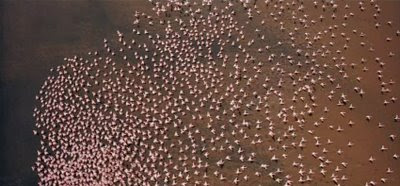


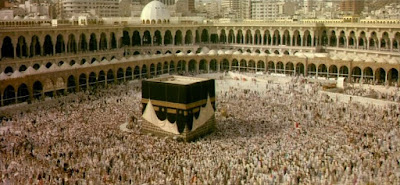
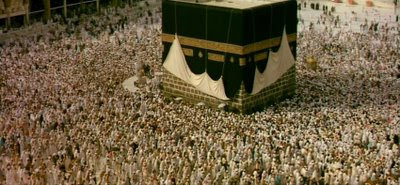
And for those who create synthetic environments, there is plenty to examine. Modern cityscapes, both crisp and new, and dilapidated and pathetic. Ancient ruins, religious temples, places of intense historical horror, and locales of deep spiritual significance. Also represented are elements of the earth; water, wind, sky and stars.
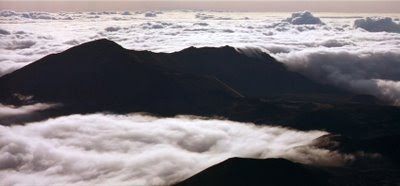


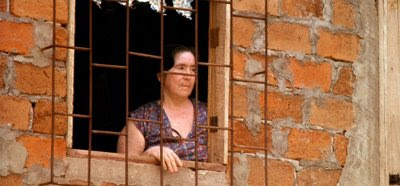

Although there are no optical tricks used in "Baraka" to enhance the film, one technological technique used to create certain shots involves a giant step in the evolution of time lapse photography. Several shots in the film feature extreme speed changes, both slow motion (running the film camera at a higher frame rate), and fast motion (running the film at a slower frame rate). Traditionally, these shots are from a locked off camera with a single exposure, which freezes the point of view. It's the time-lapse with which our eyes are quite familiar. The filmmakers behind "Baraka" added an additional element to their time lapse (fast motion) shots: a moving camera.
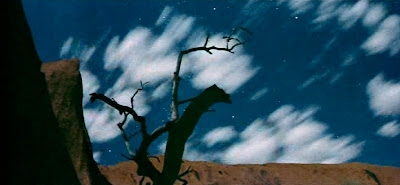
Using motion control dolly systems, the cinematographer was able to program a dolly/pan/tilt move on their time-lapse shots, which creates a unique viewing experience. The process is very much the inverse of so-called 'Bullet Time,' which features elaborate camera moves on slow motion shots. The "Baraka" team also had the capability to program exposure changes into their timelapse shots, which means they could photograph a single take that occurs over several hours and compensate for massive changes in light. This is especially important for the day-to-night time-lapse shots, such as the big city dolly into traffic, or the film's climax which features several moving camera time-lapse shots of canyons at night with starfields and clouds zipping past mountains.


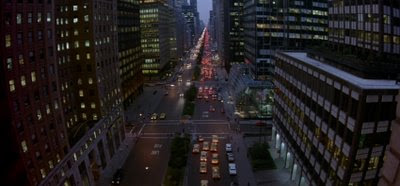
 In this amazing time-lapse shot, the camera slowly dollys forward through an open window to reveal the living, breathing city, just as the sun sets. The rhythmic pulsing of the synchronized street lights, along with the subtle soundtrack, imparts an ironic sense of organic life amidst a sea of concrete and steel. This motion control time-lapse shot is one of the most memorable scenes in the film.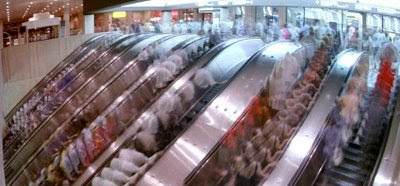


 "Baraka" also has fun with its editing style, frequently cross cutting between two very disparate scenarios, allowing the viewer to interpret its significance. In one of the showcase montages of the film, Fricke cross cuts between baby chicks placed on conveyor belts in preparation for their lives as egg hens, and various time-lapse shots of commuters around the world. This narration-less juxtaposition of images allows the viewer to interpret a message (if one exists), rather than having it spelled out by the artist.
Consistently, the photography of "Baraka" is honest and true. It provides a gold mine of inspiration for modern visual effects artists whose job it is to create honest and true images, both in the grand scheme and in specific terms.
Even though "Baraka" is a small, special-interest film that is over 15 years old, its following is strong. 70mm prints of the film show up at 70mm film festivals in big cities all the time. (Take a peek at
this schedule from
in70mm.com, which shows upcoming 70mm screenings from all around the world, and notice all of the "Baraka" listings.) I've personally seen it projected in 70mm in Chicago, Los Angeles and San Francisco. And the DVD of the film looks pretty darn good, as well. But for those of you with Blu-ray players, you're in for a special treat.
Recently, the film was painstakingly restored for future generations, creating a stunning new video transfer which is
now available on Blu-ray. Ebert wrote, "The restored 2008 Blu-ray is the finest video disc I have ever viewed or ever imagined. It was made from the Todd-AO print, which was digitally restored to a perfection arguably superior to the original film... 'Baraka' by itself is sufficient reason to acquire a Blu-ray player."
The Digital Bits wrote: "Quite simply, Baraka is the best looking live action Blu-ray release I have EVER seen. It's truly an extraordinary viewing experience... astonishing. [The] Blu-ray release of 'Baraka' is a landmark achievement for the format."

Over the years, I have been hesitant to toss a DVD of "Baraka" in front of someone who had never seen the film before, thinking that I would be giving them an abstract approximation of the film by showing them a crippled, low-resolution version of the film. And although the DVD is worth viewing, it cannot remotely get close to the experience of viewing this beautiful film in 70mm on a huge screen. In fact, I considered embedding video clips into this article, but ultimately decided against it for this same reason. However, with the superlatives being thrown around concerning the quality of the Blu-ray release, I can confidently recommend a home video option for viewing this exceptional film.


 These last three shots, scenes from the Ganges river in India, are ripe for visual analysis. In the middle image of the harbor, for example, notice how the atmosphere builds up over the depth of the shot, how the foreground boats have a richness of contrast, while the background boats and buildings appear contaminated with atmosphere. The lens is not particularly wide, but the sense of depth is palpable. The lower image, of bodies being cremated at the river's edge, is richly composed. We have areas of direct sunlight and shadow, various levels of smoke and fire, atmosphere that is patchy yet discernable, and people moving in and out of all of these elements. Visual effects artists are frequently tasked with creating these scenarios completely from scratch. If one analyzes rich, deep, authentic real-life shots like these, one will have a stronger toolset of techniques to help create realistic, plausible effects scenes.