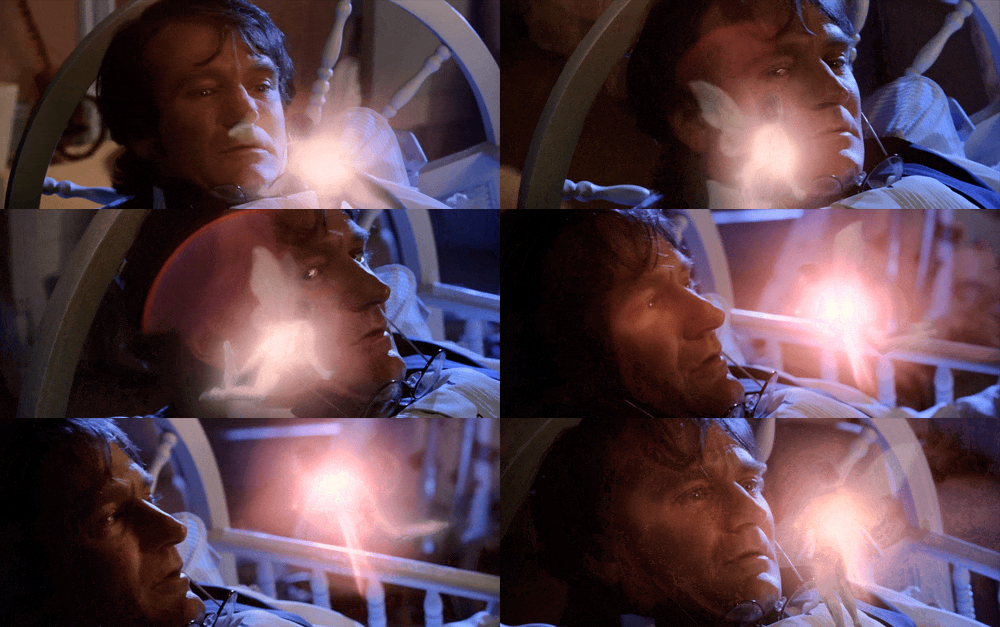
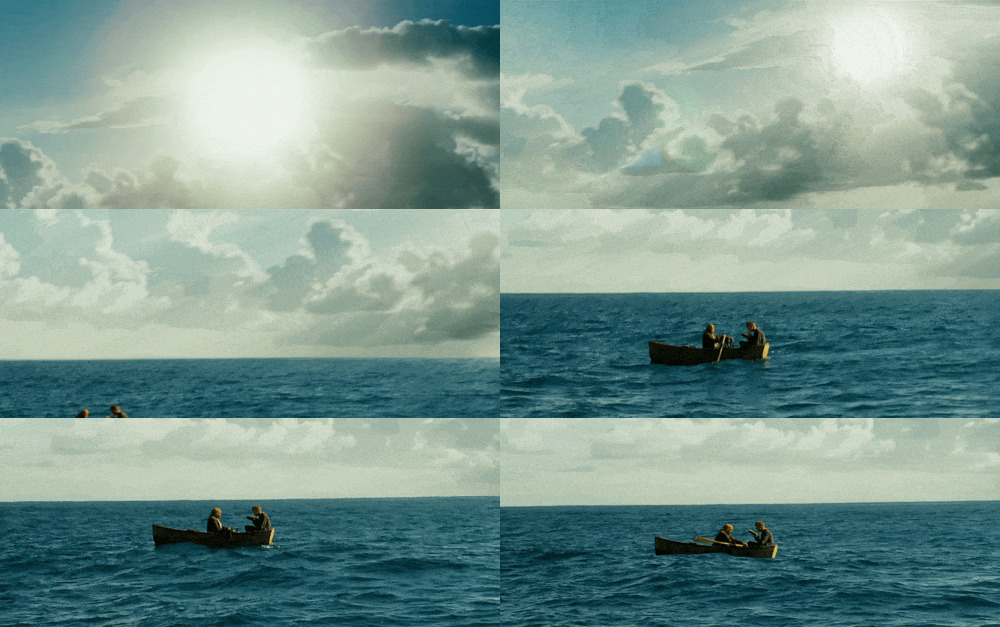
It was back in 2018 when I was a guest on a member special for Reconcilable Differences... and seven years later they asked me back! RecDiffs is one of my favorite podcasts, and it was again an honor to talk to my two friends John Siracusa and Merlin Mann about movies, parenting, podcasting, Letterboxd and a whole bunch of other stuff.
To hear this episode, you need to become a Relay member. Please consider joining the Relay community by signing up for a Relay membership.
Here's a clip from the episode where I ask John to stop referring to the movie tracking app as "Letterbox D":
Lighter Darker, The ILM Podcast’s first season comes to a close with Episode 20, our Lens Flare Extravaganza! Rob, Jenny and I are joined by John Knoll and Shannon Tindle to talk all about lens flares, those fun aberrations that occur within a lens when light rays shine at JUST the right angle. John talks all about the creation of Knoll Light Factory, the innovative and industry-changing software that allowed digital artists to create their own lens flares in Adobe Photoshop. Shannon talks about his flares in “Kubo” and “Lost Ollie” and we all talk about our favorite lens flares from movies we’re fans of, and flares that we’ve created.
The official show notes are ILM.com, but I wanted to add more visually-oriented show notes, and include clips from the shots that we discuss on the show.
Shannon makes mention of “Visions of Light”, the documentary directed by Arnold Glassman, Todd McCarthy and Stuart Samuels about cinematography that was deeply influential to me and how I look at movies. At some point, internet hero “Deus Ex Film Prof “ re-edited the entire documentary and swapped out old standard definition clips with much clearer and brighter high definition clips, which makes for a much more pleasant viewing experience.
“Cool Hand Luke” (1967)
“The Good, The Bad and the Ugly” (1966)
“Rango” (2011)
I didn't mention it on the show, but this flare from "Raiders of the Lost Ark" was also an inspiration for the "Rango" lens flare that I designed.
“Blade Runner” (1982)
“Close Encounters of the Third Kind” (1977)
“Star Trek” (2009)
Relevant article: Millimeter Magazine: Back on Trek, where director JJ Abrams, cinematographer Dan Mindel and VFX supervisor Roger Guyett talk about the lens flares of the movie, and even mention my lens flare work on the film. ILM Sequence Supervisor Todd Vaziri was responsible for developing the artificial lens-flare software system, which the company dubbed SunSpot. The system essentially combines off-the-shelf software, certain proprietary ILM tools, photographed elements, and several custom paint elements to painstakingly match the flares captured on the negative.
Relevant article: Post Magazine: “Star Trek” Returns, where Guyett and others discuss the visual effects lens flare work on the film. ILM's Todd Vaziri analyzed what anamorphic lenses do and all their different properties so they could be used in simulated shots and they call the resulting program "Sunspot." Vaziri was a sequence supervisor whose job was to overlook all the sequences and make sure that ILM's shots were "correct to the film" — that they matched. "He takes great, great pains and it shows," says [compositing supervisor Eddie] Pasquarello. "That was one of our compositing coups that I feel made a difference here — finishing touches that help our shots blend with the live action that J.J. gave us."
The first shot of the movie, composited by Greg Salter, lens flare design by Todd Vaziri
The last shot of the movie, composited by Todd Vaziri
The Vulcan Sun, shot composited by Francois Lambert, lens flares by Todd Vaziri
"2001: A Space Odyssey" (1968)
"Pirates of the Caribbean: Dead Man's Chest" (2006)
Two shots from "Pirates 2" that featured John Knoll's photographed flares.
“Kubo and the Two Strings” (2016)
Shannon's original storyboard frame for this shot.
"Lost Ollie" (2022)
"Raiders of the Lost Ark" (1981)
“Die Hard” (1988)
“Star Wars” (1977)
This is the shot that John and I roasted, indicating not only the two disparate light directions in the shot, but the fact that the foreground element (the Falcon) has been comped on top of lens flare elements which are being created inside the lens.
In March 2025, Jenny Ely and I interviewed John Knoll, the visual effects supervisor of "Star Wars: Skeleton Crew for Lighter Darker: The ILM Podcast. Listen to the show here — we also have extensive show notes and photos for that episode at the same link. Lighter Darker: The ILM Podcast, episode 14
In the episode, John refers to a shot that he's really proud of in our segment "One Final, One CBB" from "Pirates of the Caribbean: Dead Man's Chest", and a shot from the original "Pirates of the Caribbean" that he wished he could have approached differently for his CBB, so I've put those two shots on YouTube so you can see them with your eyeballs instead of imagining it with your ears and brain:
John talks extensively about his motion control unit he developed to film the miniature spaceship in "Skeleton Crew", and we added a lot of photos to the show notes. But you know what's better than photographs? An entire video, hosted by Adam Savage! It's really good!
watch "How ILM Films Star Wars Motion Control Spaceships!" on YouTube