Showing posts with label film. Show all posts

Thursday, May 14, 2026

A Scan of a 35mm Print is Not "Ground Truth"


I'd love to talk in much greater detail about this topic, because it's a wonderful and complicated and nuanced issue. In the meantime, here's a Bluesky post I made:


Posting an image of a 35mm print from a film as “ground truth” for color and tone is almost always ridiculous. Even brand new release prints vary from print to print, and prints deteriorate over time in different ways for various reasons. Plus the variables that exist when scanning a print.


Generally speaking, resist the urge to compare a "scan of a 35mm print" to a "screenshot of the 4K" or whatever, because at that point you might as well compare two different iPhone photos taken of a movie in a dark theater. The comparison is giving you less information and clarity (ha!) than you think.


Monday, June 01, 2015

Super Speed End Credits


The other night, I happen to watch the final act of “Alien vs. Predator”, a questionable piece of ‘entertainment’ in Fox-owned synergistic franchises. I was watching the film on the Esquire Network, a basic cable channel branded as “an upscale Bravo Network for men”, whatever that means.

As final scene began (spoiler warning for an incredibly stupid eleven year-old film), I paid close attention to the stunning live-action creature effects in this film. Tom Woodruff and Alec Gills supervised the creature work, which holds up astonishingly well.

The movie ended... and then this happened:

This was recorded in real time on my iPhone. View on YouTube

Nearly every single film and television show presented on cable is presented with its end crawl sped up, or scaled down to a tiny portion of the frame, or, in most cases, both. Networks speed up content to fit more commercials in standard blocks of time. In fact, the actual content of nearly every single show you see on cable is sped up a certain amount for this same reason, sometimes up to 8% faster. Occasionally, the studio provides a 'reprint' of the end credits, which are clearly (but quickly) printed at the bottom of the screen, making the credits technically legible, without bizarre scale-downs or speed-ups. But in most cases, the end crawl is destroyed with a speed change and/or scale change.

An example of 'reprinted' end credits, and allow the cable network to show larger-screen promos to fill the frame.

The typical treatment of end credits, scaled down and sped up.

Nearly all cable presentations preserve the opening titles of a film, which feature the ‘above the line’ credits, like production companies, lead actors, all the way to producers, writers and directors.  These opening titles are usually treated the same as the body of the film, without egregious speed changes. The end crawls (usually starting with Unit Production Manager and the First Assistant Directors are frequently run anywhere from 2x to 5x on television.

Many modern films, however, present their 'above the line' title sequence at the end of the picture. This is the first time I’ve ever seen the ‘above the line’ end credits run at an incredibly high rate of speed. And this isn’t a typical white titles against black sequence; “Alien vs. Predator” has an elaborate, expensive animated end title sequence. Then comes the final indignity--midway through the 'below the line' credits, the entire screen gets squished into the left third of the screen. Pretty much the entire end credit sequence is illegible, disrespecting the hundreds of individuals that worked on the picture, not to mention the animators who designed the end titles, and the music composer and artists that created the score.

I wonder if this violates any union or guild agreements with studios.


Thursday, May 28, 2015

Diopter Tweets

The other day, I unleashed a mini-tweetstorm about diopter shots. It all started with a visual effects shot from "Star Wars: Episode III", which I proposed to include synthetic diopter artifacts, to simulate the use of a diopter. 


Wednesday, February 12, 2014

Visual Effects, Oscars and the Box Office in 2013

Just as I did for 2012 films and 2011 films, I thought it would be interesting to track the average global box office grosses from this year's Academy Award nominees, per category.


This year's numbers, compared to the last two years, were heavily skewed by the box office behemoth "Gravity" which, tied with "American Hustle", earned more nominations than any other film. With a worldwide gross of nearly $700M, "Gravity" radically boosted the average box office of all 10 categories it was featured; compared to the last two years, this is anomalous.

For context, here are the top two nomination earners and their global box office take over the last three years:

86th Academy Awards
Gravity (10 noms, $695M), American Hustle (10 noms, $188M)

85th Academy Awards
Lincoln (12 noms, $204M), Life of Pi (11 noms, $548M)

84th Academy Awards
Hugo (11 noms, $83M) The Artist (10, $34M)

As a result, nearly all categories got a major boost from "Gravity"'s box office.  Even so, Best Picture's average went down a bit to $177M average (as opposed to 2012's $203M).

The Best Animated Feature's average box office was boosted by three megahits ("Despicable Me 2" ($970M), "Frozen" ($867M) and "The Croods" ($587M)), giving the category an average box office earning of $506M.

But at the top of the heap, yet again, is the visual effects category. Buoyed by "Gravity"'s giant earnings, the average visual effects Academy Award nominee earned $698M globally.  Even with earning nearly $700M, "Gravity" is actually the third highest grossing film of the category, after "Iron Man 3" ($1.2B) and "The Hobbit 2" ($855M).

The five nominees for visual effects earned a total global box office gross of $3.5 billion.

Repeating what I've said in the past, this chart should surprise no one.  I wrote all my caveats and explanations in previous articles, so I won't rehash them here.  Put simply, the average box office earnings from 'the best' visual effects films films far exceeds any other discipline's 'best' work.

I wrote this concerning the 2011 box office when I charted the box office averages for the 84th Academy Awards, and unfortunately, this still is true.

It also illustrates the sad state of the visual effects community. The average Oscar nominee for visual effects made over $662 million globally, and yet our industry has relatively little power in Hollywood.

Showing my work, CSV of this year's data.


Tuesday, January 07, 2014

"Grown Ups 2" Trailer with Music from "2001"


The teaser for Gareth Edwards’ “Godzilla” was given high praise from moviegoers for its beautiful, evocative imagery. The rhythm and pacing of the teaser, combined with the gorgeous visual effects work of a group of paratroopers gliding their way into the ravaged San Francisco skyline, made it one of the most memorable teasers of the year.

Most importantly, the “Godzilla” teaser succeeded because it teased; it didn’t reveal a shred of the film's plot or character, or show audiences exactly what the movie is about, which is refreshing.

One of the reasons the “Godzilla” teaser works so well is the music -- in fact, the first time I watched the trailer, I shouted at my computer screen, “Hey, that’s cheating!” The filmmakers used the music from a sequence in Stanley Kubrick’s “2001: A Space Odyssey”, the famous Jupiter And Beyond The Infinite scene, which features the dazzling slit screen photography, shot by the visual effects legend Douglas Trumbull.

“Any trailer that uses that music would look cool!” I joked. And then, I wondered if that’s really true? Can any trailer with the music from the “2001” stargate sequence look cool?  Challenge accepted!

So I put the Lux Aeterna orchestration from “2001” (by Gyoergy Ligeti) underneath the “Grown Ups 2” trailer, starring Adam Sandler, the least-cool trailer I could think of.  I did some minor picture editing to make the edit work, sweetened the audio and added some stingers.


Now that looks like a terrifying movie. Maybe even more terrifying than the original.


Saturday, February 23, 2013

Visual Effects, Oscars and Box Office


Just like last year, I thought it would be interesting to see a breakdown of the average box office earnings of each of this year's 85th Academy Award nominees, per category.

And, just like last year, it is completely lopsided.  Here is this year's chart, indicating the average domestic and international box office take of the nominees for each category, as of February 5, 2013.  Click here for a larger version of the chart.


The average Oscar nominee for visual effects earned $763M (up from $662M last year).  By comparison, the average nominee for Best Picture this year earned $202M, which is a particularly strong box office year for Best Picture nominees.  Leading the pack in the visual effects race was "The Avengers" (which earned $1.5B), "The Hobbit 1" ($956) and "Life of Pi" ($548M).

The second highest grossing category is Best Music (Song) with an average of $503M box office earnings per nominee; the category was buoyed by hits like "Skyfall" ($1.1B),  "Life of Pi" ($548M) and "Ted" ($529M).

Again, this should surprise virtually no one.  I wrote all my caveats and explanations last year, so I won't rehash them here.  This only proves that in each major cinema discipline that the Academy chooses to reward with a statuette, the average box office take of 'the best' visual effects films far exceeds any other discipline's 'best' work.

I wrote this last year when I charted the box office averages for the 84th Academy Awards:
It also illustrates the sad state of the visual effects community. The average Oscar nominee for visual effects made over $662 million globally, and yet our industry has relatively little power in Hollywood.

This is still true, of course.

Showing my work; a CSV of the data is here.


Monday, February 06, 2012

Visual Effects Are Important To Box Office


An image from "Harry Potter and The Deathly Hallows, Part II", which has earned over $1.3 billion at the global box office.

Last month, I tweeted this:

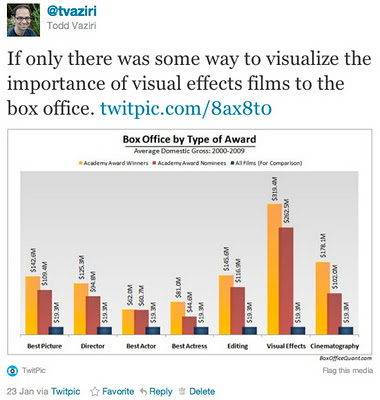
If only there was some way to visualize the importance of visual effects films to the box office. http://twitpic.com/8ax8t0

The above chart was made by the website BoxOfficeQuant.com, which, as many pointed out, only chose certain categories to chart, since they made the chart to support a specific point in one of their articles.

This inspired me to make my own, complete chart, customized to include everything I wanted to see.  I wanted to visualize the average global box office take of each of the nominees of each category of the 84th Academy Awards.  I had an idea of how the graph would ultimately turn out, but I wasn't expecting it to be this lopsided.  Click here to see a larger version of the chart.


Now, I can happily, confidently and completely say that visual effects films have a significantly higher box office take than any other Oscar category for this year's 84th Academy Awards.  The average nominee for Best Visual Effects earned over $662 million in global box office.

This should surprise virtually no one.  Visual effects get people into the theaters.  Our amazing images, brilliant spectacles, and never-before-seen worlds are the new movie stars, not just domestically, but globally.

To be fair, the Academy usually rewards actors and directors of prestige pictures with nominations-- films that don't typically earn hundreds of millions of dollars.  I think it is, however, significant to illustrate this idea - out of all of these important categories of filmmaking that the Academy wishes to celebrate with awards, it is clear the visual effects branch's films are doing the heavy lifting of selling tickets around the world, lifting the industry.

It also illustrates the sad state of the visual effects community. The average Oscar nominee for visual effects made over $662 million globally, and yet our industry has relatively little power in Hollywood.

Some notes: Had this been a typical year, the Animated Feature average would have been much higher, since two out of the five nominees from this year have yet to see a wide release.  But even if those two nominees made, say, $350M globally, it wouldn't have pushed the average even close to the visual effects average of $662M.  Also, the Makeup category was significantly bolstered by the inclusion of "Harry Potter 7.2" (which currently has a global box office take of $1.3 billion), which offset its two very modest fellow nominees, "The Iron Lady" and "Albert Nobbs" (which has yet to have a wide release).

And, just to state the obvious, it would be interesting to see what this chart looks like for, say, the last 10 years of Academy Awards, to see if this years' chart is an anomaly, or if this is a good reflection of a decade's worth of data.

Showing my work; a CSV of the data is here.

Sunday, February 20, 2011

Oscar Pool Ballot

It's time for the Awesomest Oscar Pool Ballot In The History Of Oscar Pool Ballots.

Each year I create a special ballot based on the oscar.com printable ballot -- but on my ballot, each category has a different point value. The highest valued category is "Best Picture," while the mainstream films' categories are valued at two points. The non-mainstream categories (like the documentary and short film categories) are valued at one point.

This way, in a tight race for the winner, the winner most likely would not be determined by the non-mainstream films (i.e., blind guesses).

Download the ballot here and use it at your Oscar party.


And if you're wondering why Tom Cruise is on my ballot... he's on every one of my Oscar ballots. Because he's soooo cool.

Monday, May 10, 2010

If You Can't Make It Good, Make It 3D

Yep, this pretty much sums it up from my perspective.

"If you can't make it good, make it 3D."
source

Friday, March 05, 2010

Oscar Pool Ballot

Having an Oscar party this weekend? Want to liven things up with a pool? If so, use this ballot I created for my Oscar party.

Every year I create a special ballot based on the oscar.com printable ballot -- but on my ballot, each category has a different point value. The highest valued category is "Best Picture," while the mainstream films' categories are valued at two points. The non-mainstream categories (like the documentary and short film categories) are valued at one point.

This way, in a tight race for the winner, the winner most likely would not be determined by the non-mainstream films (i.e., blind guesses).

To download the ballot, click here.


And if you're wondering why Tom Cruise is on my ballot... he's on every one of my Oscar ballots. Because he's soooo cool.

Tuesday, December 15, 2009

The Cinematography of "Let The Right One In," Part 2

In Part 1, we looked at cinematographer Hoyte van Hoytema's geometric motifs in "Let The Right One In." In this post, we look at some simply cool images from the film.

Images may contain minor spoilers.

Monday, November 16, 2009

The Cinematography of "Let The Right One In," Part 1

Illustrating a visual motif without being overt and obvious is not a simple task. Director Tomas Alfredson and his cinematographer Hoyte van Hoytema achieve this delicate balance in "Let The Right One In," the excellent Swedish thriller from 2008.

We'll present two posts on the cinematography of "Let The Right One In." In this post, we'll examine the geometric shapes formed within the images, and illustrating how the camerawork and production design work together to give the film a distinctive look. In the second post, we'll feature a few, simply cool images.

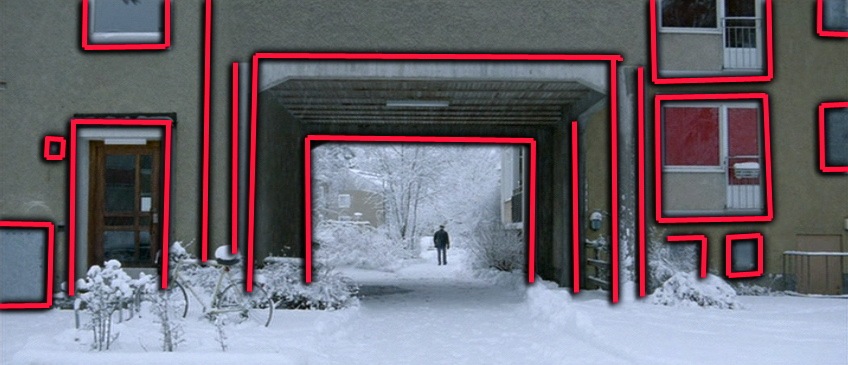
Hoytema frequently frames his shots with long lenses, allowing vertical and horizontal lines to remain parallel to the edges of the frame, giving the feeling of the shapes within the frame existing as subsets of the theater screen. Contrast this with, say, the wide-angle photography of Christopher Nolan's "The Dark Knight" (which we examined here: "Converging Lines and 'The Dark Knight'"). The production design and cinematography of "The Dark Knight" worked together to impart a sense of dread, a feeling of the decaying world collapsing around the characters. In addition, "The Dark Knight" was filmed with anamorphic lenses, which bow and bend straight lines giving even long lens shots a fish eye, distorted and abstract feel, while Hoytema chose to film "Let The Right One In" with spherical lenses (in Super35 for a 2.35 to 1 composition), minimizing distortion. Hoytema's images have straight lines that are parallel to the edges of the frame, emphasizing, coldness and geometric precision.

Alfredson, Hoytema and production designer Eva Noren use everyday objects to highlight this geometric precision. The window frames of Oskar's apartment building is used to great effect, along with the tiny jungle gym in the building's snowy yard (where we meet the mysterious Eli for the first time). Even props like the Rubik's Cube Oskar gives to Eli help drive home the visual theme.

For "Let The Right One In," the use of long lenses significantly reduces the impact of converging lines; wide lenses exaggerate perspective, while longer lenses compress perspective. When a zoom lens is framed on characters, it isolates and focuses the subject. Using longer lenses also exaggerates and enhances the feeling depth of field, so extreme foregrounds and backgrounds drift in and out of focus, further isolating our characters.

American Cinematographer Online has a short article about the film here, called "An Unusual Romance," from December 2008.

Images may contain minor spoilers.

In Part 2, we'll look at some simply cool images from the film. Go to Part 2.

Monday, May 25, 2009

A Summer of Sequels

Two summers ago, I wrote about a Pixar film standing tall as the only major summer studio feature that was wholly original. In Wonder Takes Time, we marveled at Pixar's genuine intent on giving the marketplace of ideas fresh stories. Among sequels ("Pirates 3," "Spider-Man 3," "Shrek 3") and based-on-toy-films, television shows, and reboots ("Transformers," "The Simpsons Movie," "Halloween"), Brad Bird's "Ratatouille" stood alone as the unique entry of the summer.

Well, here we are again, in the summer of 2009, where Pixar has the lone wholly original film of the summer. Pete Docter's "Up," which opens May 29, and is a (gasp!) original screenplay, goes up against these summer films:
  • Fast and Furious (sequel)
  • X-Men Origins: Wolverine (sequel)
  • Star Trek (reboot/sequel)
  • Angels and Demons (sequel/based on novel)
  • Land of the Lost (based on television show)
  • Night at the Museum: Battle at the Smithsonian (sequel)
  • Terminator: Salvation (sequel)
  • The Taking of Pelham 1 2 3 (remake)
  • Transformers: Revenge of the Fallen (sequel/based on toy)
  • Ice Age: Dawn of the Dinosaurs (sequel)
  • Bruno (based on television character)
  • Harry Potter and the Half-Blood Prince (sequel/based on novel)
  • Julie and Julia (based on article)
  • G.I. Joe: The Rise of Cobra (based on television show)
  • The Final Destination (sequel)
  • H2 - Halloween 2 (sequel of a remake)

Friday, February 27, 2009

"Button" Buttons Up VES Awards

The visual effects teams from "The Curious Case of Benjamin Button" nabbed four VES Awards last week, with "The Dark Knight" earning three and "Changeling" earning two.

It wasn't easy to find coverage of the VES Awards from the Visual Effects Society itself. If you go to VESAwards.com, there is no information on the winners listed (only applications and nominees). No email went out to VES members, which is strange because VES is usually pretty good about disseminating information via email. I went to visualeffectssociety.com, and on the far right side is a tiny link to a hastily prepped PDF file, which contained the names of the winners. The site contained no photographs of the event, no video, no acceptance speeches, and no links to other press coverage of the event. Disappointing, to say the least, especially for VES' biggest night of the year.

One of the many elaborate matte paintings for Clint Eastwood's "Changeling"

As for the awards themselves, I heard that it was a fun show. They gave lifetime achievement awards to the one and only Phil Tippett, as well as the monster producing partners Kathleen Kennedy and Frank Marshall.

As for the awards themselves, I was, of course, rooting for my fellow ILMers for our nominations for "Iron Man" and "Indiana Jones." I especially was hoping for an "Indiana Jones" win for Best Created Environment, since I contributed to the Temple Heart sequence (hopefully more on this in a future post). But "Button" and "Dark Knight" swooped up most of the awards, and for the most part, rightfully so.

If you haven't seen it yet, make sure you visit the well-made The Science Behind Benjamin Button, which nicely highlights some of the visual effects challenges from the film.

Here are some press clippings that I was able to muster:
And here are all of the winners of the live-action feature film categories. (To see all the nominees, click here.)

Outstanding Visual Effects in a Visual Effects Driven Motion Picture
THE CURIOUS CASE OF BENJAMIN BUTTON
Eric Barba, Edson Williams, Nathan McGuinness, Lisa Beroud

Outstanding Supporting Visual Effects in a Motion Picture
CHANGELING
Michael Owens, Geoffrey Hancock, Jinnie Pak, Dennis Hoffman

Best Single Visual Effect of the Year
THE CURIOUS CASE OF BENJAMIN BUTTON - Benjamin's Secret
Eric Barba, Lisa Beroud, Steve Preeg, Jonathan Litt

Outstanding Animated Character in a Live Action Motion Picture
THE CURIOUS CASE OF BENJAMIN BUTTON - Benjamin Button
Steve Preeg, Matthias Wittmann, Tom St. Amand, David McLean

Outstanding Matte Paintings in a Feature Motion Picture
CHANGELING
- 1928 Downtown L.A.
Romain Bayle, Abel Milanes, Allan Lee, Debor Dunphy

Outstanding Models and Miniatures in a Feature Motion Picture
THE DARK KNIGHT - Garbage Truck Crash Models and Miniatures
Ian Hunter, Forest Fischer, Branden Seifert, Adam Gelbart

Outstanding Created Environment in a Feature Motion Picture
THE DARK KNIGHT - IMAX Gotham City Scapes
Peter Bebb, David Vickery, Philippe Leprince, Andrew Lockley

Outstanding Compositing in a Feature Motion Picture
THE CURIOUS CASE OF BENJAMIN BUTTON - Benjamin Comes Together
Janelle Croshaw, Paul Lambert, Sonja Burchard, Sarahjane Javelo

Outstanding Special Effects in a Motion Picture
THE DARK KNIGHT
Chris Corbould, Peter Notley, Ian Lowe

Tuesday, February 24, 2009

"Button" Buttons Up The Oscar

“The Curious Case of Benjamin Button”
Eric Barba, Steve Preeg, Burt Dalton and Craig Barron

Hearty congratulations go out to the visual effects teams behind "The Curious Case of Benjamin Button," which won the Oscar for Best Visual Effects at the 81st Academy Awards. Here's Eric Barba's acceptance speech:

Oh my God. On behalf of myself, Steve Preeg, Burt Dalton and Craig Barron, I'd like to thank the Academy for this incredible honor. I'd also like to thank Edson Williams and his team at Lola Visual Effects and Nathan McGuinness and his team at Asylum as well as all the other visual effects teams that worked so hard on this film. I'd like to thank our amazing team at Digital Domain, my mentor Ed Ulbrich, my wonderful producer Lisa Beroud, the woman who is my biggest supporter, my wife Roma, Kathleen Kennedy, Frank Marshall and Ceán Chaffin, for trusting that we could actually pull this off. Brad Pitt for an amazing performance. And of course David Fincher for giving us all the opportunity to work on this film. To my kids, Cole and Nicolette, I'd just like to say, "Work hard, do good work and never give up." Thank you.


This was a rare year in which all three nominees were worthy of Oscar, in my opinion. And it was extra special to see my friend Craig Barron holding that statuette on the stage of the Kodak Theater. Way to go, Craig!

I even updated the Academy Awards section of Visual Effects Headquarters. How about that?

Update: Here is the backstage Thank-You cam, where Steve Preeg, Burt Dalton and Craig Barron were allowed to make their thank-you's.

...and there are the four winners, answering questions from the press backstage.


Monday, January 19, 2009

VES Announces Nominations for 7th VES Awards

Hi, all! Here's the press release sent out by the Visual Effects Society, announcing their nominees for the 7th Annual VES Awards. I'll provide some personal notes in a forthcoming post. What follows is an edited list of nominees, listing live-action feature film categories only.

-todd

VISUAL EFFECTS SOCIETY (VES) ANNOUNCES NOMINEES FOR 7th ANNUAL VES AWARDS
"Iron Man" Leads with 5 Noms, Awards Ceremony Scheduled for February 21, 2009

Los Angeles, January 19, 2009 - The Visual Effects Society (VES) today announced the nominees for the 7th Annual VES Awards ceremony recognizing outstanding visual effects in over a dozen categories of film, animation, television, commercials and video games. Nominees were chosen Saturday, January 17, 2009, by numerous panels of VES members who viewed submissions at the FotoKem screening facilities in Burbank.

In making the announcement, Jeffrey A. Okun, Chair of the Visual Effects Awards Committee said, "Because visual effects continue to grow in complexity and intensity, touching every aspect of the entertainment industry, we are proud to announce the nominees and their work, which have been deemed by the judges as the best of the best. I congratulate all the artists on their achievements."

The nominees for the 7th Annual VES Awards are the following:

Outstanding Visual Effects in a Visual Effects Driven Motion Picture
THE CHRONICLES OF NARNIA, PRINCE CASPIAN
Wendy Rogers, Dean Wright, Andrew Fowler, Greg Butler
THE CURIOUS CASE OF BENJAMIN BUTTON
Eric Barba, Edson Williams, Nathan McGuinness, Lisa Beroud
HELLBOY II THE GOLDEN ARMY
Michael J. Wassel, Lucy Killick, Adrian de Wet, Eamonn Butler
CLOVERFIELD
Kevin Blank, Chantal Feghali, Michael Ellis, Eric Leven
IRON MAN
Ben Snow, Hal Hickel, Victoria Alonso, John Nelson

Outstanding Supporting Visual Effects in a Motion Picture
CHANGELING
Michael Owens, Geoffrey Hancock, Jinnie Pak, Dennis Hoffman
EAGLE EYE
Jim Rygiel, Jim Berney, Crys Forsyth-Smith, David Smith
VALKYRIE
Richard R. Hoover, Maricel Pagulayan, Peter Nofz, Daniel Eaton
NIM'S ISLAND
Camille Cellucci, Scott Gordon, Fred Pienkos, James Straus
SYNECDOCHE, NEW YORK
Mark Russell, Richard Friedlander, Eric Robertson, Brett Miller

Best Single Visual Effect of the Year
CLOVERFIELD - Statue of Liberty Crash and Woolworth Tower Collapse
Michael Ellis, Chantal Feghali, David Vickery, Ben Taylor
THE CURIOUS CASE OF BENJAMIN BUTTON - Benjamin's Secret
Eric Barba, Lisa Beroud, Steve Preeg, Jonathan Litt
THE DAY THE EARTH STOOD STILL - Newborn Klaatu
Jeffrey A. Okun, R. Christopher White, Thomas M. Boland, Ben Thompson
INDIANA JONES AND THE KINGDOM OF THE CRYSTAL SKULL - Valley Destruction
Stephanie Hornish, Pablo Helman, Jeff White, Craig Hammack
IRON MAN
Ben Snow, Wayne Billheimer, Victoria Alonso, John Nelson

Outstanding Animated Character in a Live Action Motion Picture
THE CURIOUS CASE OF BENJAMIN BUTTON - Benjamin Button
Steve Preeg, Matthias Wittmann, Tom St. Amand, David McLean
HELLBOY II THE GOLDEN ARMY - Elemental Sequence
Colin McEvoy, Christoph Ammann
IRON MAN
Hal Hickel, Bruce Holcomb, James Tooley, John Walker
THE SPIDERWICK CHRONICLES - Hogsqueal
Todd Labonte, Michael Brunet, Nathan Fredenburg, Aharon Bourland

Outstanding Matte Paintings in a Feature Motion Picture
CHANGELING
- 1928 Downtown L.A.
Romain Bayle, Abel Milanes, Allan Lee, Debor Dunphy
INDIANA JONES AND THE KINGDOM OF THE CRYSTAL SKULL

Richard Bluff, Barry Williams, Yanick Dusseault, Yusei Uesugi
SYNECDOCHE, NEW YORK
- Matte Paintings
Brett Miller, Garrett Eaton, Matthew Conner
SPEED RACER
- Overall Matte Painting Presentation

Lubo Hristov, Dennis Martin, Ron Crabb

Outstanding Models and Miniatures in a Feature Motion Picture
THE DARK KNIGHT - Garbage Truck Crash Models and Miniatures
Ian Hunter, Forest Fischer, Branden Seifert, Adam Gelbart
INDIANA JONES AND THE KINGDOM OF THE CRYSTAL SKULL
David Fogler, Craig Hammack, Brian Gernand, Geoff Heron
IRON MAN - Suit Up Machine
Aaron McBride, Russell Paul, Gerald Gutschmidt, Keiji Yamaguchi
MY DARLING OF THE MOUNTAINS - Hot Springs
Taro Kiba, Kenji Nagatani, Yuki Minagawa, Hideo Udo

Outstanding Created Environment in a Feature Motion Picture
CLOVERFIELD - Brooklyn Bridge Sequence
David Vickery, Phil Johnson, Victor Wade, Sean Stranks
THE DARK KNIGHT - IMAX Gotham City Scapes
Peter Bebb, David Vickery, Philippe Leprince, Andrew Lockley
INDIANA JONES AND THE KINGDOM OF THE CRYSTAL SKULL - Temple Heart
Michael Halsted, David Fogler, Steve Walton, David Weitzberg
THE MUMMY - TOMB OF THE DRAGON EMPEROR - Avalanche Sequence
Mike Meaker, Rich Mahon, Jason Iverson, Sho Hasegawa
SYNECDOCHE, NEW YORK - Created Environment
Brett Miller, Garrett Eaton, Matthew Conner

Outstanding Compositing in a Feature Motion Picture
THE CHRONICLES OF NARNIA, PRINCE CASPIAN
Stuart Lashley, Arundi Asregadoo, Mark Curtis, Richard Baker
THE CURIOUS CASE OF BENJAMIN BUTTON - Benjamin Comes Together
Janelle Croshaw, Paul Lambert, Sonja Burchard, Sarahjane Javelo
IRON MAN - Head Under Display - HUD Compositing
Jonathan Rothbart, Dav Rauch, Kyle McCulloch, Kent Seki
QUANTUM OF SOLACE - Sienna Chase and Fight Sequence
Anthony Smith, Christian Kaestner, Adrian Metzelaar, Jon Thum

Outstanding Special Effects in a Motion Picture
THE DARK KNIGHT
Chris Corbould, Peter Notley, Ian Lowe
THE DARK KNIGHT - Garbage Truck Crash Mechanical Effects
Scott Beverly, Robert Spurlock, Jon Warren, Brian Kelly Hahn
DEFIANCE - Special Effects
Neil Corbould, Steve Warner, Anne Maria Walters, Alan Young


This year the VES will present producers Kathleen Kennedy and Frank Marshall with the VES Lifetime Achievement Award and Phil Tippett with the Georges Méliès Award.

For more information on the VES Awards, sponsorship and tickets, please visit www.visualeffectssociety.com.