Monday, December 21, 2015

Academy Announces the List of 10


The executive Committee of the visual effects branch of the Academy has announced the list of ten films that will be going to the bake off.

Ant-Man

Avengers: Age of Ultron
Ex Machina
Jurassic World
Mad Max: Fury Road
The Martian
The Revenant
Star Wars: The Force Awakens
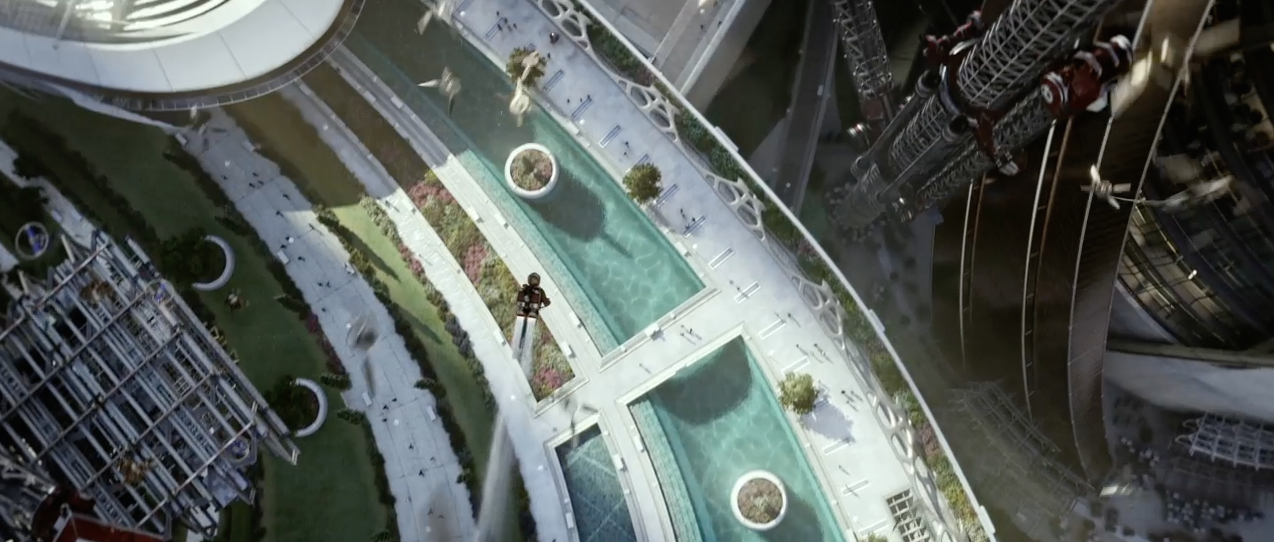
Tomorrowland
The Walk

Back in December, the executive committee announced the list of 20 eligible films. This two-step process allows the committee to see all the films and make a better determination as to which films make it to the bake off. 

If you are keeping track, that means the following films have been knocked out of the competition: Bridge of Spies, Everest, Furious Seven, The Hunger Games: Mockingjay Part 2, In the Heart of the Sea, Jupiter Ascending, Mission: Impossible - Rogue Nation, Spectre, and Terminator Genisys.

In January, the visual effects branch will hold the bake off; each of the ten films presents a ten minute reel of finished work (no breakdowns or before/after reels) to the entire branch, along with a short question and answer session. Then, after all of the films have been presented, the branch votes for their top five choices. The five films with the most votes become the Oscar nominees. The nominations for the 88th Academy Awards will be announced on January 14, 2016.

The full Academy membership votes for the winner of the visual effects Academy Award, which will be presented at the full awards ceremony on February 28, 2016.



Friday, December 18, 2015

My Pre-Release "Force Awakens" Thoughts


For nearly a year, I helped create visual effects for "Star Wars: The Force Awakens". I feel honored and grateful for the experience. I tried to summarize my feelings before the release of the film in a series of tweets, Storify'd below.


Monday, December 07, 2015

Academy Announces the List of 20


The Academy announced the twenty films of 2015 that will be eligible to attend the visual effects bake-off. The list of twenty was determined by the Executive Committee of the visual effects branch.

Ant-Man

Avengers: Age of Ultron
Bridge of Spies
Chappie
Everest
Ex Machina
Furious Seven
The Hunger Games: Mockingjay – Part 2
In the Heart of the Sea
Jupiter Ascending
Jurassic World
Mad Max: Fury Road
The Martian
Mission: Impossible – Rogue Nation
The Revenant
Spectre
Star Wars: The Force Awakens
Terminator Genisys
Tomorrowland
The Walk

Later this month, the Executive Committee will narrow this list down to the ten films that will participate in the bake-off.  At the bake-off, the ten films present their ten minute reels, and the visual effects branch of the Academy votes that night, determining the final five nominees for Best Visual Effects. The nominations will be announced on January 14, 2016.

The full Academy membership votes for the winner of the visual effects Academy Award, which will be presented at the full awards ceremony on February 28, 2016.


Monday, September 07, 2015

My Visual Effects Twitter Q&A

A few weeks ago, I did an impromptu question and answer session on Twitter. I've collected all the tweets into a Storify, and am reposting it below. Enjoy.


Monday, August 31, 2015

"Be Prepared for Dailies", Restored


Many moons ago, a valuable blog post by “Vizy Acky” was circulated in online visual effects communities, simply titled “Be Prepared For Dailies”. The post was a concise, laser-focused white paper on how visual effects artists should approach “dailies”, the morning ritual of visual effects artists, supervisors and producers sitting in a dark screening room and reviewing the previous day’s work. Every visual effects shop runs differently, and every visual effects and animation supervisor has his or her preferences as to how dailies should be run.

For example, sometimes animation and lighting have combined dailies. Others invite roto and paint artists. Some run dailies just with only top-level supervisors, and rely on coordinators to disseminate the notes. However, there exist certain universal commonalities of decorum, etiquette, and plain common sense when communicating in dailies.

Generally speaking, dailies should be run as efficiently as possible. No one wants dailies to run endlessly for hours and hours-- that’s valuable time wasted, which frustrates everyone in the pipeline. My personal pet peeve is dailies that never start on time… but I digress.

Unfortunately, the original source of the terrific blog post about dailies has vanished from the internet. I did some poking around on Internet Archive, and was able to resurrect the text. This is a lovely document which should continue to live on. The author was specifically commenting on ‘effects’ dailies, which involve particle effects and simulations (like water, dust, smoke, etc.), but the essay is applicable to nearly all types of animation and visual effects dailies.

I’m printing it below with some slight typo and clarification corrections, and occasional annotations. Enjoy.

(Plus, if you like this kind of thing, head over to Scott Squires’ blog, where he writes thoughtful posts like this one, “What Makes a Good Visual Effects Artist?”, which touches on the dailies process.)


Be Prepared for Dailies
from Vizy Acky Blog, Garman Visual Effects Academy
Resurrected from https://web.archive.org/web/20120712084932/http://vizyacky.com/blog/work-life/be-prepared-for-dailies/

Here are four things you should always be prepared to discuss during dailies.
1) what to look at and what not to look at
2) what changed from the previous version
3) what the artist thinks should be done to improve their shot
4) any questions or concerns about this shot

Visual effects iterations sent to dailies often look abstract and can be difficult to comment on. Dailies can become a huge waste of time and I’ve noticed when studios followed this kind of format often each shot can be covered in as little as 20-40 seconds. The submission might be a work in progress, a technical proof-of-concept test or a rough comp not refined by the final compositor.

Here are four questions I had asked my visual effects team to prepare for me each day for each shot.  These questions came out of my years of working at studios in Los Angeles, a composite of the things I learned from my supervisors about how to speed the dailies process. I started using these questions when dealing with a Chinese team in Beijing.  This gave time for the crew to write out their comments and allow time for the translator to prepare.

This method also works well for regular dailies where the artist is prepared beforehand.  This also helps the vfx supervisor to know what they are looking at and what to comment about.

Garman’s Four “Questions” for dailies.
Each of these four questions should be answered by the artist before dailies. The coordinator playing shots should state the shot name and the artists’ names, play the shot and ask the artists for their comments. The artist should be go through these “questions” as the shot is being looped, before any comments are expected.

Don’t wait in silence for the VFX Supervisor to guess what they are looking at. [Todd: This is super important. Don’t think the vfx supervisor is a mind-reader. Speak up!] Tell the supervisor what to look for.

1) What to look at and what not to look at.
-Tell what you need comments on and what to ignore.  This helps the vfx sup to not waste his time trying to figure out what he is looking at.
-An example would be, “Look at the speed of the particle motion but not the color or size.”

2) What changed from the previous version.
-Tell what  you changed or what you were asked to change.  If this is the first time the effect is show, state what you are trying to demonstrate.
-An example would be, “This motion is 2x faster than the previous version and the particles now live 1.2x longer.”

3) What the artist thinks should be done to improve their shot.
-Tell what you think you should do next.  This helps the vfx supervisor know if you are on the right track and perhaps they will say “fine, continue” and will avoid him having to think for you.
-An example would be, “In this version the particles would cover the hero in the background so I feel we should have the particles move a bit faster and have a shorter lifespan so we can see the actors.”

4) Any questions or concerns about this shot.
-Now is the time to ask for specific guidance.
-Examples would be, “Does the smoke linger in the following shot because this is a closeup of the hero and we should see smoke from that camera view but  it’s not assigned.”  Or, “I noticed a bump in the camera track where the smoke goes around the car.  Can we look into that.”

Getting Comments Back
Now we can get the comments from the VFX supervisor or others.   Since you already stated what you think should be done next, then it can make it easier to say, “OK to continue.”  Or to get more specific guidance.

Take Notes
I’ve always been a good note taker since I was in high school.  Perhaps because I was good at taking notes made it easier for me to study less after class.  Taking notes made me pay more attention to what was being said while it was being said. I’m always amazed to be in meetings where people are discussing actions which involve tens or hundreds of thousands of dollars worth of work, yet not many people are taking notes.   [Todd: I always take notes in dailies, then after I return to my desk, I immediately transcribe the notes with clearer language and specific frame numbers or screen coordinates (screen right fire on frame 1024 looks pinkish)]

Don’t depend on the coordinator to take notes for you.  They may be a professional note taker as part of their job but they don’t understand effects like you are supposed to and often don’t get it as accurate as you need it. Take notes about what you are supposed to do.  Then take notes about what others are talking about even if you don't understand it.  Use your notes to help you find out what you need to understand later.  If you want to be the VFX Supervisor someday, you’ll need to know a lot, and taking notes at dailies is a great way to start.

Take It Offline
Dailies is the time for quick review of work in progress.  It helps production know it is staying on schedule, and helps the supervisors see all the work being done each day. It’s supposed to be quick.  Most shots can be covered in 15-30 seconds.  [Todd: If you spend over two minutes on a single shot in dailies, something is wrong.] Dailies is not the time to determine deep technical solutions while wasting everyone else’s time.  Dailies is to help find problems and solve them later.

-Garman
2012.01.07  Vancouver BC


Tuesday, August 25, 2015

Monday, July 06, 2015

Monday, June 01, 2015

Super Speed End Credits


The other night, I happen to watch the final act of “Alien vs. Predator”, a questionable piece of ‘entertainment’ in Fox-owned synergistic franchises. I was watching the film on the Esquire Network, a basic cable channel branded as “an upscale Bravo Network for men”, whatever that means.

As final scene began (spoiler warning for an incredibly stupid eleven year-old film), I paid close attention to the stunning live-action creature effects in this film. Tom Woodruff and Alec Gills supervised the creature work, which holds up astonishingly well.

The movie ended... and then this happened:

This was recorded in real time on my iPhone. View on YouTube

Nearly every single film and television show presented on cable is presented with its end crawl sped up, or scaled down to a tiny portion of the frame, or, in most cases, both. Networks speed up content to fit more commercials in standard blocks of time. In fact, the actual content of nearly every single show you see on cable is sped up a certain amount for this same reason, sometimes up to 8% faster. Occasionally, the studio provides a 'reprint' of the end credits, which are clearly (but quickly) printed at the bottom of the screen, making the credits technically legible, without bizarre scale-downs or speed-ups. But in most cases, the end crawl is destroyed with a speed change and/or scale change.

An example of 'reprinted' end credits, and allow the cable network to show larger-screen promos to fill the frame.

The typical treatment of end credits, scaled down and sped up.

Nearly all cable presentations preserve the opening titles of a film, which feature the ‘above the line’ credits, like production companies, lead actors, all the way to producers, writers and directors.  These opening titles are usually treated the same as the body of the film, without egregious speed changes. The end crawls (usually starting with Unit Production Manager and the First Assistant Directors are frequently run anywhere from 2x to 5x on television.

Many modern films, however, present their 'above the line' title sequence at the end of the picture. This is the first time I’ve ever seen the ‘above the line’ end credits run at an incredibly high rate of speed. And this isn’t a typical white titles against black sequence; “Alien vs. Predator” has an elaborate, expensive animated end title sequence. Then comes the final indignity--midway through the 'below the line' credits, the entire screen gets squished into the left third of the screen. Pretty much the entire end credit sequence is illegible, disrespecting the hundreds of individuals that worked on the picture, not to mention the animators who designed the end titles, and the music composer and artists that created the score.

I wonder if this violates any union or guild agreements with studios.


Thursday, May 28, 2015

Diopter Tweets

The other day, I unleashed a mini-tweetstorm about diopter shots. It all started with a visual effects shot from "Star Wars: Episode III", which I proposed to include synthetic diopter artifacts, to simulate the use of a diopter. 


Saturday, March 28, 2015

Movie Marketing is Hard! "From The Director of TRAINING DAY", updated again!


This is an update to a previous post.

Since directing the magnificent "Training Day" in 2001, Antoine Fuqua has directed seven more feature films. Every single film predominately featured nearly exact same title card in its trailer: "From the director of TRAINING DAY". With the release of the first trailer for "The Equalizer", the filmmakers added "and OLYMPUS HAS FALLEN", which earned over $161M worldwide at the box office to the card. Now, with the trailer for "Southpaw", they switched out "Olympus Has Fallen" with "The Equalizer" (which earned $192M worldwide).


Saturday, March 14, 2015

New "Tomorrowland" Trailers


Brad Bird's "Tomorrowland", which hits theaters on May 22, 2015, has a couple of new trailers.  First, here is the new U.S. trailer.

YouTube link - iTunes link

And now, the new Japanese trailer, which has additional visual effects shots created by Industrial Light & Magic.

Watch the Japanese "Tomorrowland" Trailer on Vimeo

And, look, the Randomizer found some new images from the trailers that it hopes you like.


Sunday, February 22, 2015

"Interstellar" Wins The Oscar

Congratulations to the entire visual effects team behind "Interstellar", the winner of the visual effects Oscar in the 87th Academy Awards.

INTERSTELLAR
Paul Franklin, Andrew Lockley, Ian Hunter and Scott Fisher

And, as for The VFX Predictinator... well, we got this one wrong. I'll be writing an article in the coming days about how and, perhaps, why we got it wrong.  And here it is.

Thursday, February 19, 2015

Oscar Pool Ballot, 87th Academy Awards

It's time for the Awesomest Oscar Pool Ballot In The History Of Oscar Pool Ballots.

Every year I create a special ballot based on a typical Academy Awards printable ballot -- but on my ballot, each category has a different point value. The highest valued category is "Best Picture," while the mainstream films' categories are valued at two points. The non-mainstream categories (like the documentary and short film categories) are valued at one point.

This way, in a tight race for the winner of the pool, the winner most likely would not be determined by the non-mainstream films (in other words, blind guesses).  This year, I started with a ballot from The Gold Knight, since Oscar.com didn't make a pretty, printable ballot this year.

Download the ballot here for the 87th Academy Awards and use it at your Oscar party.


And if you're wondering why Tom Cruise is on my ballot... he's been on every one of my Oscar ballots. Because he's soooooooooo cool.