Friday, November 23, 2018

"The Fugitive" Behind Bars


This little business from "The Fugitive" (1993) of Dr. Richard Kimble sneaking around a hospital hiding ‘behind bars’ during his escape. Those bars are probably part of the location and not art directed and built by the production. Either way, a classy, understated bit of visual flair.


I can imagine a scenario where the crew started blocking the scene on location and someone had the idea of Kimble taking a moment behind those bars, and the subsequent discussion. Is it too “on the nose”? Is it too stylish for a movie like this? Shoot it two ways, for safety?

Another great example of this, from Walter Chaw from "Strangers on a Train" (1951).


Original Tweet.


Thursday, November 22, 2018

"Terminator 2" and Explosions


I'm thankful for "Terminator 2" (1991), the only action movie I can think of that took the time to show us how a fiery explosion could plausibly occur after a major vehicular collision: two, quick closeup shots of a battery lead sparking, igniting the leaking fuel behind it.


As an aside: I've been looking at T2, frame by frame, ever since its CAV LaserDisc release and this is the first time I ever noticed the first shot of this GIF has added (digital) camera shake, to help with the edit and better tie it in with the chaos of the preceding crash shots.)

original tweet


Wednesday, November 07, 2018

"Patriot Games" Diopter


Vashi Nedomansky and I joke around a lot about split diopters on Twitter, so it's time for some real talk. Shoved smack in the middle of a traditional Hollywood narrative film, they're jarring and bizarre. And the best use cases for split diopters take advantage of this. Out of context and as a still frame, this split diopter shot from "Patriot Games" (1992) seems utterly ridiculous.

"Two planes of sharpness? The only shot in the movie where this happens? Puh-leeze. It's a trick shot. The cinematographer is just showing off, whatever."

But here's the shot in context. Ryan is desperately trying to piece together fragments of his memory from the traumatic event that opened the film. The split diopter shot is from the point of view of his memory, not an omniscient, objective observer. It's supposed to be weird.


The bizarre visual nature of the split diopter feels right at home for a dream sequence, or a personal flashback moment--the shot is literally Ryan's POV as he's visually searching his memories for details, looking for evidence. An innovative use of the split focus shot.


Sunday, October 14, 2018

"Caddyshack" Long Lens Focus


A shot from "Caddyshack" (1980), filmed with a long lens, with a dramatic focus change. The same shot at 8x speed.

Friday, September 21, 2018

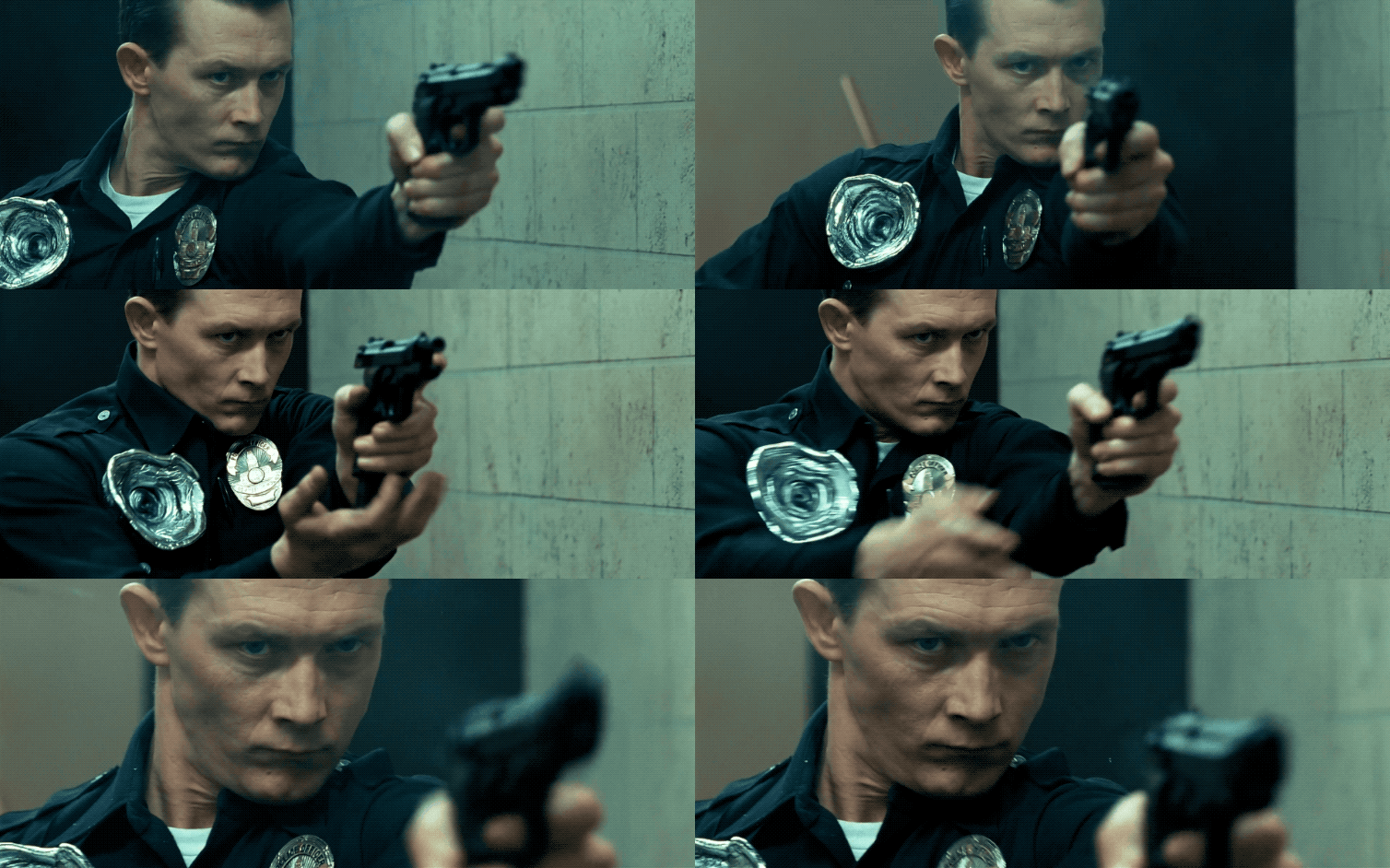
Robert Patrick, "T2" and Blinking


For "Terminator 2: Judgment Day" (1991), Robert Patrick learned how to fire a gun without blinking, to prepare for his role as the T-1000, a killer robot.

πŸŽ₯ 4 shots
πŸ€– 16 rounds
πŸ‘ 1 blink

The GIF at the top of this post is real-time, as it was seen in the film. If It Were Made Today™: would still have Patrick train to fire the weapon without blinking; the one blink in this sequence could be digitally painted out by a talented paint artist.


Original tweet. 


Thursday, September 20, 2018

A Cold Open for "Better Call Saul"


The cold open montage from “Better Call Saul” S4E07 is one for the ages. A narrative and technical masterpiece.

✂️ Edited by Skip Macdonald
⌨️ Written by Alison Tatlock
πŸŽ₯ Directed by Deborah Chow

original tweet


Apple Event Film 2018 vs. "Mission: Impossible - Ghost Protocol"


While the music was from “Fallout”, the inspiration for Apple’s terrific opening film for the iPhone event was clearly “Mission: Impossible - Ghost Protocol”.

direct YouTube link


Monday, September 17, 2018

Twitter and Quote Tweets


Seems to me that Twitter should allow users to easily be able to view all "Quote Tweets", just like users can easily list a Tweet's Likes and Retweets.

My quick and dirty mockup of how Twitter could implement Quote Tweet tracking. Clicking on the "Quote Tweets" gives you all the instances, which is just a Twitter search for the URL of the original Tweet. This seems like low-hanging fruit.


My original tweet.


Sunday, September 16, 2018

The Birth of Sandman


For my money, one of the great visual effects shots of all time. "Spider-Man 3" (2007), with visual effects by Sony Pictures Imageworks.


direct YouTube link


Thursday, September 13, 2018

When You "Buy" a Movie on iTunes


There's been a lot of chatter about what exactly does it mean to "buy" a movie from iTunes, Amazon Prime Video, or any of the other online movie services.


Rene Ritchie says that when iTunes severs a licensing agreement for a particular film, the film disappears from the iTunes Store. You can no longer stream the film from Apple servers, even if you "bought" it. (However, if at some point you had downloaded the movie to your Mac/iPhone, you would still be able to watch that movie, even after it leaves the store, apparently.)

If Apple (and Amazon Prime Video, Comcast, etc.) were a little more honest about what it meant to "Buy" a movie on their service, I think the user interface buttons would look a little different.


Wednesday, September 12, 2018

An Editing Trick in "Terminator 2" and "The Road Warrior"


To add impact to a shocking moment of extreme violence, director Jim Cameron and the editors of "Terminator 2" used a very old-fashioned, low-tech editing trick.


A single frame of solid white was added into the edit precisely at the moment of impact. Nestled within a predominantly dark sequence, the quick 1/24th-of-a-second flash of bright light shocks the audience and makes the moment that much more striking.


"Mad Max 2: The Road Warrior" (1982): another example of adding a single bright frame in the middle of the edit to intensify a moment of personal violence.


Unlike the "T2" example, the frame is a single frame of overexposure (rather than a white solid color).


There's also jump cut to a different take a just before the head butt, which is hardly noticeable in real-time, especially with the added subsequent flash frame.


Another example from "The Road Warrior", again with a single frame of overexposure to punctuate the impact.


Tuesday, September 11, 2018

The Myth of the "Jaws" Shooting Star


Update: If you've been here before, you absolutely need to scroll down to Gigantic Update, 1/20/2025 for some new information.

The GIFs below were part of a Twitter thread where I attempted to debunk the whole "the Jaws shooting stars were real and actually happened on camera" mythology. These read better as tweets than as a blog post, so see the thread here, if you want.

All these "Jaws" tweets reminds me to dig up my half-finished project files debunking the whole "those shooting stars were real" myth. I'm just going to post these in their current state, without context. I planned to talk day-for-night, fast lenses, film stock, exposure of stars, depth of field, motion blur, tracking, hand-drawn animation composited into live-action... but nobody's got time for that.


In summary, contrary to what the mythology might be, there is no way those two shooting stars you see in "Jaws" were real-life shooting stars photographed in-camera during filming. Those shots contain animated effects work to simulate shooting stars. For more reactions, visit the original Twitter thread.

Update, 10/24/2021, from Paul Hirsch's fantastic book "A Long Time Ago in a Cutting Room Far, Far Away: My Fifty Years Editing Hollywood Hits":


As I watched [Jaws], I noticed something odd in one of the later reels. In a low-angle close-up of Roy Scheider showing the early evening sky behind him, I saw what looked like a brief fiery streak in the sky. Later the evening at a party at Steven's hotel to celebrate the opening, I asked him about it. "Hey," he called out, "Paul Hirsch saw it! He saw the UFO!" As I had suspected, that streak was deliberate; it was a little foretaste of Steven's next picture, Close Encounters of the Third Kind.

the shot, brightened for clarity

Gigantic Update, 1/20/2025

Here we are again.

I find it astonishing that folks are still repeating the myth that the shooting stars in "Jaws" were captured in-camera. To recap, here's a quick summary of the forensic evidence that the two shooting stars are animated and were not photographed in-camera during first unit production.
  1. The sequence was shot day-for-night and exposure values where they are for this sequence could not possibly expose for a real shooting star.
  2. In both shots, there is zero motion blur on the hottest part of the shooting star, while the head of a real shooting star, if captured, would be smeary.
  3. The shooting star, in both shots, has a single point of intensity and a variably flickering pink tail. This is not what shooting stars look like.
  4. The Roy Scheider shot is photographed with the camera panning and tilting a bit, however the animation is locked in screen space indicating the animator didn't "match move" the camera.
  5. Anything in the background of the Roy Scheider shot would be out of focus. Just look at Richard Dreyfuss, who is soft. The shooting star is crisp and sharp, indicating a non-defocused animated effect.
  6. They looks animated as HELL, with extremely similar characteristics to hand drawn animation of shooting stars from animated films like "Pinnochio" and "Sleeping Beauty". In fact, they look similar in spirit to the hand-painted animated effects that brighten the barrels' lights in the water in the exact same scene. The second shooting star in "Jaws" is even animated on two's, meaning the animation is exactly the same in the shot for two frames in a row. The film runs at 24 frames per second but the animation is only running at 12 fps (to reduce the animation workload) and is double printed for every frame of animation. (Thanks, Randy Cook!)
One reason it's bubbling up again on blogs and social media is due to "The Shark is Broken" which debuted on Broadway in August 2023. Co-written by Robert Shaw's son Ian Shaw, the play dramatizes the often-difficult production of "Jaws", and the shooting star makes a cameo in the play, with the authors of the play implying that it actually happened during filming - a beautiful example of serendipity and happy accidents amidst a troubled film production.


From Deadline: "Fans of the film – who isn’t? – will be delighted with the attention to detail on this Broadway stage, right down to that famous shooting star accidentally captured by the late, great cinematographer Bill Butler."

Here's the problem - those shooting stars featured in "Jaws" were NOT captured in-camera. They are optical effects added in post-production by an animator. Film fans need to stop repeating the false claim that they were happy accidents captured in-camera during the filming of the movie.

If the forensic analysis of the footage indicating that the two shooting stars were added in post-production doesn't convince you, then maybe the fact that director Steven Spielberg's well-documented love of "When You Wish Upon a Star" from "Pinocchio" can convince you. Or Spielberg's vivid childhood memory of a meteor shower that captured his imagination (see Joseph McBride’s ‘Steven Spielberg: A Biography’). Or that he later adding hand-drawn animated shooting stars into "Close Encounters of the Third Kind" and "Indiana Jones and the Temple of Doom". Or the Paul Hirsch quote printed above. 

If all of this isn't enough, perhaps this reporting will help slam the door on this myth.

I reached out to film historian Jamie Benning about this issue. He said, "let me ask Joe Alves."


Alves was the "Jaws" production designer and also worked with Spielberg on "The Sugarland Express" and "Close Encounters of the Third Kind", and has spoken extensively about his experience on "Jaws". Paraphrasing, this is the response he got from Alves in August 2023: yes, the shooting stars in the movie were animated. Yes, they were added in post-production.

Let's put this myth to bed, once and for all.

As an aside, let's discuss why this myth gets perpetuated. Firstly, with the well-documented production troubles that "Jaws" had to overcome, the shooting stars being real, in-camera events invites a pleasant bit of magical serendipity, which captures one's imagination. Even when all hell was breaking loose, months behind schedule and millions over budget, this movie was destined to be a masterpiece, and nothing exemplifies that than the wonderful serendipity of two shooting stars that happened to get captured on film for the movie! It's a terrific bedtime story, but one that is pure mythology.

But another piece of the puzzle is that there might have been an actual meteor shower that occurred during the filming of the movie. Someone sent me this bizarre quote from cinematographer Bill Butler apparently given to American Cinematographer 1975 that birthed the myth:

"During the scene where Brody and Hooper are waiting for the shark and comparing scars, we had a meteor shower in the sky behind them. We didn't plan it, but when we saw it happening, we quickly set up and filmed it. This kind of natural phenomenon does a lot for a film. It wasn't an optical effect." 

(Complicating the issue - I can't find this quote in the AC archives. I went into a deep dive in the American Cinematographer archives (here's the "Jaws" issue from March 1975),  and reviewed every single 1975 issue, and couldn't not locate this quote. As an aside, the AC Archives are absolutely amazing.)

A version of this story is often repeated, sometimes attributed as being mentioned in a “making of Jaws” documentary, but I’ve scoured the several documentaries about the making of the film and I have not come across this story. 

Here's what I think happened: Yes, there was a meteor shower during filming. Yes, Butler and crew did what they could to photograph the event, devoid of the boat or actors, just to attempt to capture something on film. And he erroneously says in the "it wasn't an optical effect", meaning that what they filmed was what they filmed. However, and this is a gigantic "however", the footage of the real meteor shower they filmed is not in the final movie. It's not. The "meteor shower being filmed by the crew" story was told by Robert Shaw to his son Ian, which became part of his father's "Jaws" lore, but mistakenly morphed into "the shooting stars in the movie were REAL".

The shooting stars in "Jaws" are animated optical effects executed in post-production.

•  •  •  •

Oh... there's just one more thing.

Another source has access to Steven Spielberg. So this person asked Steven Spielberg in September 2023:


Paraphrasing from Spielberg: Yep, it's animated shooting star, animated by Albert Whitlock.

This was a bombshell for me. No, not that Spielberg confirmed that it was animated, but that it was supervised by none other than Al Whitlock who passed away in 1999, the veteran visual effects artist who contributed to some of the most amazing visual effects of all time. Not to mention that really terrific illusion in "The Blues Brothers" (1980) that I documented on Twitter.


Update, 2/19/2026

Because I apparently am now the keeper of the "Jaws Shooting Star Myth Debunked" texts, here's some more information. In the book "Joe Alves: Designing Jaws", by Dennis L. Prince, one of Joe's storyboards for the film is presented, courtesy of Jamie Benning:


caption from Alves' storyboard:
"Matt (sic) shot - barrel circling Orca
phosphorescence effect
shooting stars to be animated (day-for-night)"


And here's an excerpt from the book "Spielberg: The First Ten Years" by Laurent Bouzereau concerning the shooting star (courtesy of Alex Horwitz):


Bouzereau: There's a famous night shot of the Orca with a shooting star in the sky.

Spielberg: In fact, there're two shooting stars that I added optically to underline the shark becoming almost a mythic character. I also added phosphorescence on the surface of the water when the barrels are moving around the boat at night. That was also an optical effect..."


Motion Smoothing is Bad


Just about every single TV sold in the U.S. has ‘motion smoothing’ switched on by default.

The TV attempts to create additional temporal frames, to make the motion feel “smoother” and less jerky. This makes movies (shot and projected at 24fps) appear smeary and wrong.

Films seen on a TV with motion smoothing on are not being presented properly. The “new” look changes the emotional impact of every single scene. This is not how the film was intended to be seen; this is similar to the appalling process of colorizing black & white films.

Check out the Twitter hashtag #tvninja - a TV ninja is someone who stealthily turns off motion smoothing on a TV owned by friends, relatives, or Airbnb.

Directors who have publicly fought motion smoothing include Reed Morano and Rian Johnson, who, as far as I know, came up with the hashtag #tvninja.

More, please.

Christopher Nolan and Paul Thomas Anderson Battling TV Motion Smoothing


Motion smoothing goes by many different names (Auto Motion Plus, TruMotion, etc.). Turn it off. Here's a great blog post by Stu Maschwitz from 2011 properly titled, "Your New TV Ruins Movies".


"Darth Vader Being a Jerk", HD Restoration


I made a Special Edition High Definition restoration of Doomblake's video, "Darth Vader being a Jerk."

direct link to YouTube

I used an HD source of "The Empire Strikes Back" and did a frame-by-frame restoration of Doomblake's edit. Later, I realized I messed up one of the edits (a second cut to Piett), but I liked my cutaway to Veers more, so I kept it. Making arbitrary changes to source material is a Star Wars Special Edition trademark, so why not continue that tradition. I also added titles, and an actual introduction and conclusion. The audio of the new sequences is mine, but the audio from Doomblake's amazing editing is pure Doomblake.

Update: Doomblake deleted her/his YouTube account, but the good news is that I kept an archive copy of the clip.


A Low-Tech Effects Shot from "Mission: Impossible III"


This is one of director J.J. Abrams' favorite visual effects shots from his film, "Mission: Impossible III". Rather than have actor Eddie Marsan forcibly shove the prop into Tom Cruise's nose, J.J. came up with a different idea on how to accomplish the shot.

direct link to YouTube

Watch his full TED talk from March 2007 here.