this page is periodically and (hopefully) frequently updated
Over on social media, I provide an extensive and exhaustive chronicle of movie directors and studios denigrating, marginalizing, and outright insulting the visual effects crews of their own films.
I want to do a better job of chronicling the positive: the lovely, fleeting moments of Hollywood leadership actually publicly acknowledging and praising the digital visual effects work in their films and the people who create the work.
Have you seen a studio, producer or a director specifically praising the people and work behind the visual effects of their film? Send me a link - tvaziri@tvaziri.com .
• • • • •
2023, Rian Johnson and "Poker Face"
Here's "Poker Face" showrunner Rian Johnson talking about the show's visual effects, calling out supervisor Craig Clarke and the visual effects houses that contributed to the show.
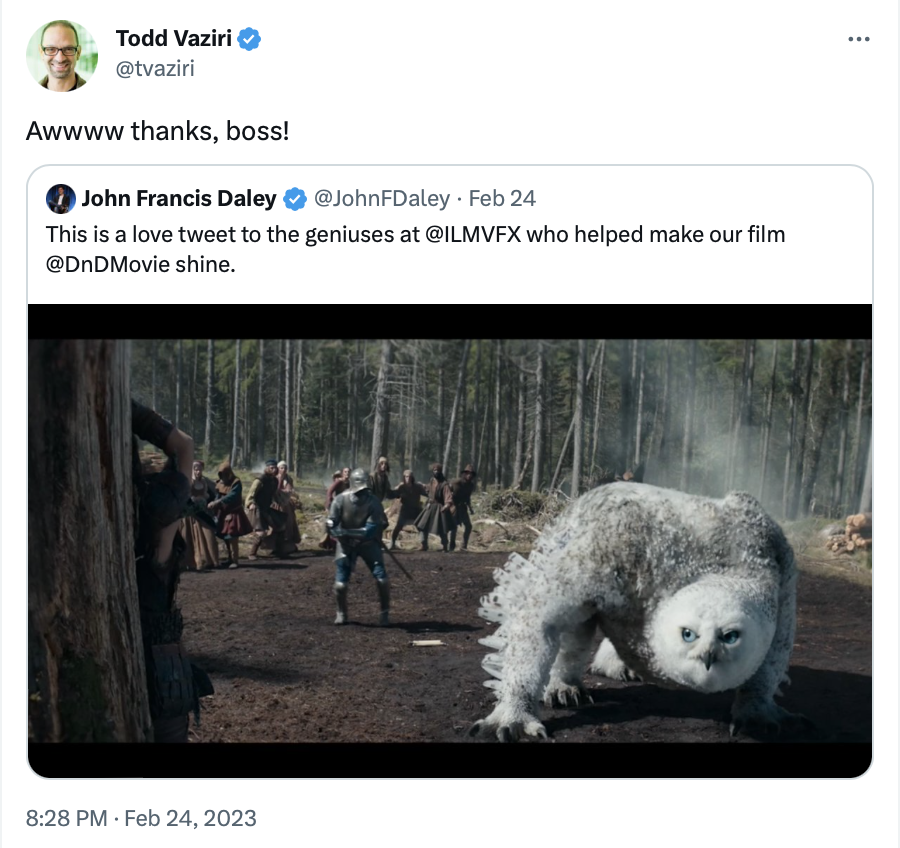
2023, John Francis Daley and "Dungeons and Dragons"
I served as ILM's compositing supervisor on "Dungeons and Dragons" (2023) and directors John Francis Daley and Jonathan Goldstein were fantastic partners on the movie.
Writer and producer Craig Mazin was extremely complementary of the visual effects work on "Chernobyl" on his podcast Scriptnotes, and even dedicated an episode of the show to a discussion about visual effects. In Scriptnotes 588, Mazin goes out of his way to praise the visual effects artists of his show "The Last of Us".
2023, Jim Cameron and Jon Landau, "Avatar: The Way of Water"
I wrote about how director Cameron and producer Landau were public and supportive of their visual effects teams on the night of the Visual Effects Society Awards in 2023. See also Landau calling into Corridor Crew's VFX Artists React video.
I had the pleasure of having a quick chat with Boots Riley when he was prepping "I'm a Virgo" - he's such a thoughtful gentleman and I was thrilled to see his tweet about both the in-camera effects work and the digital work for the show:
Director J.A. Bayona was effusive with praise on the visual effects of his film "Society of the Snow", and promoted an interview with the film's visual effects supervisor Laura Pedro. (Thanks, Charmaine!)
Co-director of "Nyad" Jimmy Chin promoted the work of visual effects supervisor Jake Braver and the visual effects team on Instagram. Thank you, "megbaratta"!
• • • • •
2023, Reginald Hudlin, "Candy Cane Lane"
Director Reginald Hudlin went out of his way to talk about the artists of ILM:
"There were so many joyful things about making this movie, but one of the best was working with the brilliant artists at Industrial Light And Magic. Watching the magic unfold weekly was a treat!"
Director Michael Sarnoski talks about digital effects in "A Quiet Place: Day One".
“The monsters themselves are physically unique and a bit impossible to do practically. But we had amazing people at ILM who had a lot of experience bringing those monsters to screen and did an incredible job making these monsters extremely real and extremely terrifying,” he says.
2024, Wes Ball, "Kingdom of the Planet of the Apes"
Director Wes Ball has been exuberant about his experience working with Wētā FX and about digital visual effects in general, both on his own Twitter account and promoting the movie.
"I've been spoiled as a fairly young filmmaker - I've made four movies with Wētā . They are the best in the world... I can't say how humbling it is to work with people that are the best in the world at what they do. It's absolutely a thrill every day to see the stuff they do. They are true artists. They are not just 'computer tech nerds'. People don't totally appreciate the artistry and storytelling, filmmaking craftsmen that these people at Wētā are."
Watch the people behind "Fallout" (Prime Video) talk about creature effects, stunts, LED volume, practical effects and visual effects and how they all work together to tell a story. No need to present one craft as more "pure" than another.
In one tweet, he writes about why he's so happy to talk about the digital work in the film: To shed light on all the amazing work contributed to a grounded' film like REBEL RIDGE by VFX artists who are usually only honored when aliens or dinosaurs attack shit.
Amidst a flurry of ignorant accusations of the use of generative AI in his new film "The Legend of Ochi", director Isaiah Saxon fiercely defended the work of his crew, including digital effects.
From the Indiewire article:"Six years of handmade work: puppets, animatronics, matte paintings, and a bit of 3D animation. No AI. There’s the statement... I’ve been making handmade films that feel painted since 2005. Along came AI, and now we have crusaders like you shitting on people who’ve dedicated their life to craft,” Saxon wrote to one Twitter user. He continued, “Shot 1 is full 3d animation and took a year of work, shot 2 is fully in-camera shot in Romania, shot 3 is a built model fg element, shot 3 is in-camera shot in the Carpathian Mountains with a partial matte painting integration on mountains. No mid-journey storyboards. Just stop.”
There is lots of great practical work here. But I don’t want to discount all the great work by the VFX artists at @CraterStudio who spent tons of hours creating some amazing visuals. @tvaziri talks about this lots but just because you can’t see them doesn’t mean they aren’t there.
🤘
• • • • •
2024, Alex Garland "Civil War"
Director Alex Garland talked about the digital visual effects of his film "Civil War" at the BFI. The movie features over 1100 visual effects shots, and the last act takes place in war-torn Washington D.C.
In film there's a sort of, like, virtue signaling, a sort of piousness that can relate to 'practical effects over VFX'... I don't go along with it. I don't because all of film is essentially a fiction. All of it is constructed one way or another. And VFX is a tool in the tool set. Shooting [the movie in Washington] D.C. itself... impossible. Impossible.
Director James Gunn talks to Framestore about crafting characters that are made in digital effects, and also touches on the design aspects of character creation and how 1-to-1 comparisons of "practical vs. digital" are silly arguments.
Sometimes you get people that are, like these sorta 'practical effects fundamentalists' who are like "why don't you just have Groot as a guy in a suit?" I'm like, because you can't do [that]! He doesn't move like a human. He moves differently - his body is shaped differently - his is face is shaped differently."
Director Ryan Coogler went on The Tonight Show with Jimmy Fallon and went out of his way to mention "Sinners" VFX supervisor Michael Ralla and VFX producer James Alexander when praising the unique visuals of his movie.
Fallon: How'd you do that?
Coogler: We've got a brilliant visual effects department, man. Our head of VFX Michael Ralla and our VFX producer James Alexander, they developed a lot of excellent technologies for us, man.
note: This is an update to an old post, which has a lot of cool links to articles concerning the historical link between MPAA rating and box office performance.
I'm really proud of my original post, which looked at the percentage of the top ten films at the domestic box office as they relate to the films' MPAA ratings. I've always felt that the dominance of PG live-action movies had been waning (taken over by PG-13) hits, and it was reassuring to see that feeling accurately play out in chart form.
The chart above adds years 2016-2022, which saw a staggering increase in PG-13 domination, culminating in 2021 and 2022 where PG-13 films made up a 93% and 86% of the top ten box office dollars, respectively.
The gigantic 2021 PG-13 percentage was fueled by five PG-13 superhero movies, "F9", "No Time to Die" and "Ghostbusters: Afterlife". That's nine of the top ten films at the box office; the sole non-PG-13 film in the top ten was "Sing 2".
But look what happened in the truncated, abbreviated, all-around-crummy year of 2020: 41% of the top ten's box office was from R-rated films! The top film of 2020 was "Bad Boys for Life" which was rated R, and there were impressive showings from fellow R-rated movies "Birds of Prey" and "The Invisible Man". Granted, due to the pandemic the severely-constricted box office for the top ten films of 2020 was about 1/5 of the 2019 top ten, which included hits like "Avengers: Endgame", "The Lion King", and "The Rise of Skywalker".
That said, 2020's performance of R-rated films was the highest percentage since 1988 when "Rain Man", "Coming to America", "Die Hard" and "Cocktail" dominated the box office (42%). In 1996 when R-rated fare like "Jerry Maguire", "Ransom", "The Rock", "The Birdcage" and "A Time to Kill", restricted films made up 39% of the top ten box office.
The year which saw the highest percentage of R-rated hits in the top ten was 1987, where movies like "Fatal Attraction", "Beverly Hills Cop II", "Good Morning, Vietnam", "The Untouchables", "Stakeout", "Lethal Weapon" and "The Witches of Eastwick" made up for a staggering 70% of the top ten box office.
Criticize a finished movie all you want but please don’t make pretend “before and after” split screen images to stoke anger about color timing. The discourse is bad enough as it is.
The top image is a production still taken with a still camera and processed and color corrected for the express purpose of looking good as a production still (to be used online, magazines and newspapers). The bottom image is an altered frame from the trailer(?), which typically has different color timing choices than the final film. Of course, the original poster doesn't care about any of this.
It's very easy to make fake before/after images. See?
Also, please define "before" to me, either with film acquisition or digital acquisition. (There is no "before". There's only "the image as it has been handed to me by the previous step in the image pipeline".)
A while back someone tried to do a "gotcha!" tweet comparing the original "Halloween" (1978) and a grab from the trailer of "Halloween Ends" (2022). The original tweet is no longer online because the author has protected their tweets. This was their "comparison image", complaining how ugly the new movie looks:
[screenshot from 30-year old masterpiece, one of the most beautiful movies ever filmed]
[screenshot from random modern shitty movie gamma’d up]
look how fuckin ugly movies are today
But it wasn't even a fair comparison, since their "Halloween" screengrab was artificially brightened, and the screengrab from the "Ends" trailer" was decontrasted and brightened falsely.
Below is a good faith comparison of a production still (made by a still photographer corrected for use on the web/newspaper/magazine) and the finished MOVIE frame. Very different images made for very different uses.
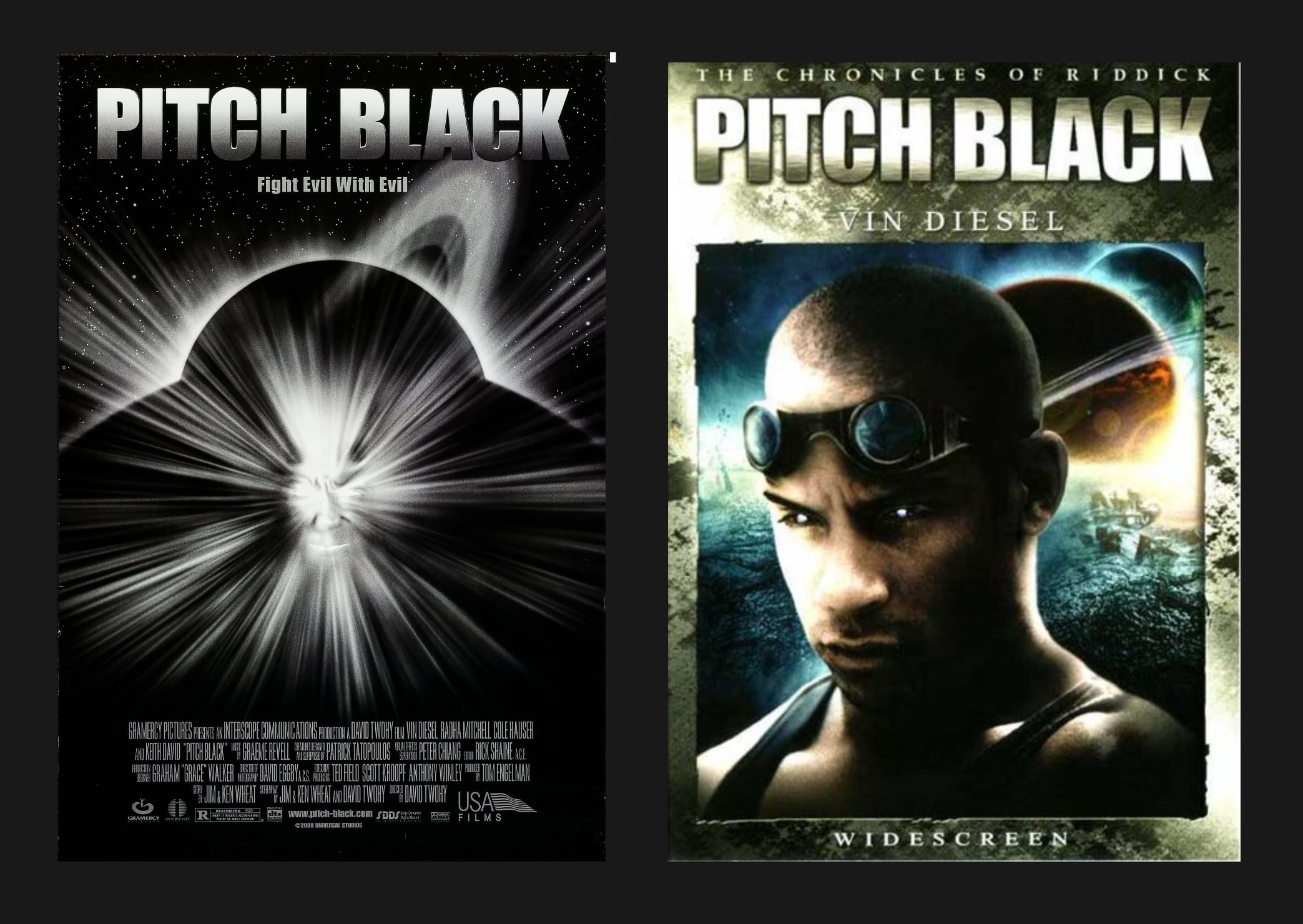
At left, the original poster for "Pitch Black". At right, the retrofitted key art which now includes the star's name, and the 'Chronicles of Riddick' tag to indicate it's part of a film saga. A bit of a difference.
"Pitch Black" (2000) is a great movie.
The film is an ensemble piece that has beautiful design, genuinely shocking moments, and authentic characters. It's a surprisingly grown-up science fiction film.
I think it also suffers from the fact that one of the ensemble became an international star who headlined the (ugh) sequels, which--I think--puts off folks from seeing the original for the first time. Rather than the film positioned as a gorgeous one-off ensemble piece, it's been unfairly retrofitted as "the first film in the superstar's saga", which isn't fair to the movie. Part of the mystery of the first film is genuine uncertainty of alliances or survival.
Anyway, we joke a lot about 'sequels ruining the original', but in this case I'm kinda on board with it because the mere existence of the sequels reshapes how potential audiences view the first one. New viewers push PLAY are 'waiting for the superstar' to do their thing.
update:Ryan Butterworth on Mastodon says the license plate prop falling off the real license plate has been painted and 'fixed' in the 4K edition of "Goodfellas". The official statement from Todd Vaziri Incorporated is that fixing stuff like this is incredibly dumb and whoever asked for this to be fixed is wrong.
I was thinking about "M*A*S*H" s08e11, the 'real time' episode with the ever-present clock in the lower right corner of the screen. When comparing my DVDs (which are faithful representations of what was aired on CBS) and the Hulu HD remastered versions of the episodes, I noticed a few things.
As created in 1979, the clock in the episode must have been a video effect (as opposed to a film optical) placed over the conformed film edit. For the HD remaster, which features per-shot reframes, they created a new burn-in of the clock.
left: HD remaster on Hulu, right: the original way it was seen on CBS
I'll do you one more. s07e04 was a "clip" show. As aired, Fox clearly cut together video segments of a bad CBS telecine which included the stupid laugh track. For the HD remaster, they actually RE-CUT the clips from the previously remastered episodes. Bravo, Fox!
In addition, as aired, the black and white sections and the titles were clearly video effects. The Fox HD remastered version properly pillarboxes the black and white material, but didn't reconstruct the video composite using the camera negative. They would have had to create new titles, as well. So I understand the decision.
left: HD remaster on Hulu, right: the original way it was seen on CBS
left: HD remaster on Hulu, right: the original way it was seen on CBS
Fellow "Heat" (1995) fans - I just found an amazing Easter Egg on the Blu-ray. It's an early edit of the infamous Pacino/De Niro coffee shop scene, created early in the film's production when director Michael Mann wanted the scene to be shorter and have a lot less dialogue. It's much moodier and more threatening than the final version, if you ask me.
The tweet you see above is an absolutely perfect example of how the success of plausibility and believability of modern digital effects is used by bozos as evidence that "CGI sucks".
Because the suit in the "Iron Man" (2008) shot they're referring to is computer graphics, not a physical suit.
"Nope" was shot on film—the day-for-night material was shot on film AND digital infrared simultaneously, which were combined in the digital intermediate and every single sky in the movie [except one] was computer graphics/digital paintings.
Important context for the discussion of "how easy is it to remaster an old TV show in HD?"
Old TV shows that were shot on film, edited and conformed on film:
Knight Rider
Columbo
Murder, She Wrote
M*A*S*H
The Love Boat
V
Old TV shows that were shot on film, edited and conformed on video:
Frasier
Scrubs
Star Trek: The Next Generation
Star Trek: Deep Space Nine
Friends
Seinfeld
Shows shot on film & edited and conformed on film -- the path to an HD restoration is straightforward. A scan of the already edited and conformed negative. Yes, color balancing and fixes are required.
"Star Trek: Deep Space Nine" s01e09, in standard definition as it appears on Paramount+
Shows shot on film but edited and conformed on video -- the path to an HD restoration is much more difficult. All filmed material needs to be scanned and that means hunting through original camera negatives. Then the whole show has to be reedited. MUCH MUCH MUCH more complicated.
Another complication for shows "shot on film but edited and conformed on video" - visual effects. The visual effects were finished at VIDEO RESOLUTION, while the rest of the live-action for the show was captured on film. The choices at this point are:
upscale the video resolution visual effects (720x480) to HD (1440x1080)
redo the visual effects from scratch at HD
The former is cheap and is generally unacceptable. The latter is very expensive and time consuming but looks much better.
This is why shows like "The Love Boat" made for a relatively easy HD transition, and shows like "Star Trek: The Next Generation" took years and millions of dollars to go to HD, and why we may never see "Scrubs" and "Star Trek: Deep Space Nine" in HD.
Looks like the on-screen subtitles of Somali dialogue in “Captain Phillips” (2013) are broken on HBO Max in the U.S. Scenes in Somalia feature no on-screen subtitles (even when English CC is ON), unlike the English Blu-ray and DVD versions of the film which show the lines of dialogue in English.
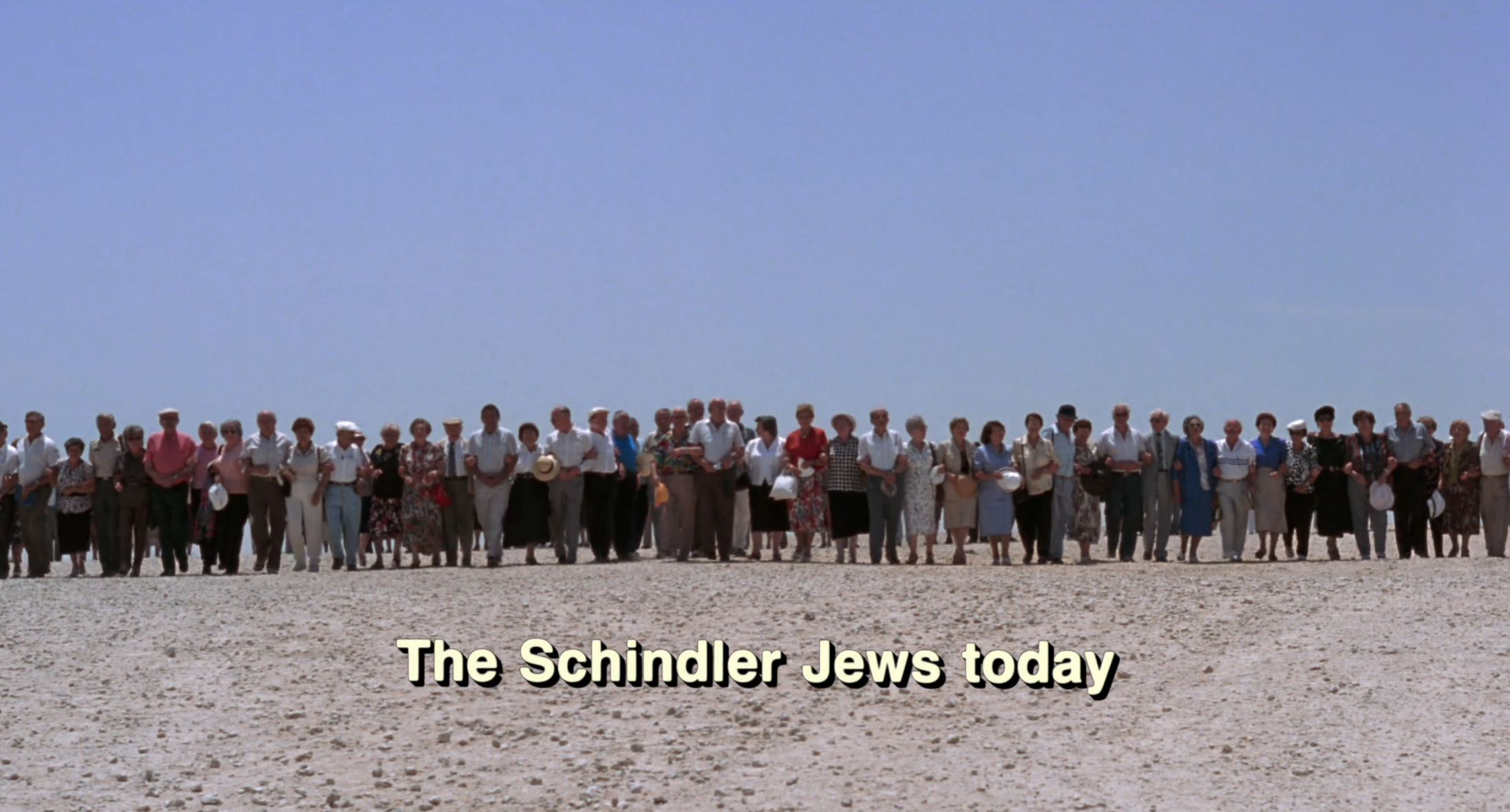
Most likely, this is similar to the "Schindler's List" issue on Peacock (which has since been fixed!). The issue: two versions of the English-language-native movie are made available to the streaming service, a textless version for international use, and a version with English subtitles where appropriate burned into the movie (as was seen in English movie theaters upon initial release).
The textless version of the movie is used for streatming in non-English localities and the local language is subtitled with on-the-fly on screen graphics. The problem might be that HBO Max is serving the textless version of the film for English localities, like the United States.
New rule (if I was in charge): a movie studio can’t release any 4K titles of their already-in-HD movies from their catalog until every single film they own the rights to has a solid HD release.
"Why does OLD MOVIE's visual effects still hold up?"
shot design
planning and organization
taste
sticking to a plan
appropriate timeline
small volume of work
appropriate budget
These principles are timeless.
If you think a visual effects shot looks like crap, the people involved with the movie can point to one or more of these bullet points to indicate the reason.
Please note how none of these bullet points are about technique because making good art is technique-agnostic.
There's a bit of a problem with "Schindler's List" (1993) as it appears on the Peacock streaming service in the United States. As of January 4, 2022, the end titles are missing from the film that describe the real-life events that happen after the end of the film. This is a bit of a problem because the viewer is missing vital information that was intended to be given, and leads to off-putting shots of 'nothing'. On Peacock, Goeth's execution shot (not featured in the comparison below) is particularly awkward since the shot ends with a ten-second long freeze frame of his body hanging from a noose, with no titles.
This seems to be a localization issue - a textless version of the film is frequently created so that the on-screen titles can be presented in different languages instead of subtitles OVER the native language of the film (English). In this case, the textless version of the film might have been given to Peacock by Universal with the intention of the titles appearing as rendered-on-the-fly subtitle overlays in each user's local language.
I have sent this movie to @Peacock and @PeacockTVCare on Twitter. There's no "submit a problem"-type page on the Peacock web site that I've been able to find.