 I may or may not be live-Tweeting the Oscars. I'm @tvaziri.
Keep your expectations low.
 Last May, when the Academy finally expanded the number of nominees for the visual effects Oscar from three to five, I wrote this:
And what will this mean to The VFX Predictinator, our totally awesome formula that accurately predicted the visual effects Oscar winner across 21 years? It will require a serious overhaul, since many of the formulas are dependent on the assumption of three nominees. More likely than not, we'll have to come up with an all-new formula.
 And if you're not interested in squinting at the final scores, here they are:
 "Potter," "Alice" and "Iron Man 2" all had similar numbers, with nearly identical box office earnings, but "Potter" and "Iron Man 2" lost points for being sequels. Both "Hereafter" and "Alice" suffered with poor critical acclaim, and "Hereafter's" box office, relative to the other blockbusters, gave the Clint Eastwood film no advantage. "Potter"'s second place score was earned with its late release date, coming to theaters in November (earning it a huge point).
 Amazingly, this years' crop of nominees featured very little organic creature work. Only "Alice" qualified in the criteria of "Primary VFX Are Creatures," and also picked up more points with all of the facial animation featured in the film. With only 1/5 films heavily featuring character animation, the 2011 nominees are a bit of an anomaly, since regularly, most races include 2/3 or 3/3 films featuring character animation. Even with "Alice" earning these critical points for character animation, it still wasn't enough to topple "Inception"'s gargantuan point count. In fact, even if every other film earned those character animation points, it wouldn't have been enough to beat "Inception's" score.
 So we shall see if The Predictinator can live again. If we're dead wrong, we'll have to determine how we screwed up, and perhaps, come up with a Predictinator 2.0 (for this new world order of five visual effects nominees), which will evolve over time. That would be unfortunate and, quite frankly, boring, since it feels quite gratifying to have a solid, mature algorithm to predict the winner of the visual effects Oscar. Starting over and patiently waiting year after year, nursing the formula back to health. Naah, we don't want to do that.
 We'll know in just a few days, when the winners of the 83rd Academy Awards are announced February 27, 2011.
 It's time for the Awesomest Oscar Pool Ballot In The History Of Oscar Pool Ballots.
 Christopher Nolan's "Inception" won big at the 9th Annual VES Awards on February 1, 2011. "Inception" won in every category for which it was nominated, with awards also going to "Hereafter" and "Harry Potter and the Deathly Hallows: Part I."
 For the first time ever, the visual effects category of the Academy Awards is filled with five nominees (rather than the traditional three).
 From Variety:
 I have a new metaphor to describe the studio-driven push for 3D stereo films.
 This is another follow-up post to our "Back To The Future" podcast on The VFX Show.


 Real photographic background plate of Delorean, with glows and time slice animation created by the animation department at Industrial Light & Magic.
 The fire and sparks (and their reflections) were created on the set with special effects rigs attached to the Delorean.

 A large strobe light on location provided bright interactive light. Full frame flashing was also achieved in the optical composite.
 Hey, look in the upper left corner of the screen. Say hi to the crew!


 Panning left with Delorean. The car is actually on the set, with animation and effects added optically.
 The pan reveals bluescreen-photographed Marty and Doc. The actors were tracked and matted into the shot.

 Pan abruptly stops, explosions and flares optically composited to represent time slice effect.
 First visible frame of explosion element. The main explosion element has a faked reflection in the wet ground, achieved in the optical composite.
 Explosion element runs backwards, giving the impression of an implosion. On-location, live-action ignition of fire trails appear, and are skip printed to appear to ignite much faster than reality would allow, approximating the feeling of 88mph.
 Marty's foreground foot is rotoscoped to allow the fire trail to appear behind his leg.
 The last frame of the shot.
 In-camera effect, featuring on-set fire trails, using stunt performers.
 This shot was skip printed in post production to give the ignition the feeling of greater velocity, giving the impression of the Delorean continuing its 88mph journey in a parallel dimension of time. As a result, the fire's motion is somewhat strobey.
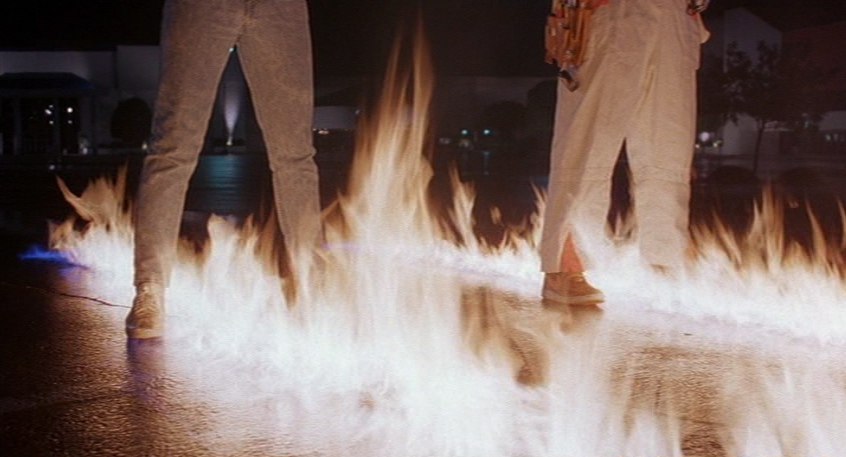 Notice the relative exposure difference between this shot and the shots preceeding and following it. In this shot, the cinematographer exposed the film to feature the fire (or was underexposed in the colortiming or visual effects process), which reveals the internal structure of the fire. In the shots before and after, the actors and environment were the target exposure values; consequently, in those shots, the fire is blown out and overexposed, leaving only hot white fire shapes.
 The first frame of the iconic Einstein time slice effect, featuring actors Christopher Lloyd and Michael J. Fox. The actors were shot against a bluescreen, standing on a mirror. The mirror gave the effects artists pristine reflections of the actors; the reflections were matted to separate them from the actors, and treated in the composite to appear as wet, pavement reflections by adding displacement and tweaking the brightness.
 Michael J. Fox's screen right foot was placed behind fire licks via frame-by-frame rotoscoping. Areas of fire were articulated to bury Fox's foot within the fire. Like the previous two shots, the background plate was skip printed to give the fire trails more energy and speed.
 "What did I tell you?!?"
 "Eighty eight miles per hour!!" This shot is entirely in-camera. The fire trails are a practical effect, just like all of the previous shots. In the sequence, the trails have been fully formed, and are no longer being generated; as a result, there was no need to skip print the trails for this shot.


